The Living World
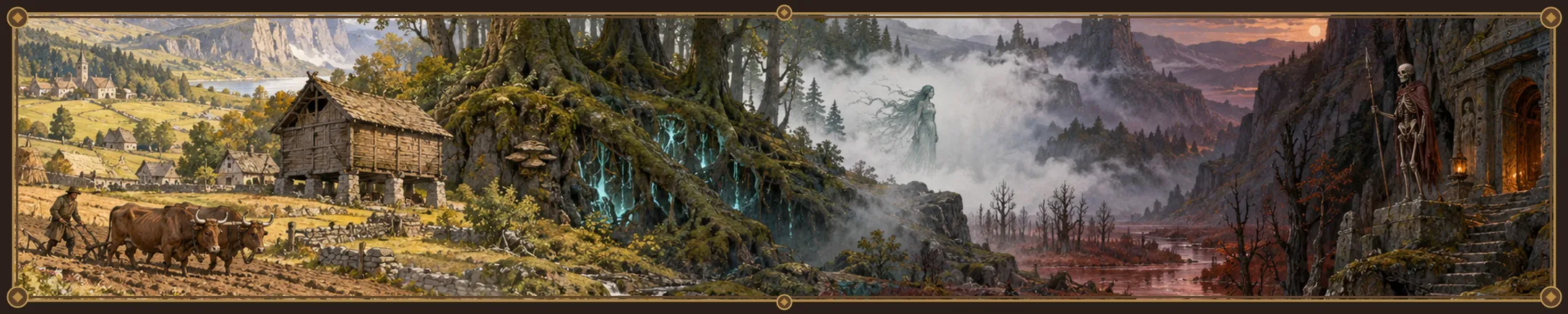
Gather in measure: a stand stripped bare
will not come back in the spring.
Cut the bark in strips the tree can heal.
Ask whose body before you ask what ails it;
the brew that mends a Human
may do little for a Dwarf, or harm.
The Book of Small Mendings
Every people of Caeldon shares its world with beings that are not peoples, and lives by them, beside them, and in fear of some of them. A basin village counts its wealth in cows and its year in grain; a Dark Elf house eats the fungus that grows on dead root and lives beneath the living root that carries its ceilings; an Orc kindred pays for its wrongs in herds; a Thaluren run reads the open sea through two great beings it has barely seen. Beyond them lie stranger things: the peoples and beasts of the other planes, the creatures the Resonant Zones breed or make, the hosts that the Dark Entities send out ahead of themselves, made things that walk, and the dead that do not lie still. This book gathers all of them, one entry to each being: five hundred and eleven in all, on nine shelves. The peoples themselves, from the Elves and Dwarves to the Wrought, are told in The Peoples of Caeldon (FND). This chapter does not retell the entries; it follows what runs across them, and names the entries and shelves where each being is told.
What the Peoples Live By
Ask any people of Caeldon what it lives on, and the answer is something alive, and seldom more than two or three things. The Human villages of the cradle-web give it as herd and field: Cattle on the common meadows, Oxen under the yoke, Sheep on the summer slopes, and above all Grain, whose surplus on the deep basin soil is what the corridor towns eat and what a lord’s levy is counted in. Under the Elderweald the answer is Fungus Beds: a Dark Elf house holds a cavern where the fungus grows thick by the same chamber-right as its water, and loses its food with the chamber if the chamber falls. Across the Glassbelt the Orc kindreds of the Windscar Pacts answer in heads of stock (Stair Kine); the harbours below them answer in the catch (Fish, Shellfish); the Thaluren, who tend the shoals around their reefs, answer as keepers do.
Whatever a people lives on, it measures itself by. A household is rich or poor in cows before it is rich or poor in coin, and the line between a farmer who will eat in spring and one who may not runs through the plough-team: who owns a share in one, and who must hire. Among the kindreds a herd is not only food and hides but the price a wrong is paid in, so that a feud has a count and a reckoning has an end; and the oldest game on the shelves is the cattle-raid, in which a young Orc wins a first name by driving off a rival kindred’s beasts by night. The Dwarven holds measure by what they must buy, and the basin wool that comes up the Headwater roads, which the holds cannot grow for themselves, is part of every hold’s year. Even praise is taken from the field: the hardier grain of the foothills (Barley, grown beside Oats) gives the holds their word for a worker who never fails, and a pot of Beans means something precise to an Ogre band, which eats before it lifts.
What feeds a people can also fail it, and every people knows the shape of its own failure. The basins fear the tired field more than the bad summer: a ground pressed for a second harvest every year gives less each time, and the rest-year kept by the farmers of Anvelle the Harvest-Mother is custom set against that loss, for as long as the lord’s riders let them keep it. Every store has its thief, the granary its Rats and Vermin; every orchard (Orchards and Fruit) its debt to the Insects and Bees that set it. A village notices the things it lives by most when they fall silent. The hundred and twenty-four entries of the first shelf, Animals, run from Air-Finches to Wound Flies; the ninety-five of the second, Plants and Fungi, hold sixty-six plants, seventeen fungi, and thirteen crops.
Roads, Trade, and Rivalry
The roads of Caeldon run on animals, and each kind of animal belongs to a kind of road. Speed and rank travel by Horses, which carry the courier and the lord and are beyond most farmers, and which the commonest outlaws of the road steal and hang for; the mountain stages belong to Mules, trusted on a bad road above any guide; behind them come the strings of Pack Animals that the toll-houses count by the head and the inns stable by the night. Dogs and Hounds keep the yard and the flock, and in the lawless edges of the medieval present they also keep the bounty-taker’s road: a fugitive’s first fear in the Broken Marches is not the lamp but the dog beside it.
The roads have their own beasts, and every carter knows them. In autumn the Pass Bears come down to the mountain waystations for the stores, and a bear that has learned to break in is hunted by the whole road; whoever brings in its pelt drinks free at every waystation from the basin edge to the Ironspine gates for a winter. In a hard winter the Grey Wolves come to the fold gates, the Bridge Hall at Greyford pays a bounty on every pelt brought to the toll-gate, and the fold villages name the wolf-winters after their heroes. In the ruins the Ruin Hogs have killed more salvagers in some seasons than falling stone, and nobody in the Marches puts a bare hand into a dark gap for fear of the Glove Spiders. On the ravine crossings of the Briarreach a Ravine Cat that has taken a lone walker is hunted by every crossing family on the ravine, and across the salt pans of the Glassbelt the Pan Hyenas follow a sick caravan for days, taking one straggler a night.
Living goods tie peoples together who have little else to say to one another. Wool climbs from the basins to the holds; dried fish climbs the cliff stairs from the Tidelace Coasts to the Windscar; grain goes down the Serath on the barges, past landings where the Great Catfish has taken a dog or a child at dusk. A trade like this makes neighbours, and neighbours find something to look down on. At the Greyford Reach the two banks of one river are divided by what they eat, the Goblin households of Lowbank by their Eels and the inns of Highbank by their Trout, and each bank’s name for the other is a fish. Under the forest the Roothollow houses eat from their reservoirs what the dark has left them (Pale Cave Creatures), and nobody above has thought them worth naming.
Who May Take and Who May Cut
Much of what people fight over in the living world is not the beast or the tree but who may take it, and the answer is usually whoever is strong enough to say so. Wild game is a privilege before it is a meal. Deer are hunted by the Elven groves, each of which hears about it from the next if it takes too many, and by Human lords in their own woods, where a poacher who takes one hangs if he is caught and the outlaws of the forest edge live on venison and the songs about it. A bird on the wrist (Hawks and Falcons) says who may hunt at all; falcon-thieves hang in most lordships, and the theft of a great lord’s white falcon has started more than one feud between houses. The boar-hunt (Wild Boar) is the lords' most dangerous sport, and in some basin houses it has killed more young lords than war. What nobody claims, nobody protects, and Foxes are cursed in every hen-yard for living off that gap, and taken by outlaw bands as their sign.
Trees carry the oldest of these quarrels. To the Wood Elves the never-cut forest of the Elderweald (Great Trees and Groves) is kin and not timber, and cutting a living tree is a wrong against kin; groves have driven out those who did it, and hunted the Human woodcutters who tried. To the High Elves of the Crownboughs the same trees are a living material, bent over generations into hall and gate; to a basin farmer looking at the forest edge, they are fields not yet cleared. Below them the Roothollows live under a ceiling of Living Root (Gloam) that holds up their halls, breathes for them, and gives their only native light, so that what the groves above decide about a tree is, for a Dark Elf house, a decision about its roof.
The plants that hold an edge are the ones whose cutting starts trouble. Thorn and Thornwood takes the ground nobody holds and becomes, in the Briarreach, a wall that chooses its visitors; a war-band that tried to cut its way through a Thornbound hedge was met at the gap by watchers who had heard every stroke, and the songs say none of it came out. Reed and Willow mark where the river has been and where it will be, and to the Reedfolk a reed bed is the record of the water, read before anyone builds; it is also where outlaws and smugglers hide from the lord’s riders. On the far side, Kelp is where the young who come down from the rivers are counted, and a thin count at the Kelpshade is grief and evidence at once.
Care, Omen, and Offering
The living world is the first medicine and the first prayer. The Herbs of every healer work, because they carry a little of the lifeforce that runs through all living things, and they work differently in different bodies, which is why the healers' rule at the head of this chapter asks whose body before it asks what ails it. The rarest are fetched from places that kill: herb-hunters who go into the Verdant Expanse or the Drowning Garden are a known and short-lived trade, and a healer’s shelf with a jar from the Expanse on it is a shelf someone died to fill. Poisoners keep the same shelves, and a Gallows Root found in a house after a sudden death has hanged more than one widow, guilty or not. Wildflowers, which feed nobody, are given to nearly every power of nearly every people: thrown on the water at the spring rise, or sent downstream with a sorrow.
Animals are read as well as kept. Birds above all are taken for messengers: Crows and Ravens for death, so that soldiers call a gathering of crows over a camp "the tally" and some sellsword captains will not march on a day the crows go ahead of them; Owls for ill luck by most people and for good mousing by farmers; Seabirds for the wind by the coast folk who hear the gulls before dawn. A silence where insects ought to sound is read too, and of all the omens of the living world it is the one most often right.
At the edge of what anyone can read stand the beings of the open sea. The Thaluren tell of the Deep-Witnesses and the Devourers as peoples of the ocean, the one honoured and the other feared, and know them from a few glimpses passed down the run-line; the runs that pressed past the known roads to look came back late, scattered, or not at all. Nearer the shore every Tidelace alehouse has a man who saw a fog serpent take a boat whole, though the Gnome sounders have measured the ribbonfish it really is. Further still lies the Dragons entry, which records a being nobody has seen for longer than any record reaches. Most people hold that dragons never were, and point to the Kobold telling, a memory of the furnace-masters of an elder world worn by very long telling into scale and coil. But the old bone sold as dragonbone has never been explained, every ruin-delver has heard that some elder hold still keeps a dragon’s hoard, and the dragon may still live somewhere, and may one day come back.
Beyond the World
Behind the world, life is the law of its plane made flesh. Where cold is a force that holds all things still, in the Frost-Bound, its natives are stillness turned to purpose: the solitary Frost-Born, the Frost-Wolves that hunt without a sound and freeze what they bite, the Glacier-Drakes that pass through ice, and the Ice-Beasts they all live on. The Parched, the plane of want, makes counters and swimmers of sand, the Dust-Eaters and Dust-Wyrms; the Scourge, where nothing is ever safe, makes the Scourge-Born and the Apex Predators that hunt them. Its plants obey the same law: the Fractal Trees of the Apex repeat themselves branch by branch, the Trimmed Trees of the Gilded Cage keep to measure, the Skeletal Trees of the Whispering Trace stand bare in its mist, and in the Verdant Expanse (Verdant Expanse Flora) a seed can become a forest in an hour, and the plants are the plane.
A traveller learns quickly that the planes of want are the honest ones. The planes of plenty are dangerous in the way a gift can be. The Apex-Born are beautiful past bearing, and the Echo-Statues that smile among them were visitors who stayed until they were improved. The Gilded are courteous and bound, and the Enforcers who keep their rules do not punish so much as restore. The Verdant may love a guest past leaving, and the Linked of the Weave may take a guest’s self into their one mind as a kindness. The Harmonics keep the same rule: in the Radiance the Illuminated hide nothing and the Truth-Seekers hunt whatever a visitor does; in the Silence the Hollows fade into their stone, and what they lose spreads.
Some of these beings come to the world, or the world goes to them. At the thin places of the Veil, the old shrines and boundary roads, the Veil-Walkers keep their tolls and take payment in things other than coin (they are a people, not a beast, and told in The Veil and the Outside (FND)), and the Voice-Mimics, which call from the fog in the voices of the people a traveller loves, are the reason the crossing-words forbid following a beloved voice. From the Dreaming Veil a dream shared by enough sleepers can become a thing that stays (Dream-Forms), and a Nightmare now and then crosses with teeth.
The Resonant Zones are where the planes press into the world, and their life is the pressure made visible. A Blood River overfeeds whatever drinks from it, so that its banks run riot (Swollen Plants), its beasts outgrow their kinds, and the Hemophages call the river a god and themselves its priests, and hunt travellers to feed it. The Cinder Fields keep the Cold-Salamanders and the Frost-Burned alive on a fire that warms nobody else; the Drowning Garden hurries every life within it, the Gill-Folk's with the rest. A zone native is often a creature of its zone in a stricter sense than a fish is of water: the Shape-Shifters of the Probability Fog can be anything inside it and are held to one shape outside. And some natives were born somewhere else. The Lingerers of an Ageless Spring (The Lingerers) drank, and did not leave.
The visitors a plane or a zone has caught and changed, the Lost, the Frozen, the Drowned, and the rest, are told with the place that changed them: those of the planes in The Planes (FND); those of the zones in The Resonant Zones (FND). The shelf Natives of the Planes holds a hundred and fifteen entries, Natives of the Zones eighty.
What Comes from Outside
The powers outside the cosmos reach into it through living things. A Dark Entity takes, empties, fills, or makes, and what it sends out is its own nature on legs, so that a reader who knows the entity can guess the host, and the other way round. Krystallis, which is perfect order, sends flawless copies with nothing left to choose (Shard-Hosts), and they still stand in the Hanging Vale where the lattice stopped them; Qzoth sends change that never settles (Flesh-Hosts); Mnemosyne Null sends the emptied (Blank Hosts), and now and then a faceless thing walks out of the Paling. Those three are the only Beyonders whose hosts have walked on Caeldon, and only at the scars their Incursions left. The hosts of the other seven are examples of what an Incursion would bring: Xylos, which is a network, would send bodies that have become part of one (Root-Hosts), the Rust Flower exhaustion looking for strength to wear down (Rust-Hosts), and the most feared would be the gentlest, the Chorus-Hosts of Omm: happy, singing with one voice, with nobody in particular left inside, and very easy to love.
The fallen Stewards make their spawn out of what they could not bear. The Weeping Idol turns worship into stone and gold (Adoring Statues), the Hollow King turns service into an empty suit (Courtiers) and sends it out to crown the living, the Ashen Child turns grief into ash that wears a lost face (Ash-Wights), and the Rootless Tree, of the Unformed, turns whatever it grafts into a branch that will never find a root (The Grafted). Some faiths answer the first of them with shrines.
Not every host has a body. The spores and growths of the entities travel like weather (Beyonder Spores, Black Mould), and most of the people who meet them call them sicknesses, the Changing Fever above all, without knowing there is anyone behind them. They know the hosts as the Faceless or the wrong-born, as saints or ghosts, and ward them off with charms that sometimes help and sometimes bring them nearer. The shelf Hosts of the Dark Entities has thirty-two entries, among them the victims of the Unformed’s fields, from the edgeless Mist-Merged to The Strayed who walk until they fall; the entities themselves are told in What Waits Outside (FND).
Made Things and Unquiet Dead
Most of the made beings of Caeldon have one thing in common: they want nothing at all. The everyday kind is the servant a conjurer calls up out of the matter to hand and sends off to work (Conjured Constructs), and the people who use them thank them anyway. A caster’s Familiars are bonded companions, called back rather than invented. The radiant soldiers of Sanctified Magic (The Guardian Host) are, by their own school’s teaching, a rite held in shape; the people who have fought beside them mostly refuse to believe it.
Some made things have outlasted the reasons for them. The Predecessor-Frames of the old deep holds were built to do work that kills, and in the Awakening of the Wrought, c. 1,500 BR-c. 200 CR, some of them became someone; those are a people, told in The Bridge Peoples (FND), and the frames that did not cross are still things, and some still stand at their posts in the lost holds below the lowest kept routes. The Sepulchre-Kin’s Record-Engine was made to keep the dead in memory until they could rest; a landslide woke it c. 1,200 CR, and the survivors' Wake-Seal closed the Hushvale over it under fog. The planes and zones have their own machines and wardens, among them The Clockwork of the Frozen Moment, the Bronze Sentries of the Time Lock, and the Curators of the Memory Palace.
The dead are the most argued-over shelf. What necromancy raises (Raised Corpses, Marrow Sentinels) is a body put to work, with nobody in it; whether that is a mercy, a service, or a sacrilege depends entirely on the people watching, and a careless raising has left more than one burial ground walking. What a person leaves behind is an Echo, and most Echoes settle if they are grieved and given their rites. The ones that do not settle are the risen dead proper: Hostile Remnants where the rites failed, The Unfinished of the Whispering Trace with a debt still open, The Anchored and The Choked held by a zone, the Possessing Ancestors set over their heirs by the Rotting Crown, and the Taken, whom their own engine of memory kept until it killed them. Constructs holds twenty-three entries and The Risen Dead thirty. The changed living of the Hushvale are not dead at all, and stand alone on the shelf Other Beings. The last shelf, Touched Beasts, holds eleven beasts of the world that a zone’s outflow, a thin place, a ley line, or a working has changed, from the Greenharts of the oldest groves to the Spurred Hounds of the lords' kennels: neither natives of a plane nor anyone’s host, and several of them breed true. Two were people once and are no longer: the Skin-Lost, who forgot the way back from a beast’s form, and the Ill-Hatched of a failed chrysalis.
What People Believe
What the peoples know of a being falls away with its distance from ordinary life. Nobody knows an ox better than the farmer who yokes it, or a wolf better than the shepherd who has sat up with a brand against one. A zone’s neighbours know its dangers to the step and the cost, and quarrel only over the reason, which each of them gives in the terms of its own faith, craft, or school. The planes are known from the stories of the few who came back, and the stories disagree. The Dark Entities and their hosts are known as fear is known: by rumour, by taboo, by the rites people keep without asking why. Each entry therefore gives what a being is and does in its own sections, and what the peoples say of it under Lore and Belief, with a word on how far the saying holds.
Belief about familiar things is mostly custom, and custom is often partly right. The crow does not foresee a death but is drawn to where death is gathering, so an augur who reads it is reading something real, and goes wrong where death has already settled in. A rat aboard is good news to a sailor and bad news to a granary-keeper, and both are thinking about the same animal.
About the stranger beings, belief can kill in either direction. The faithful who kneel among the Adoring Statues are asking for exactly what may happen to them; the households that set a lamp for a Stitch-Wraith they take for a lost love are lighting its way in; the kin who beg for one of the standing ones of the Hanging Vale to be broken out may be asking for a death. But custom also knows more than it can explain. The Wrongwood’s custom against digging does keep the protean spores asleep in its burned ground. A name said aloud every night at the Paling’s edge does hold against what is left of the pallor, because a plain name is a clear memory. And the mourners in the Trace who pay a dead man’s debts and finish his sentence for him are doing more for his Echo than they know.
For a writer, the space between belief and fact is where the stories are: the village with the wrong charm, the pilgrimage to the statues, the beast-hunter paid to kill the thing in the wood who finds it was never a beast, the family sitting up with a changed son while the neighbours wait with a torch. The book keeps one rule throughout. What a being can do is a fact of the world, and its entry gives it plainly; what people believe of it belongs to the people, and the people may be wrong.
Tensions
-
The rest-year. The Headwater roads and the Serathic towns both need more basin grain than the basins can safely give. Farmers who keep Anvelle’s rest-year resist the levies that force a second harvest, and the lord’s riders come for it with spears.
-
Draining the fen. A march-town wants to embank a reach of the Reedmere for new fields. Its Reedfolk flood-keepers warn that the spring rise will go to the next village downstream instead. The warning is heard, and the town embanks anyway.
-
Whose stair. A rockfall has broken a flight of the Gullstair, and the kindreds' herds can no longer come down it to the coast. The station keepers say the repair is the kindreds' to arrange under escort custom; the kindreds say the station has every reason to let a broken stair slow arrivals.
-
A sensing that counts for nothing. A current road where a devourer has been sensed is distrusted until a later run has come through it whole, though by Thaluren custom the account of the sensing counts for nothing. Some say a devourer can be outwaited, others that it returns to a road it has broken, and each run bound for that road must decide which to believe.
-
Who answers for a construct. Conjured constructs have no will, and the deepest worry about them is who answers when one does harm. Critics of the Hall of Borrowed Forms say the line between a servant and a weapon is only an order.
-
Mercy or desecration. Some peoples revere the Bone Singer’s statues as honoured dead and decorate them on feast days; others smash them as an act of mercy, believing that breaking the bone frees the one held inside. The statues are still persons inside, and no one can say which side is kinder.
-
Nursed or burned. In the fog of the Hushvale the changed living hunt, and out of it they are men and women of the Held again. Some of the Held would watch, bind, and nurse a changed one till morning; others say the person died in the fog and something wears the body home, and that it should be burned.