Willow
Willow is the tree of moving water. It roots wherever a bar or a bank stays above the river long enough, and it holds that ground until the next great flood takes it. Willow islands stand among the gravel bars of the Greyford Reach, and willow thickets fringe the flood-ground of the Lower Serath beside the reed beds. To the river peoples it is a marker of ground that will not last, and a supply of the most useful wood they have.
Appearance
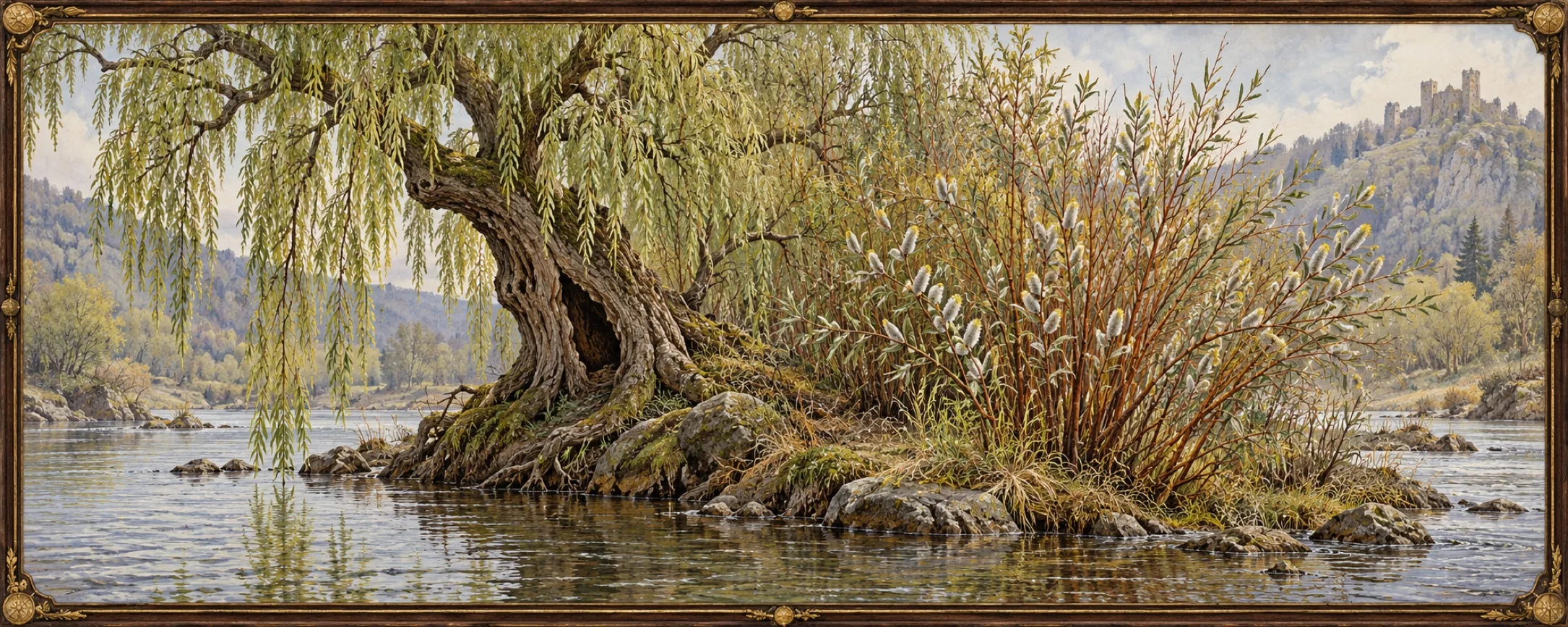
Willow grows two ways. The bar willow of islands and thickets is a many-stemmed shrub or low tree, a little over head height, its long, slender, flexible shoots red-brown or olive-yellow and its leaves narrow, pointed, and silver-grey beneath, so that a thicket flickers green and silver in wind. The bank willow of the steadier margins is a tree with a short, thick, deeply furrowed trunk that leans over the water, often hollow in age, and a loose crown of drooping branches that trail their tips in the current.
In early spring, before the leaves, willow puts out soft furred catkins, silver at first and then dusted yellow with pollen, the first food of the year for bees. Its bark smells faintly bitter and green when cut. A willow thicket in summer is loud with small birds and still with heat.
Habitat and Range
Willow needs wet roots and light. In the Greyford Reach it holds the shifting bars and islands between the side channels, where one river breaks into many. Along the Serath it grows in thickets at the margins of the abandoned channels, backwaters, and oxbow lakes, beside the reed beds, and the same kinds fringe the lower rivers of the Confluence Basins wherever the banks are left uncut.
Behaviour and Temperament
Willow is the quickest of trees to take hold. A broken branch washed onto a bar roots where it lies, and a thicket can grow on new gravel in a few years. Its roots bind loose ground, so a willow island outlasts the bare bars around it, until a flood great enough tears the whole island out and leaves its trees heaped against the next bridge pier or causeway stub.
Life Cycle
Willow sprouts from cuttings and fallen branches far more than from seed. A bar willow lives a few decades; a bank willow, cut back to its trunk every few years, can live for centuries, its head swollen and knotted from the cutting. Cut willow regrows at once, and a pollarded tree sends up a crown of straight new rods within a summer.
Uses and Dangers
Willow gives withies, the long flexible rods cut from cut-back trees and thickets in winter. River households weave them into baskets, fish and eel traps, panniers, cradles, and the hurdles and fascines that brace a bank or a causeway against the flood. Goblin households at Lowbank eat eel and small fish from wicker traps set in the side channels, and Reedfolk channel-menders stake willow along a failing bank to hold it. Willow bark is chewed or steeped against aches and fever. As timber it is soft and light, good for little but boat ribs, poles, and charcoal.
Willow harms no one. Its only danger is the one it marks: willow on a bar means the river has not moved for a few years, not that it will not.
Lore and Belief
River people read willow the way the Reedfolk read reed: a new thicket on a bar tells of a channel that has shifted, and the loss of an old island is remembered in the year it went. A Floodkeeper house’s flood-roll opens by naming the flood that took the willows. Tamsel the Season-Weaver is pictured in spring with hair like budding willow branches, and willow catkins brought indoors are an old sign of the year’s turning.
Outlaws on the river islands hide in the willow thickets, and bargemen still boast of the thief who lived for three summers on a willow island in the middle of the Serath with a lord’s bounty on his head.