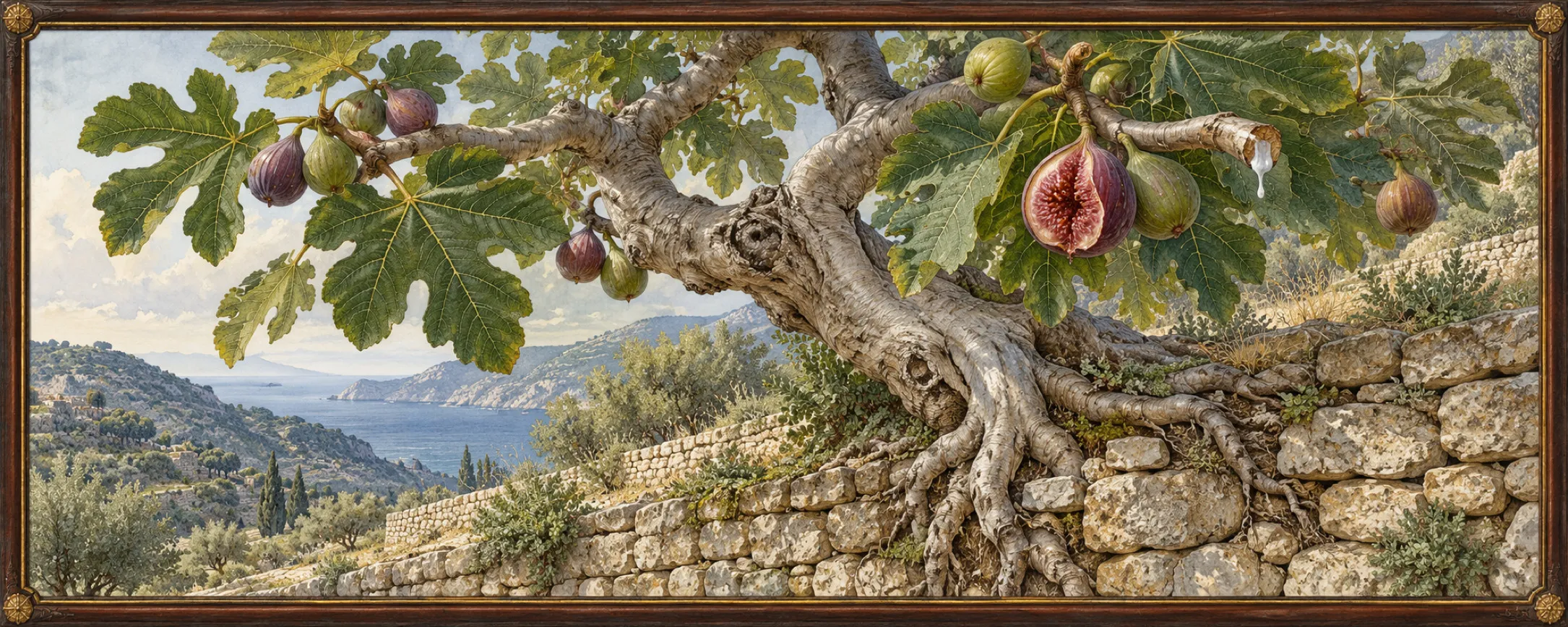
Wall Figs
Wall figs grow out of the stone. Birds drop the seed into the joints of a dry-stone retaining wall, and a fig tree comes up out of the wall face, bearing small, very sweet figs within a few years. Its roots follow the joints into the earth behind and, as they thicken, push the wall out. In the Leeward Folds, where every terrace stands on its wall, a household that will not pull its wall fig hears about it at the next commons.
Appearance
A wall fig is a sprawling shrub or small tree that leans out from the wall face, its smooth, silver-grey trunk and limbs often twisted along the stones. Its leaves are large, thick, and rough, as broad as a hand and deeply lobed into three or five fingers, and smell green and milky when crushed. Its figs are small, pear-shaped, and soft, the size of a walnut, green ripening to purple-brown, their skins splitting at the base to show a sticky pink-red flesh full of tiny seeds. Every part bleeds a white, sticky milk when cut. A wall with a fig on it in late summer hums with wasps.
Habitat and Range
It grows from the joints of dry-stone walls, from cracks in the rock of fold heads and cistern sides, and from ruined terraces, wherever warmth and some damp behind the stone allow. It is common in the Folds and the Dry Folds, and on the sea-cut terraces and harbour walls of the Tidelace Coasts.
Behaviour and Temperament
It is slow to show and quick to take hold. A seedling in a wall joint sends its roots down and back through the fill to the damp soil behind, and once rooted it is almost impossible to kill without taking the wall apart. Cut back to the face, it sprouts again from the joint.
Life Cycle
A wall fig bears from its third or fourth year, often twice a summer, and can live for generations, outliving the wall it grows from.
Uses and Dangers
The figs are sweet and good fresh, dried on the drying floors with the orchard fruit, or boiled into a paste; a wall fig is free fruit that needs no terrace of its own, which is the trouble. Its roots open the joints, push the wall face out, and let water into the fill, and a wall that has carried a fig for a generation can fail in a cloudburst and bring its terrace down on the one below. Fold wall-menders pull seedlings on sight. A household that leaves a bearing fig in its wall for the fruit is risking its neighbours' terrace, and the commons says so.
The milk irritates the skin, especially in sun, and pickers wear gloves.
Lore and Belief
Halflings say a wall fig is a guest that eats the house, and use it as a byword for a pleasure the fold cannot afford: "that’s a wall fig" ends many arguments at the commons. Some households believe a fig that seeds itself into a wall is a gift that must be thanked before it is pulled, and they leave its figs at the cistern hall. On the Tidelace, Gnomes pull them from harbour walls without debate and record the pulling in the breakwater ledger.