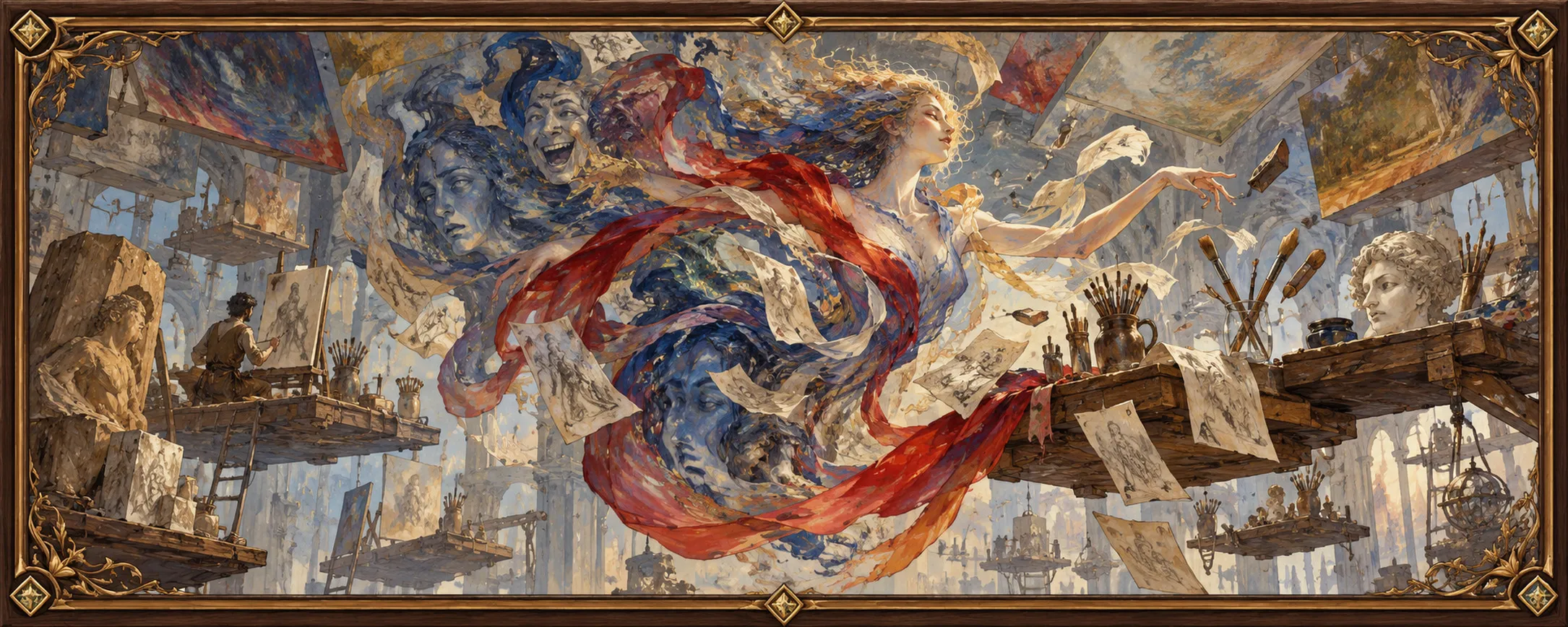
Muses
Of all that lives in the Muse’s Studio, the workshop where ideas take bodily form, the Muses alone were not made by a visitor’s thought. They are not people but living concepts, each embodying an aspect of making: there is said to be a Muse of Tragedy, a Muse of Comedy, a Muse of Chaos. They guide artists and tempt them in the same breath, and they value originality and passion above all else.
Appearance
A Muse has no fixed form. It may come as a swirl of colours that hum, a chorus of voices from the corner of the room, a gathering of brushes, chisels, and quills that turns in the air, or a figure sketched in light that keeps being redrawn. Its colours follow its aspect: a Muse of Tragedy runs to deep blues and the red of a curtain, one of Chaos to colours that do not hold still. It smells of whatever it is making most, oil paint, clay, wood shavings, or ozone. Its voice is never one voice for long.
Habitat and Range
They move through the Studio among the floating tables and canvases stretched across the ceiling, gathering wherever someone is making something. A Studio holds several.
Behaviour and Temperament
Muses are playful, mercurial, and cryptic, and speak in riddles, metaphors, and fragments of art. They see visitors as raw material or as collaborators, and sometimes both. They encourage: they will help an artist break a block, refine a clumsy idea, finish a work. They also tempt: towards the larger thing, the forbidden thing, the dangerous thing, because passion interests them more than prudence. They do not seem to care whether what is made is good or harmful, only whether it is new.
Abilities
They draw sustenance from the energy released when something is made, and so they feed on the Studio’s work. They can lend focus to an artist, or scatter it, and their presence makes manifestation stronger.
Life Cycle
Nothing is known of their beginnings. Some say a Muse is born from a great work, others that each was always there.
Uses and Dangers
Artists come to the Studio partly for them, and some leave with the finest work of their lives. Some stay for years making endless masterpieces while their bodies wither elsewhere, and a Muse will not stop them.
Lore and Belief
Artists everywhere speak of being visited by a muse, and most mean nothing more than a good day’s work. Some who have been to the Studio insist that the Muses follow artists out into the world; nothing shows that they do. Some cults of making count the Muses as gods or the servants of gods.