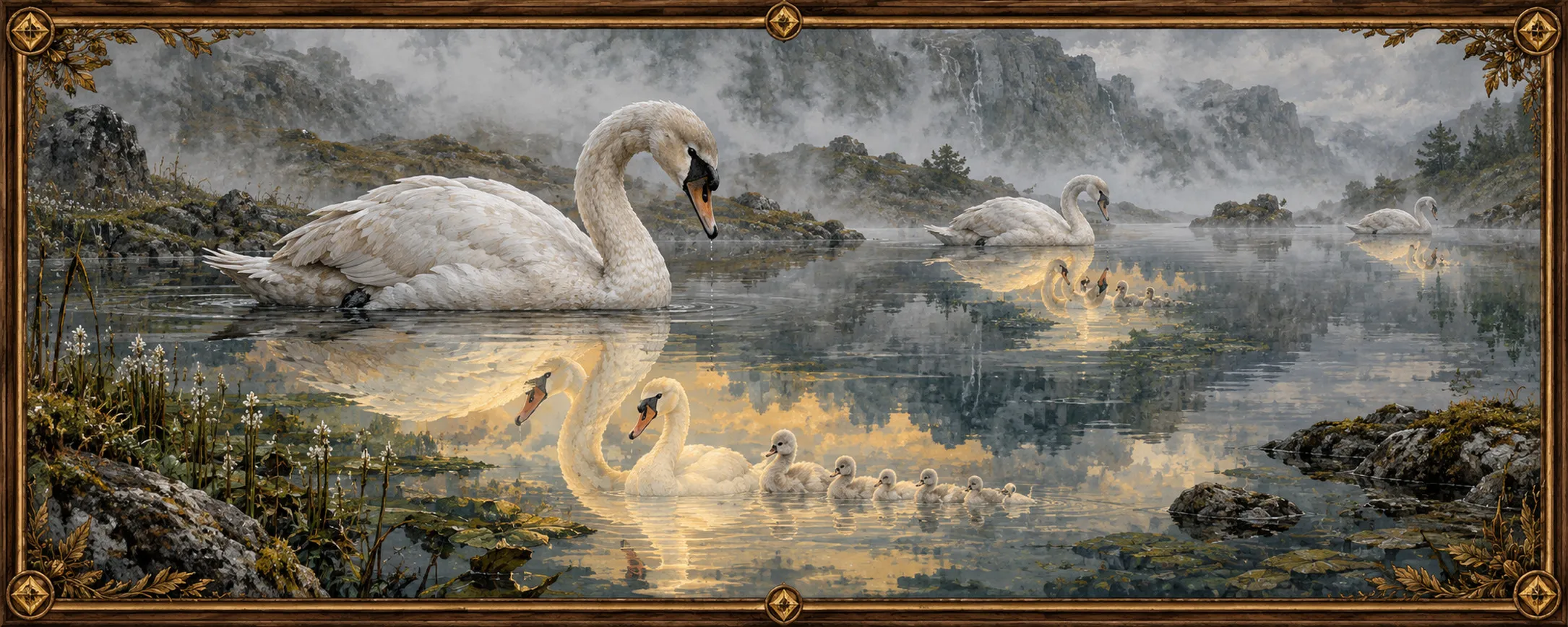
Mirror Swans
On the still water of the Mirror of Regret swim a few white swans. Their reflections do not follow them. The Mirror shows each swan, as it shows each traveller, the life it might have had, and the swan beneath swims elsewhere, with a mate the swan above has lost or young it never raised.
Appearance
They are great white swans, long-necked and heavy-bodied, with black legs and a black bill marked with dull orange. Their plumage is a little greyer than a swan’s should be, as if dusted with the zone’s mist. They glide without a ripple. The reflection below is always brighter: whiter feathers, a second swan close at its side, cygnets in a line behind. They are nearly silent, and give only a soft, mournful whistle from time to time. The air near them smells of rain and cold water.
Habitat and Range
They live on the Mirror’s water and its misty margins, a pair or a lone bird to a pool. Some of the Mirror’s pools have none.
Behaviour and Temperament
They feed on waterweed at the edges and spend long hours floating still, necks bowed, looking down. A swan that has lost its mate is said never to leave. They are wary of people and drift away from anyone who comes too close, but they do not fly off.
Abilities
They have none of their own; the Mirror works on them as it works on every viewer. What sets them apart is that they live with it. Travellers who watch a swan long enough sometimes find their own reflection quieter, as though the Mirror’s attention had shifted to the bird.
Life Cycle
Few cygnets are ever seen on the water itself. Some pairs build nests in the reeds of the margin and raise young there; others have only the cygnets in the reflection. They live long, as swans do.
Uses and Dangers
They are harmless. The Reflections are the zone’s danger, and the swans share it rather than add to it. Those who guide visitors away from the water, the Acceptors, are said to point to the swans as a lesson: a creature that has looked at its other life every day and gone on feeding.
Lore and Belief
Visitors believe that a swan which finally turns away from the water and flies has made its peace, and that seeing one take wing is a sign that the watcher may do the same. Others tell of the Broken, who have stared too long, feeding the swans by hand. Neither tale has been confirmed.