Hoodwort
Hoodwort is the most beautiful poison of the mountains. Its tall spikes of blue hooded flowers stand along the streams of the Headwater Marches, and its root is among the deadliest things that grow. Shepherds bait wolves with it, poisoners buy it, and the healers of the Ironspine Holds use it, very carefully, to numb pain.
Appearance
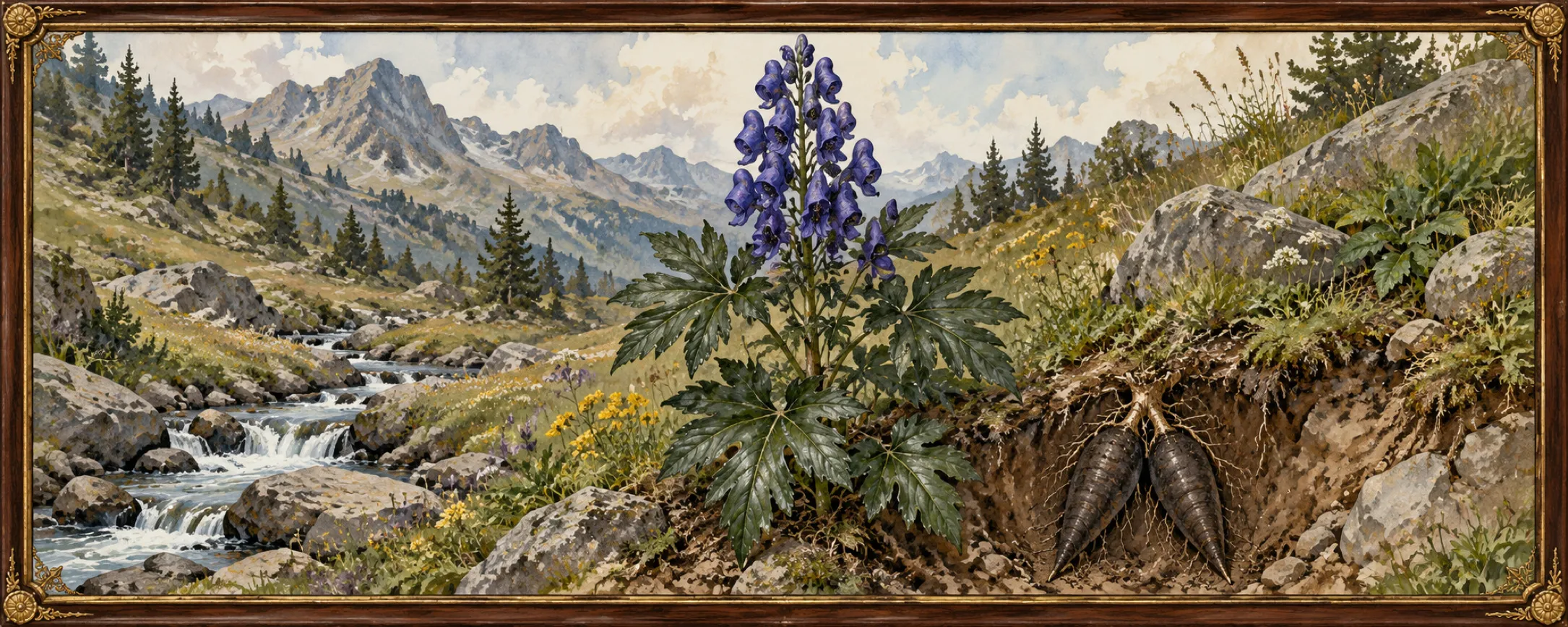
It stands waist- to chest-high on a stiff, leafy stem. The leaves are dark, glossy green, deeply cut into five or seven fingered lobes like a crow’s foot. In late summer the stem ends in a dense spike of deep violet-blue flowers, each shaped like a monk’s hood or a helmet with the visor down, the hood arching over the rest. The root is a dark, fleshy, tapering tuber, often paired, a little like a small turnip or a parsnip, with a fresh one budding beside the old. The plant has little smell; a cut root smells earthy and faintly of radish.
Habitat and Range
It grows in damp, rich, shaded ground: stream sides and the wet foot of slopes in the high valleys, gorge ledges kept wet by spray, and the mountain meadows just below the gentian of the Ironspine. It is common enough that every Headwater child knows it.
Behaviour and Temperament
A long-lived plant that comes back from its root each spring. Grazing beasts mostly leave it, and those that do not, die.
Life Cycle
It flowers each summer from its third or fourth year and renews its tuber every year, the old one withering as the new swells.
Uses and Dangers
Every part kills, the root most. A little on the skin numbs and tingles, and a little more eaten brings a burning and then a numbness of the mouth and face, vomiting, a cold creeping in the limbs, and a heart that stumbles and stops, often within hours and with the mind clear to the end. Foragers have died of mistaking the root for a turnip or a wild parsnip, and gardeners of handling it with cut hands.
Headwater shepherds rub the root into meat and leave it for the wolves that come down to the folds in a hard winter. Poisoners prize it (see Made Poisons). Hold healers make a salve of a very little root in fat, rubbed on the skin over a joint or nerve in pain, never into a wound, and only a healer of many years prepares it. Its death looks like a heart giving out, which is why poisoners like it.
Lore and Belief
Headwater folk call it wolf’s-hood and say a wolf that takes the bait dies with its teeth bared at whoever set it. Dwarves say it grows beside the ways into the deep places as a warning, and a hold child is taught its leaves along with the first marks on the walls. Some believe a sprig worn on the coat keeps wolves off, which only puts poison on the hands.