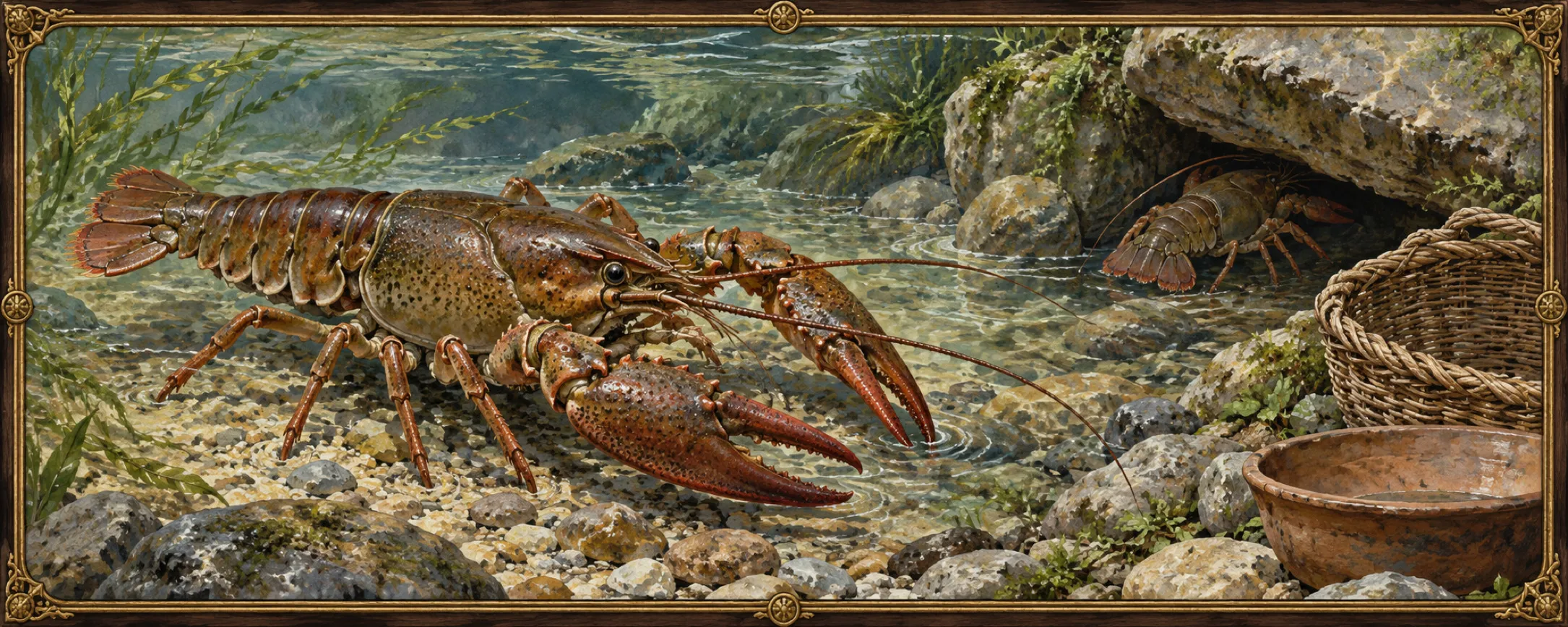
River Crayfish
River crayfish are the small armoured scavengers of the gravel streams. They are a poor household’s meat in the low months, caught by hand and basket in the shallows, and a sign the water is good: where the crayfish die, something upstream has fouled the river. The Goblins of the Greyford Reach eat them; so do the Kavari of the far-side rivers, among the foods of their bank gardens and pools.
Appearance
A crayfish is like a small lobster, as long as a finger to a hand, with a hard jointed shell, two large pincers, long feelers, and a fan-shaped tail. River crayfish are olive-brown to dark red-brown, and turn bright red when cooked.
It walks forward slowly on its legs along the bottom and flees backward with a flick of its tail, very fast. It lifts its pincers when cornered, and can pinch hard enough to draw blood from a careless finger.
Habitat and Range
Crayfish live in clean streams and rivers with gravel and stones to hide under: the side channels of the Greyford Reach, the streams of the Headwater Marches, and on the far side the upriver gravel waters of the Kavari in the Tidebound Reaches. They need clean, well-aired water.
Behaviour and Temperament
A crayfish hides under a stone or in a burrow in the bank by day and comes out at night to eat whatever it finds: water plants, snails, insect larvae, dead fish. It is solitary and defends its stone from others. Otters, herons, eels, and trout eat them.
Life Cycle
Females carry their eggs under the tail through winter, and the young cling to her for a while after hatching. Crayfish shed their shells as they grow and hide while the new one hardens. They live a few years.
Uses and Dangers
They are food: boiled in a pot of river water with a handful of greens, a cheap meal in the low months when the side fords open and the shallows can be worked by hand. They do no harm. Their use as a sign is valued: a bank of dead crayfish in a stream means bad water upstream, a dead animal, a mine’s runoff, or rot, and the water is not drunk until someone has walked up to see.
Lore and Belief
Goblin children hunt crayfish under the stones at Lowbank, and say that a crayfish’s claw kept in a pocket finds lost things. Kavari say the crayfish are the river’s cleaners and should be taken only from water that has plenty. Headwater Humans say crayfish walk backward because they are going back to the mountain, which is a joke and is told as one.