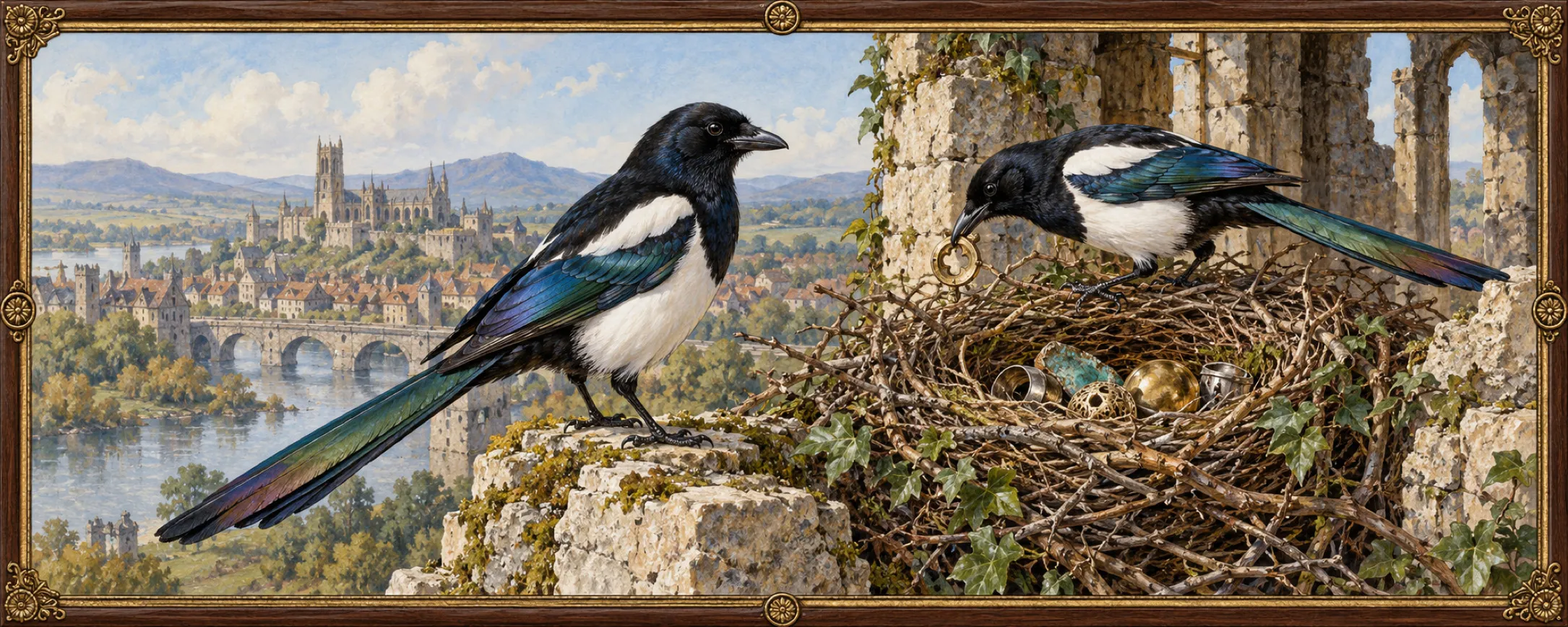
Magpies
Magpies are the loud black-and-white birds of hedge, ruin, and town edge, notorious for carrying off anything that shines. In the ruin country they pick bright scraps from the rubble and line their nests with them, and the Goblin salvagers of the Marches call a magpie’s nest the first salvage market: the bird got there before anyone.
Appearance
A magpie is the size of a pigeon in the body, with a long, stiff, wedge-shaped tail as long again. It looks black and white at a distance: black head, breast, and back, a white belly, and broad white patches on the shoulders and wings that flash as it flies. Close to, the black shines green, blue, and purple in the sun, and the tail has a bronze sheen. It hops and struts on the ground with its tail cocked, flies with quick flaps and long glides, and is never quiet for long: its call is a harsh, rapid chatter, like a stick drawn along a fence.
Habitat and Range
Magpies live where open ground meets cover: hedgerows, field edges, orchards, overgrown ruins, and the outskirts of towns. They are common across the farmed lowlands of the Confluence Basins and thick in the ruin country of the Broken Marches and around the yards and platforms of Lowbank on the Greyford Reach. A pair holds its ground year-round; in winter they gather in noisy roosts of dozens.
Behaviour and Temperament
Magpies eat whatever they find: insects, grubs, seed, carrion, scraps, and the eggs and chicks of smaller birds. They are bold, curious, and quarrelsome, mob hawks, owls, and cats together, and learn a household’s habits as quickly as a fox does. Shiny things draw them: a dropped ring, a brass fitting, a bead, a polished nail, picked up, flown off with, and tucked into the nest or a crack in the wall. Most of it is never used again.
Life Cycle
A pair builds a large domed nest of thorny sticks in a tall bush, a tree, or a high crack in a ruin wall, and lays five to seven speckled eggs in spring. The young fledge in early summer and stay with their parents until autumn. Pairs mate for life, and an old nest may be added to for years.
Uses and Dangers
Magpies take seed from newly sown fields, eggs from henhouses, and fledglings from the hedges, and farmers sling or net them when they can. Goblin children climb to their nests in the ruins for what they hold, and now and then a lost fitting, a coin, or a broken lock comes down that is worth more than a day’s salvage. They also give warning: a magpie’s chatter in a quiet ruin means something is moving there.
Lore and Belief
Goblin salvagers count magpies in a rhyme whose verses run from one for a broken fitting to seven for a cellar nobody has opened, and every warren sings it a little differently. Human villagers greet a lone magpie aloud to turn its bad luck away, and say that a pair on the roof means a wedding. Basin farmers hold that a magpie which steals from the threshing floor has been sent by someone who wishes the household ill.
Treasure-seekers swear a magpie led them to a treasure as often as they swear it led them into a cave-in; the bird is blamed and thanked in equal measure.