Conjured Constructs
Conjured constructs are the made servants of Conjuration, the school of making presence answer. A conjurer names a task, gathers nearby matter or a shape of force, and imposes enough pattern that a working body appears and does what it is told. Most last a short while, some for weeks with upkeep; none has a will of its own. They are the most common made beings on Caeldon, and most people who have seen magic at work have seen one.
Appearance
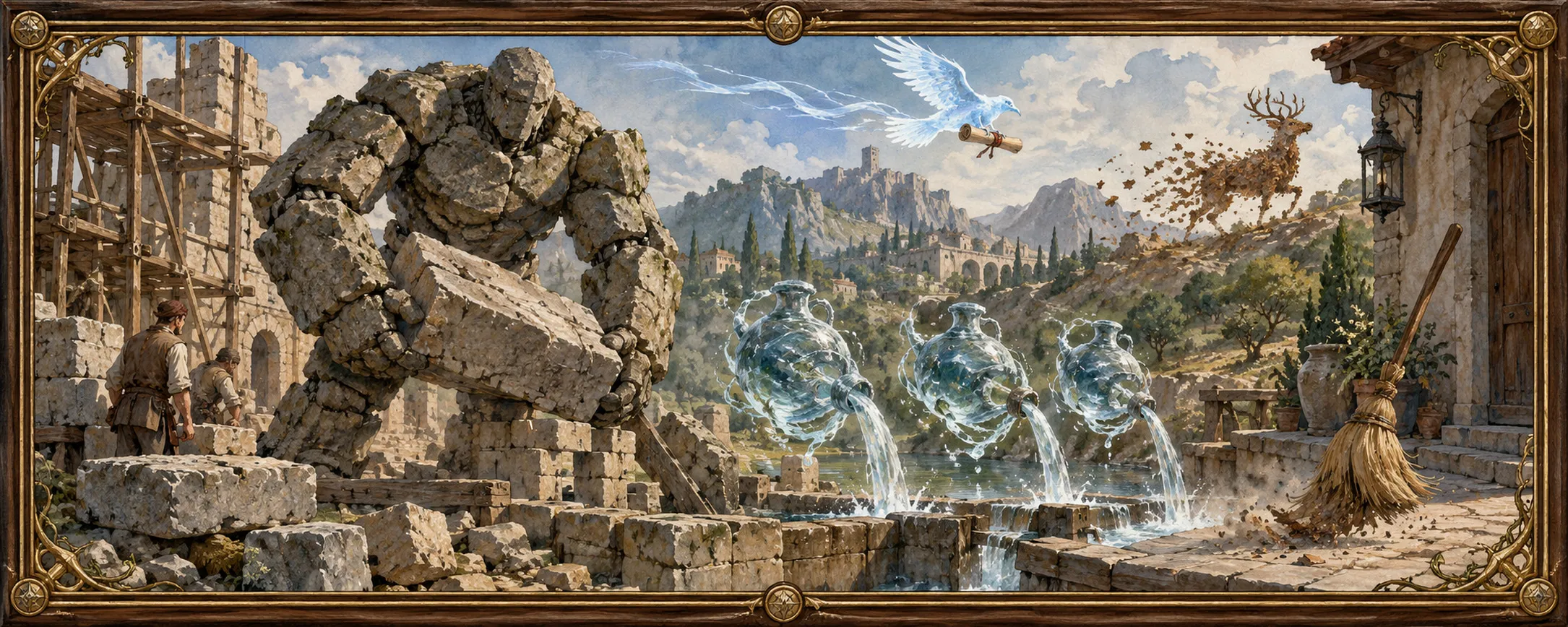
A construct is made of whatever was to hand, and looks it. A stone servitor is a rough figure of loose rock or masonry, about the height of a man and twice as broad, with blunt slabs for hands and no proper joints; it smells of wet stone and grinds as it moves. A water bearer is a hovering, slow-turning body of drawn water, clear or muddy as its source was. A messenger shape is a bird, ribbon, lantern mote, or folded sigil of light, gone after one delivery. A house-avatar takes a simple domestic shape fitted to one house, and a silent drudge has no visible shape at all: a broom that sweeps by itself, a cup that rises, a draught where nobody stands. A hunter’s decoy is a stag, a person, or a moving lure of shadow, dust, leaves, or light, convincing to the eye and without scent or weight.
All share a look of being held: edges that waver when the conjurer’s attention slips.
Habitat and Range
Constructs appear wherever conjurers are trained and hired: building sites and mines, caravans and campaign camps, wealthy households and scholars' studies, and the halls of lords who keep a conjurer of their own. The Hall of Borrowed Forms, a controversial school of temporary servitors, hard constructs, and emergency field assembly, is where most of the craft’s larger forms are taught. A construct belongs to its site: a house-avatar works badly outside the house it is keyed to, and a servitor needs stone to be made of.
Behaviour and Temperament
A construct does what it is told, and only that. It is literal-minded and has no judgement: a drudge sent to clear a table will clear the dish a guest is eating from, and a servitor told to push will go on pushing into a wall. They show no fear, wish, or loyalty.
Abilities
Constructs carry, brace, push, fetch, light, sweep, and deliver, with strength drawn from their matter and their maker. A servitor can lift a fallen lintel long enough to free the workers beneath it; three water bearers can draw seep-water out of a flooded shaft. Their strength is borrowed, and the conjurer pays for it in reserves, so a construct weakens as its maker tires.
Some are fed rather than held. A construct bound by the Hunger Engine of Sacrificial Magic stays strong as long as offerings continue, and always demands more than was promised (see Hunger Engines).
Life Cycle
A construct is made in a few breaths or a chant and ends when its task is done, its maker lets go, or its pattern fails. What remains is what it was made of: a heap of rubble, a puddle, dust, leaves. Failure has a known signature, anchor slip and construct dispersion, in which a construct drops its load, wavers, or comes apart where it stands (see Costs and Side Effects).
Uses and Dangers
Constructs give labour no living worker should risk. Their dangers are three. A construct fails without warning, and what it held falls. Bad conjuration does not fail gracefully: a construct can arrive malformed, hungry, or attached to something its maker did not intend (see Ill-Called). And a construct is a tool anyone can turn: a house-avatar can be hijacked by whoever steals its key-pattern, and smugglers and thieves use servants that answer to nobody else. Against hostile constructs, lords and temples send for a conjurer who knows the Word of Banishing, which unravels them by collapsing their path and denying them pattern.
Lore and Belief
Ordinary people treat constructs as tools and still talk to them, thank them, and name the ones that last. Many believe a construct used long enough in one house begins to know it; conjurers say it only grows familiar to the pattern, which is not the same. Because the school stands so close to ownership and trespass, the deepest worry about constructs is who answers when one does harm, and the answer is usually whoever has less to bargain with. Critics of the Hall of Borrowed Forms say the line between a servant and a weapon is only an order.
Battle tales tell of a siege where the defenders' conjurer raised a wall-breaker out of the rubble of their own gate and set it against the ram, and of the two constructs grinding each other to gravel while both armies watched.