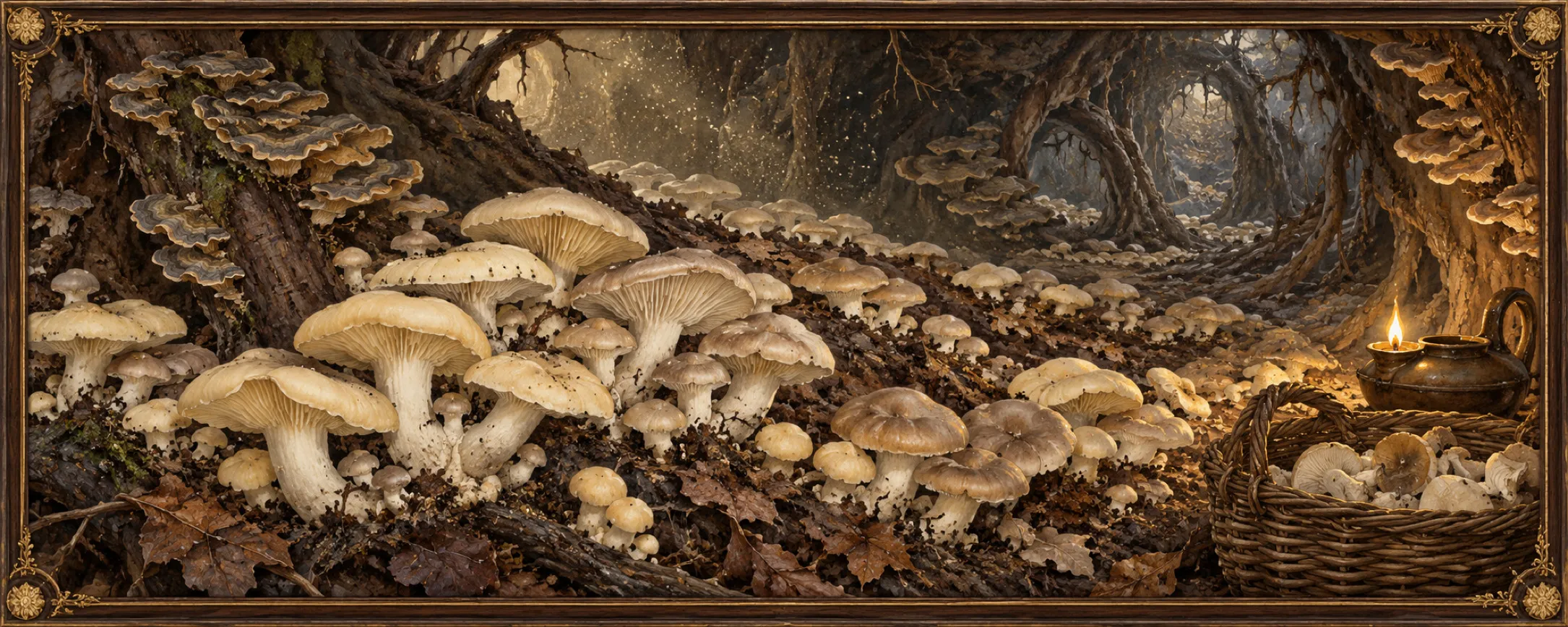
Fungus Beds
Fungus is the staple food of the Roothollows. The Dark Elf houses of the Gloamroot Covenant grow it in fungus beds on dead root and washed-down leaf-mould, and where it grows thick of itself, in the caverns called the fungal darks, they hold it by chamber-right like water. Dwarven holds grow the same kind of crop in the lower levels and the fungal basins of the deep. It gives no light and needs none.
Appearance
A bed is a low, crowded mat across a chamber floor or a slope of dead root, knee-high at its thickest. The fungus grows in clusters of close-packed caps, each from a thumbnail to a spread hand across, on short thick stems that join at the foot. Young caps are the colour of tallow; they darken as they ripen to buff and then to a dull grey-brown, and the undersides are close-ribbed and paler. Old beds put up broad, leathery shelves along the dead root itself.
The flesh is firm and cool and bruises brown where it is handled. A bed smells of wet earth and something like bread, sharpening to sourness when it is overdue for cutting. In the dark it makes no sound; in a still chamber at the right season a fine pale dust of spores settles on everything near it.
Habitat and Range
The fungus lives where dead root and leaf-mould meet damp and still air: in the lower Roothollows, where the living root above has thinned to dead strands, and above all in the fungal darks. Below the forest, little else grows. In the Stonewake Deeps it is nearly the only crop, grown in fungal basins, and in the Ironspine the holds keep fungal beds in the lower levels beside the barley and roots of the valley terraces. On the floor of the Elderweald wild kinds fruit on fallen wood and the root-mat, and Wood Elf households gather them.
Behaviour and Temperament
A bed feeds on what it stands on, eating dead root and leaf-mould down to a fine black crumb. It wants dark, damp, and still air, and it sulks in a draught. Tending is steady work: keeping water off the bed but the air wet, laying fresh leaf-mould brought down along the root, cutting the ripe caps before they shed, and pulling out any growth of another colour. A bed left alone runs to shelf and spore, and its caps turn tough.
Life Cycle
A new bed is started with crumbled spawn from an old one, worked into fresh mould on dead root. It fruits within a season and goes on fruiting, flush after flush, as long as there is dead matter under it, slowing as the root is eaten through. A spent bed is turned and fed or given up. Because the fungus lives on dead root, a house whose living root is dying gains bed-ground for a time even as it loses air and bracing (see Living Root).
Uses and Dangers
The caps are eaten fresh, dried, or pressed into keeping cakes, dense dark rounds that last through lean times. Rendered down, the fungus gives the oil that small lamps burn in every Roothollow chamber, with the gloam doing the rest. In the Elderweald the gathered fungus is one of the few things the forest lets go outward, beside nuts, fruit, resin, and medicinal herbs. A practised worker of Spore Cloud can loose a bed’s spores in a burst.
The fungus is harmless; the danger is losing it. Beds count in chamber-right like the chambers they lie in, so a house that loses a chamber loses its food with it, and fungal basins in the deep are among the resource pockets fought over and worked under coercion (see Deep World Labour and Coercion).