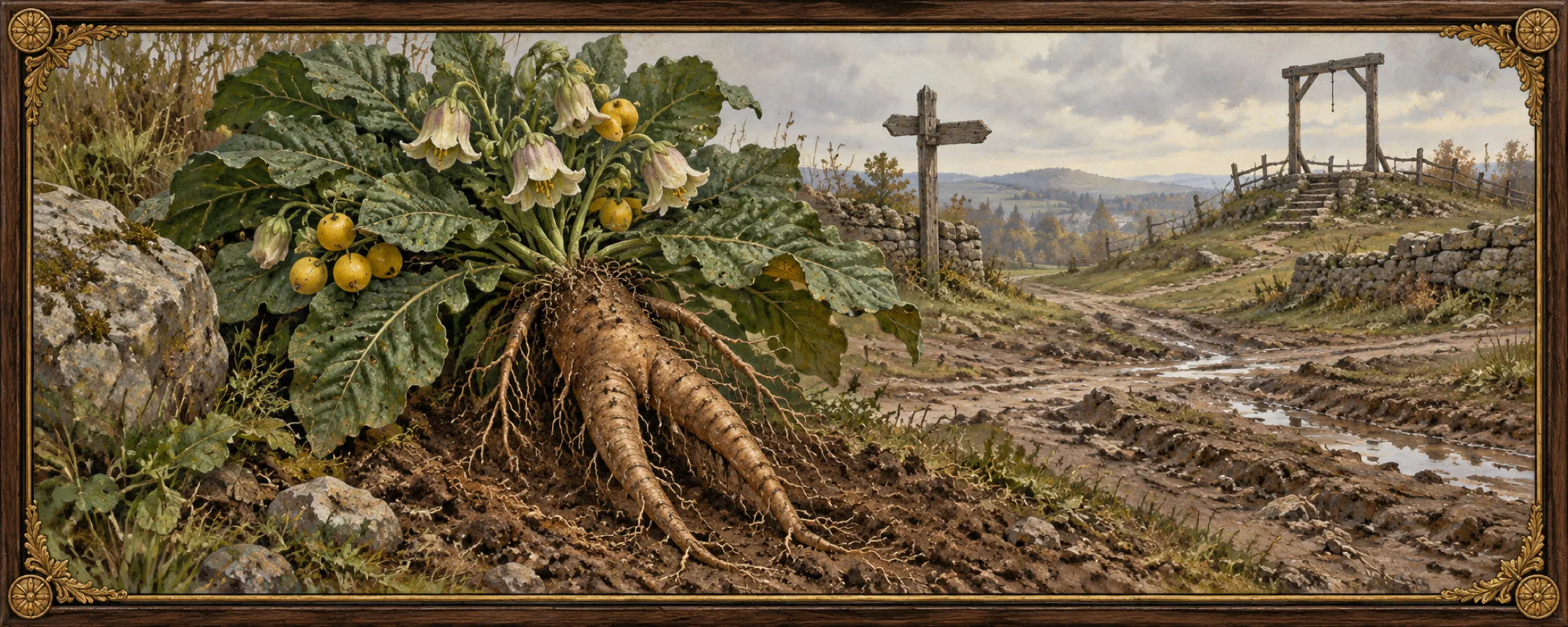
Gallows Root
Gallows Root is a low plant whose thick root forks into a shape like a small human body. It grows on trampled, rich ground, and the places it is best known from are the crossroads and gallows sites of Human country, which has given it its name and its reputation. Necromancers buy it, Sanctified clergy burn it, and most people will not touch it.
Appearance
Above ground it is a flat rosette of broad, dark, crinkled leaves pressed to the earth, with pale bell-shaped flowers in spring that sit close in the leaves' centre, and in late summer round berries that ripen yellow and smell of overripe apples. The root is the thing: brown-skinned, as long as a forearm, pale and fleshy inside, and forked into two or three legs, often with side-roots like arms, so that a lifted root looks like a mannikin. It smells rank and earthy, and the leaves smell worse when bruised.
Habitat and Range
It grows where ground has been trodden hard and fed: at crossroads where carts stop and beasts stand, at old gallows, and around hanging-places, middens, and the edges of burial pits. It is scattered across the farmed and travelled country of the cradle-web and is nowhere common.
Abilities
Every part of it is a poison. A little of the root brings sleep and dulls pain; more brings visions, a racing heart, and raving; more again kills.
Life Cycle
It is slow and long-lived, growing for many years from one root that thickens and forks further as it ages. It dies back each autumn to the root and rises again each spring.
Uses and Dangers
Healers who know it give a sliver against pain at the setting of a bone; poisoners know it too. Its greater trade is to the practitioners of Necromancy, who buy whole roots for rites that work on the persistence of body and trace, and pay well for one dug at a gallows. Its danger, beyond the poison, is suspicion: a root found in a house can bring a charge of dealing with the dead, and workers of Sanctified Magic burn any they find, with the ground it came from.
Lore and Belief
Folk say it springs from the last breath of a hanged man, that it screams when pulled, and that whoever pulls it will die within the year, so a root is dug with a rope tied to a dog. None of this is so; it grows wherever ground is trodden and fed, and gallows ground is merely famous. Necromancers say a gallows root holds something of the death above it and is worth the price; their critics say they only want a root nobody else will sell. A root kept in a box and fed with milk is said to bring luck to a household, which it does not, and to bring the clergy, which it may.
Poisoners prize it above any herb, and a gallows root found in a house after a sudden death has hanged more than one widow, guilty or not.