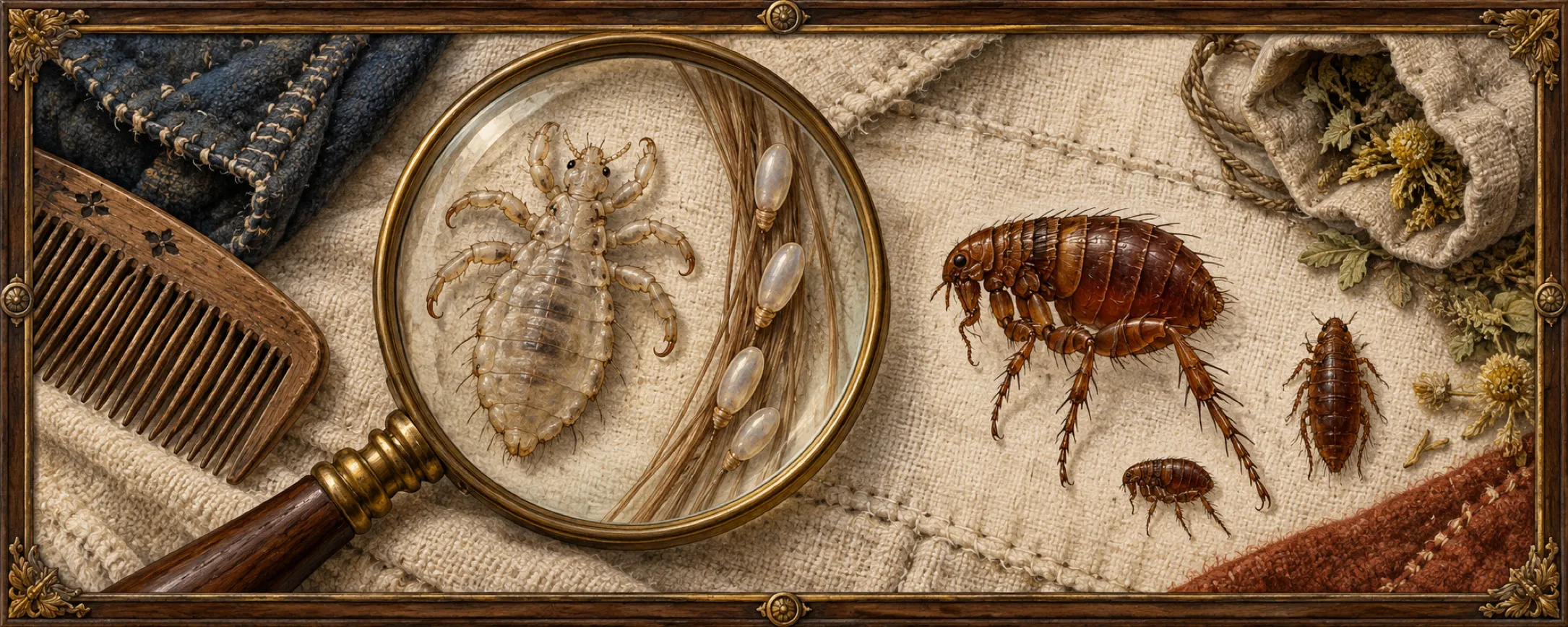
Lice and Fleas
Lice and fleas are the commonest animals in any house, and the least wanted. Lice live on the body and in clothes; fleas live in bedding, floors, and the coats of animals and come to the body to feed. They are a nuisance in a good year and a killer in a crowded one, because lice carry camp fever and the fleas of dying rats carry the swelling plague.
Appearance
A louse is a flat, pale, six-legged speck the size of a sesame seed, grey-white until it has fed and then rust-red with blood. Its legs end in hooks that grip a hair or a seam. Its eggs, nits, are glued singly to hairs near the root, pale and pearly. There are head lice, which keep to the scalp, and body lice, which live in the seams of clothes and come to the skin only to feed.
A flea is smaller still, dark red-brown, hard, and narrow from side to side, so that it slips between hairs; it has no wings, and jumps a hand’s height or more when disturbed. It is far harder to catch than a louse, and cracks between the nails when it is.
Habitat and Range
Lice go wherever people crowd and do not wash or change: camps, ships, gaols, pilgrim hostels, the poor quarters of towns, and children’s shared beds (see The Itch). Fleas breed in floor-rushes, straw, dust, and bedding, and on dogs, cats, hedgehogs, and above all rats. Both are thinner in cold, dry high country and among peoples who live in water. The Wrought carry neither.
Behaviour and Temperament
Lice spend their whole lives on one host or in its clothes, feeding several times a day, and leave only for another warm body close by, or when a body cools. Fleas feed and drop off, and they leave a dying animal for the nearest living one, which is how the swelling plague passes from rats to people.
Life Cycle
A louse lays a few eggs a day for a month; nits hatch in a week and are grown in another two. Flea eggs drop into bedding and dust, where the larvae live on crumbs of dried blood and dirt before spinning cocoons, and a flea can wait in its cocoon for months until footsteps or warmth wake it.
Uses and Dangers
They give nothing. Their bites itch, are scratched raw, and fester, and the sicknesses they carry kill by the thousand. Every household keeps a fine-toothed delousing comb of bone or horn and searches the children’s heads each week; clothes are boiled or baked in the oven after bread; floor-rushes are changed and strewn with bitter and sweet herbs; and smoke is used to drive fleas out of bedding. Healers can make a body hostile to them with Parasite Expel, but a cleared body back in a lousy bunk is lousy again within days.
Lore and Belief
Most peoples believe lice breed from sweat and dirt, and take a lousy stranger for a wanderer or worse. Soldiers say lice desert a man about to die, and are glad of their own. Basin folk hold that fleas leave a house where someone has died, and lay a fleece on the bed to catch them. Hardly anyone connects fleas with the plague, though nearly everyone knows that rats bring it.
Sellsword companies are lousy to a man after a long campaign, and towns that see one coming shut their gates as much against the lice as against the sellswords.