Garden Crops
Garden crops are what people grow by hand, close to the door: greens, onions and leeks, peas, salad leaves, and the small herbs of the pot. No field is ploughed for them. They grow in plots on the floor of a Halfling fold, in walled terraces between the stone houses of a Gnome harbour, on mud patches of the islands below Lowbank, and in sheltered courts among ruins. They rarely travel and are never counted as wealth, but they are what makes a meal of fish, grain, or stores worth eating, and in a lean season they are often what keeps a household going.
Appearance
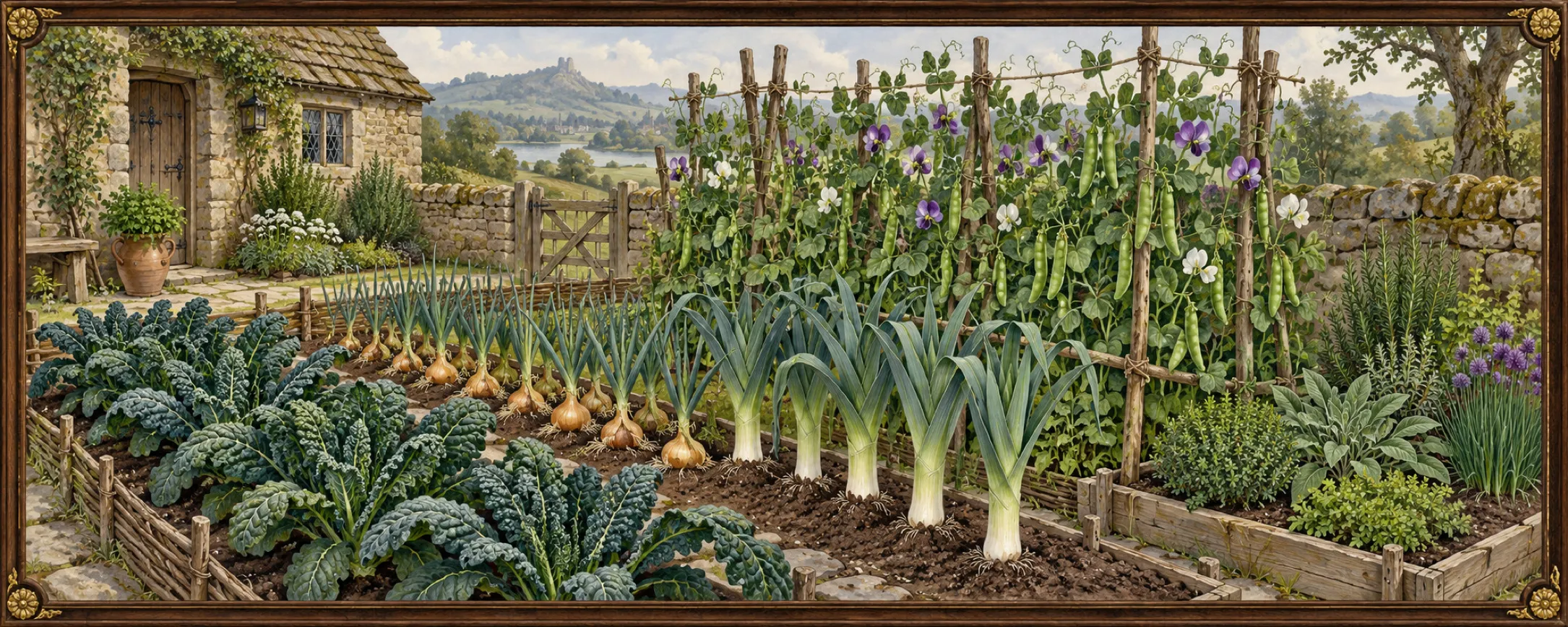
Greens
Leafy greens are the commonest garden crop everywhere: broad, crinkled, dark green or purple-tinged leaves on a thick stem, standing shin to knee high and cut leaf by leaf from autumn through the winter. They grow sweeter after frost. Beside them stand short beds of tender salad leaves for summer and the bitter wild-looking greens that seed themselves along every path.
Onions and leeks
Onions sit half out of the soil in rows, their hollow blue-green leaves flopping as the bulb swells, and are lifted and plaited into strings to hang from rafters. Leeks stand straighter and taller, white at the foot where earth is heaped against them, and stay in the ground through the winter until wanted. Both leave their smell on the hands of whoever weeds them.
Peas and small pulses
Peas scramble up twigs and string, grey-green, with curling tendrils, white or purple flowers, and short fat pods eaten green in summer or left to dry for the winter pot. The coarser field beans belong to the fields, not the gardens.
Pot herbs
Every garden keeps a corner of pot herbs for flavour and simple remedies. Their uses are described with the herbs.
Habitat and Range
The Halfling folds
In the Leeward Folds the orchards take the warmer slopes and grain and garden plots the valley floors. Fold gardens are watered in turn from the cisterns like every terrace, and kept close and tidy. Garden food stands beside fruit, grain, and stored goods at every Halfling table.
The Gnome terraces
On the Tidelace Coasts the stone houses of the harbour families climb the cliffs with walled terrace gardens between them, built against the salt wind and filled with soil carried up the stairs. They grow small crops: greens, onions, and peas that ripen in the sea air. The Gnome harbours of the Soundchain Roads keep the same terrace-garden crops where the cliffs allow.
The islands below Lowbank
In the Greyford Reach, the Goblin households of Lowbank grow greens on patches of silt on the river islands, below their platforms. A flood can take a patch and lay down a better one; the households replant without complaint.
Ruin-courts and grove-gardens
In the Broken Marches food comes partly from small plots in sheltered ruin-courts, where old walls keep off the wind and the soil is rubble and ash. Thorn Elves of the Briarreach keep small grove-gardens inside their hedges, and the High Elves of the Crownboughs raise their gardens into the canopy and plant the understorey beneath it. Human villages of the basins keep a plot behind every house.
Behaviour and Temperament
Garden crops need constant hands: weeding, watering, staking, picking. In return they bear much from little ground, and several of them bear more than once. They are easy prey for slugs, birds, and goats, and much of the stone walling around a garden is meant to keep animals out as well as the wind.
Life Cycle
Most garden crops live a single season, sown in spring and cleared by autumn. Leeks and winter greens stand through the cold and are cut as needed. A few of each kind are left to flower and set seed, and seed is kept in each household from year to year, swapped between neighbours, and given to a new household as a gift.
Uses and Dangers
Garden crops are eaten fresh in season and kept where they can be: onions hung, peas dried, greens left standing in the cold. Goblin households on Lowbank eat island greens with eel and small fish from the side channels and porridge from Highbank grain. Gnome tables set terrace crops beside fish, shellfish, kelp, and seabird eggs. A good Halfling table, generous without being lavish, always has garden food on it.
Their dangers are small. A garden in a ruin-court can grow in soil that is not safe, and salvage households of the Broken Marches learn which courts to plant and which to leave.
Lore and Belief
Halflings count gardens as household work, not common work. A fold’s commons asks what the orchards and the grain terraces will bear, never what a household’s garden does, and the garden is the one patch of a fold that no one tallies aloud. Gnomes say a terrace garden that grows well has been sited honestly, out of the wind. Goblins of Lowbank say that the river owes them a patch for every one it takes.
In a siege or a raiding year the gardens are the last food, and many villages remember a winter when the raiders took the stores and the household gardens carried them to spring.