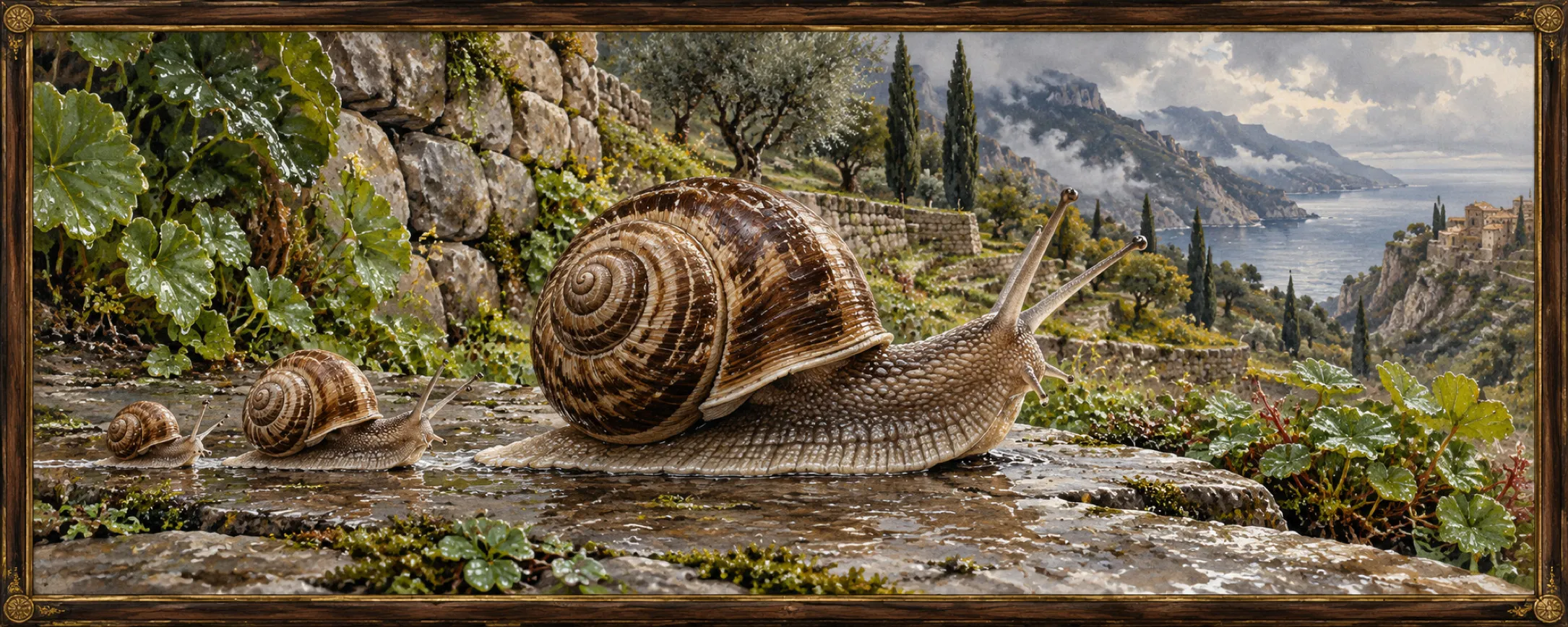
Terrace Snails
Terrace snails are the big brown snails of the terraced gardens and walls of the Leeward Folds. They eat the young greens of the garden plots and are the gardeners' commonest pest, and they are also food. After rain the snails come out by the hundred, and gathering them is children’s work in every fold.
Appearance
A terrace snail’s shell is as big as a walnut, round and coiled, glossy pale brown banded with darker brown and cream in spirals, with a white lip round the mouth. The snail itself is grey-brown and wrinkled, with two long feelers carrying its eyes and two short ones below. It glides on a broad foot, leaving a shining silver trail on stone and leaf. It is silent, though a basket of them clicks and rustles, and it smells of wet earth.
Habitat and Range
They live through the Folds wherever there is lime in the stone, moisture, and green growth: on the terraces, in garden plots, along the bases of the retaining walls, in orchard grass, and in the hollows of the cistern halls. They are fewest on the dry saddles and in the Dry Folds.
Behaviour and Temperament
Snails feed at night and after rain on young leaves, seedlings, fallen fruit, and the green film on stone, and hide by day in the gaps of walls and under leaves. In the dry months of summer and through the cold of winter they seal the mouth of the shell with a chalky door and wait, sometimes for months, until rain wakes them.
Life Cycle
Every snail is both male and female, and two snails court and mate after rain in spring. Each lays dozens of pearly eggs in a hole in soft soil, and the tiny snails hatch with thin, clear shells. They grow for two or three years and live several more.
Uses and Dangers
In a wet spring snails can strip a bed of young greens in a few nights, and households hunt them out at dusk. The same snails are eaten. Children gather them in baskets after rain; they are kept in a jar or a pen on herbs and grain for a week or so to clean them, then boiled and eaten with garlic and oil or baked in their shells. The best, from the oldest walled gardens, are a market good in the autumn. The empty shells are crushed for the hens.
Lore and Belief
Halflings say a snail carries its house with it and keeps its own reserve, and they hold it up to children as a model: it sealed its door in the dry and came out when the rain came. Snail-gathering after the first rain of autumn is half a game, and the child with the biggest basket wins the first share. A snail trail across a doorstep at dawn is said to bring a guest that day.