Dust Runners
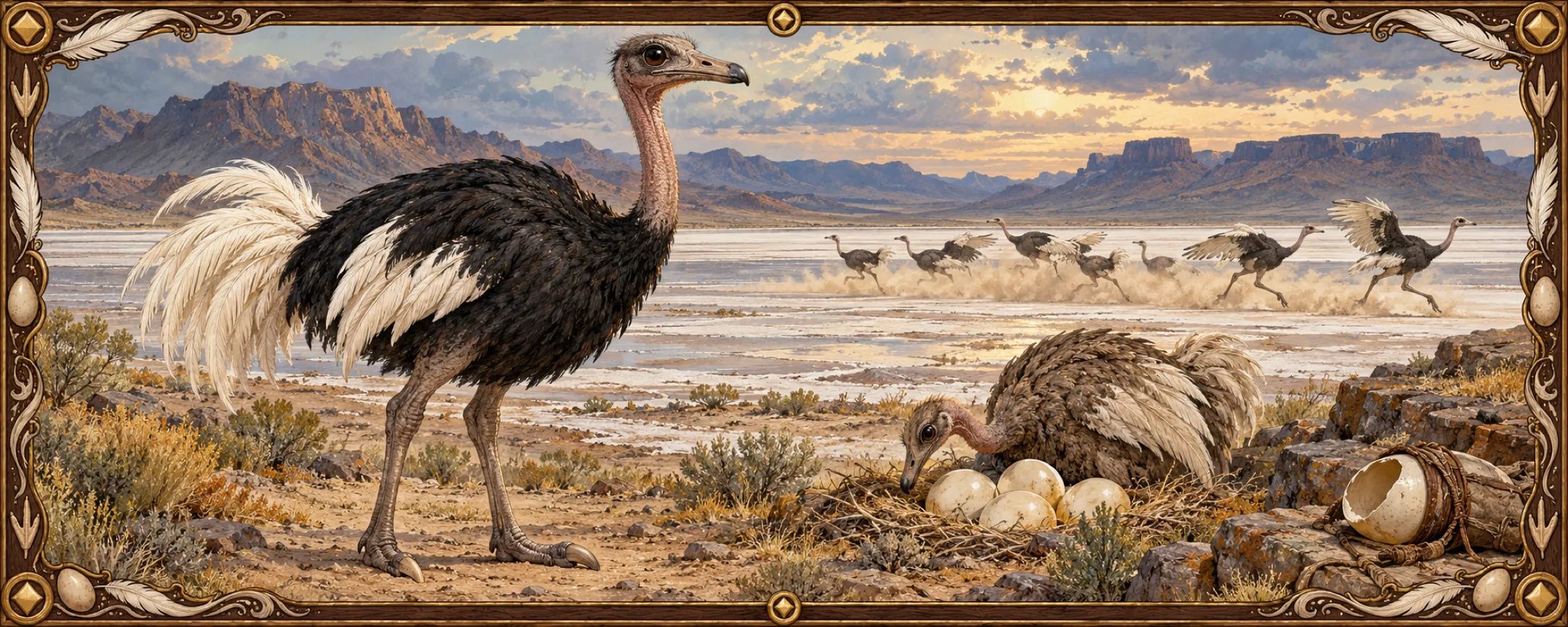
Dust runners are the great flightless birds of the open floors of the Rimward Basins and the edge of the Glassbelt. They are taller than any person, faster than a horse over a short run, and dangerous when cornered. Their emptied eggs, as big as a child’s head and nearly as hard as pottery, are the water flasks of the far crossings, and every crosser on the Glassbelt carries some.
Appearance
A grown dust runner stands taller than a tall man, most of that height a long bare neck and long, thick, bare legs. Its body is a heavy oval of loose, soft feathers: the cocks black with white wing-plumes and tail, the hens and young a dusty grey-brown that disappears against a basin floor. The small flat head has a broad bill and huge, dark, long-lashed eyes. Each foot has two toes, one of them armed with a thick claw like a blunt horn. It runs with long, bounding strides, wings half spread for balance, raising the dust trail that gives it its name. Cocks boom at night in the breeding season, a deep sound like a far-off roar; at other times the birds hiss.
Habitat and Range
Dust runners live on the flattest, most open ground: basin floors, dust flats, the edges of salt pans, and the stony desert at the Glassbelt’s rim, where nothing can come at them unseen. They wander in small flocks between grazing and the rare waters, and gather in larger numbers on the Long Pan’s green fringe after a good flood. They go a long way without drinking.
Behaviour and Temperament
They eat grass, seed, shoots, insects, and small creatures, swallowing stones to grind them. They are watchful and nervous, run from anything they see coming, and keep company with the wild grazers, which benefit from their height and sharp eyes. A dust runner that cannot run, or a cock guarding a nest, kicks forward and down, and that kick can break a man’s leg or open his belly.
Life Cycle
A cock scrapes a shallow nest in the open ground, and several hens lay in it, sometimes twenty eggs or more, cream-white and glossy. The cock sits by night, the leading hen by day. The chicks run within days and grow to full height in a year. A dust runner lives thirty or forty years.
Uses and Dangers
The eggs are the great prize. One egg feeds a whole family, and its shell, emptied through a small hole and stoppered with wood and wax, carries water well and does not taint it; strung in a net and wrapped in hide, eggshell flasks are carried by Edgeway Kindred caravans and Orc escorts on the Glassbelt’s edge, and some are buried full along the routes as water caches. Feathers are traded as ornament, and the skin of the legs makes a tough leather. Taking eggs from a guarded nest is how most dust-runner injuries happen.
Lore and Belief
Crossers mark their eggshell flasks with their own signs and pass them down; an old flask scratched with the marks of many owners is a treasure, and to drink from a stranger’s without leave is a wrong. Some salvagers hold that water carried in a dust-runner egg cannot go bad. It can, more slowly than in a skin. The kindreds say the dust runner was once a bird that flew, and gave up its wings to the wind in exchange for its legs.
Basin raiders ride down nesting grounds for the eggs, and the crossers who rely on them treat an egg-thief as they would a well-poisoner.