Liver Flukes
Liver flukes are the flat worms behind the "sheep rot" of the wet common meadows. They spend part of their lives in small water snails and part in the livers of sheep and cattle, and a wet summer that suits the snails costs the flocks of Human herders dearly by the next spring. The sickness itself, its signs and its cost, is told under Sheep Rot and Fly-Strike.
Appearance
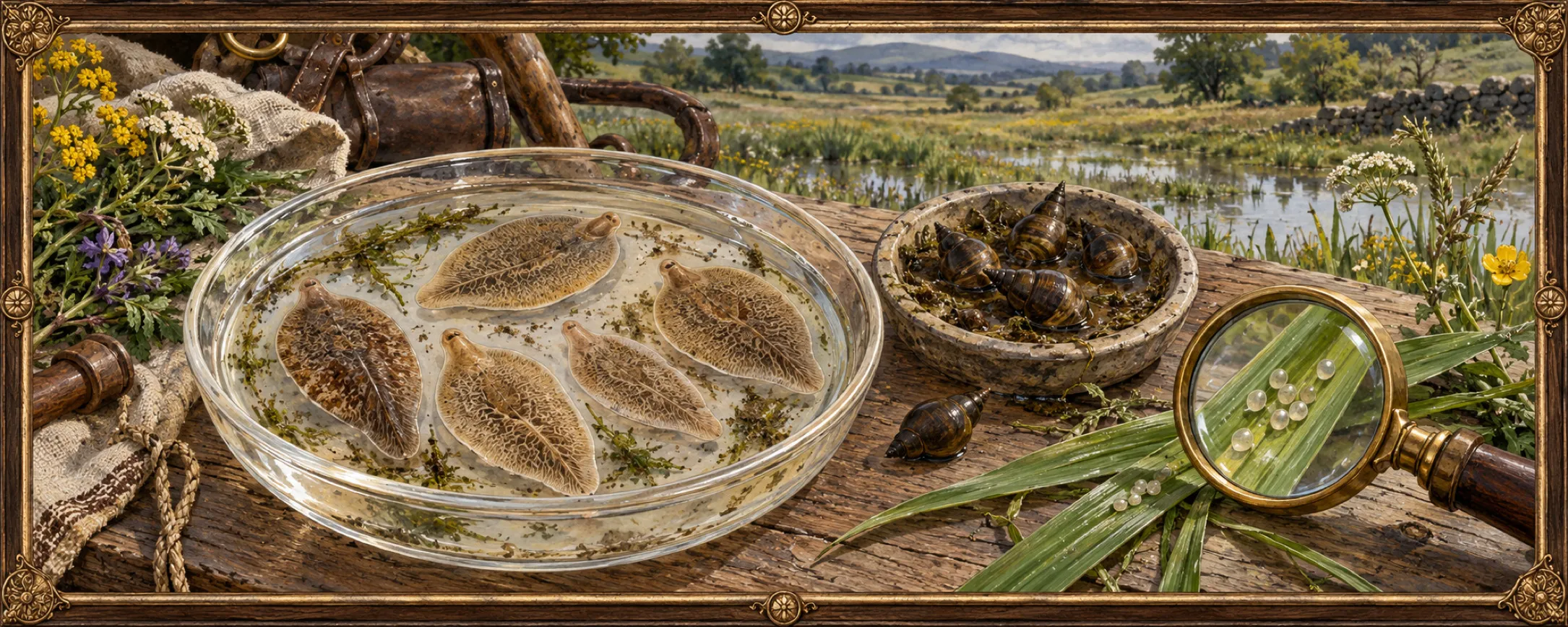
A grown fluke is a soft, flat, leaf-shaped worm about the length and breadth of a thumbnail, grey-brown or tawny, thicker at the front, where a small cone holds its mouth. A shepherd who butchers a rotten sheep finds dozens in the bile channels of a liver gone hard, pale, and gritty. The young stages are too small to see: a speck swimming in a puddle, a dot of cyst stuck to a grass blade. The snails they pass through are small, dark, pointed water snails no bigger than a pea, found on the mud of seeps, ditches, and hoof-pocked wet ground.
Habitat and Range
They live where wet grazing, snails, and herds meet: the wet meadows grazed in common below the villages of the Confluence Basins, the seeps and stream-sides of the terraced valleys of the Headwater Marches, and any field that floods and stands. Dry hill pasture is free of them.
Behaviour and Temperament
A fluke does nothing a watcher could see. Its eggs pass in a sheep’s dung; in water they hatch into swimming specks that seek out the snail and burrow in. Inside the snail each one multiplies into many, which swim out again, cling to the grass, and wait in a hard skin to be eaten. In the sheep they bore through the gut into the liver and feed there for years.
Life Cycle
The whole round takes a few months in a warm, wet year and stops in a dry one, when the snails die back. That is why the rot comes after a wet summer and why one dry year cleans a meadow for a while. A fluke in a liver can live as long as the sheep does.
Uses and Dangers
They give nothing. In a wet year they can take a third of a flock and more, and cattle on the same meadows grow thin and give less milk. Rotten livers are eaten without harm to people. Herders move flocks to high, dry ground in wet years, drain or fence the worst seeps, and keep the wet meadows for cattle and hay, and nothing known cures a sheep already struck.
Lore and Belief
Shepherds know the rot follows wet ground and blame the wet itself, "rotten dew", or grazing before the dew has lifted. Few have seen the snail as part of it. Some valleys say a rotten meadow lies over a grave. A Headwater saying holds that "a wet year fattens the flock and the fluke", and an old shepherd who sees sheep thriving on soaked grass in summer sells before autumn.