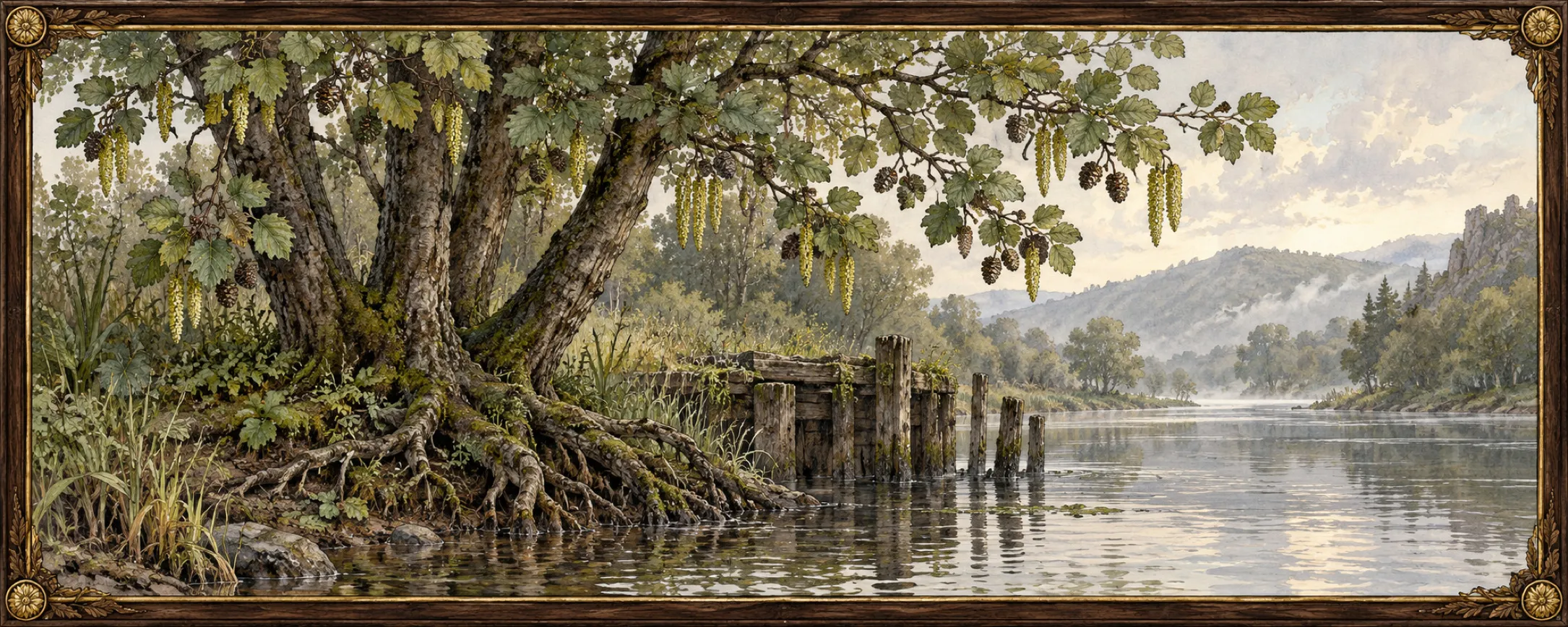
Alders
Alders are the trees that stand with their feet in the water. They line the banks and gravel islands of the rivers and the edges of the fens, and their wood has one virtue every river people knows: kept wet, it does not rot. Quay piles, ford stakes, weir posts, and the footings of the ruined causeway at Greyford are alder.
Appearance
An alder is a middling tree, two or three storeys high, with a narrow, cone-shaped crown when young that rounds with age, and often several trunks from one root. Its bark is dark grey-brown, almost black when wet, cracking into small square plates. The leaves are round and blunt, even notched at the tip, dark glossy green and sticky when young, and they fall still green in autumn. In late winter, before the leaves, it hangs out long purplish-brown catkins that shed yellow pollen; its seed is held in small, hard, dark cones like tiny pine cones that stay on the twigs all winter. Cut, the pale wood turns a startling orange-red within minutes, as if it bled.
Habitat and Range
Alders want wet roots: river banks, flood-ground, spring lines, and the margins of reed and fen. They grow thick along the side channels and willow islands of the Greyford Reach, in the flood-ground of the Lower Serath, and along every stream of the Confluence Basins. Their roots hold banks together; where they are cleared, banks slump.
Behaviour and Temperament
Alder is quick and stubborn. It takes new gravel bars and fresh mud within a few years, often beside willow, and it comes back from the stump when cut, so a bank can be coppiced for poles for generations.
Life Cycle
Seed falls in winter and floats; it sprouts on bare wet ground in spring. An alder grows fast for its first decades and seldom lives past a century or two. Coppiced, a stool lives longer.
Uses and Dangers
Its wood is soft and rots fast in air, but driven into wet ground or sunk in water it hardens and lasts for centuries. The corridor towns build their quays and water-gates on alder piles, Reedfolk stake their channels and stilt houses with it, and Lowbank’s Goblins set their platform piles and ford stakes in it. The old causeway’s footings at Greyford still stand on alder timbers older than any record of the causeway. Its bark and cones make a black dye and ink, and its charcoal is the best for powder-fine work and for smiths' fires that must burn quick and even.
It does no harm, except that a bank cleared of it to make a landing loses its hold, and the next flood takes the landing.
Lore and Belief
Because the cut wood reddens, many river folk say alder bleeds, and woodcutters ask its pardon before they fell one. Reedfolk say an alder on a bank means the bank will hold and an alder in the water means the river has moved. Greyford’s Goblins hold that the old causeway was built by people who knew the river would outlast them and built for that, and they set their own stakes the same way, in alder.
Old river tales say the drowned are buried in alder roots, and fishers who pull a skull out of a root-tangle on a gravel island leave the island alone for a year.