Dogs and Hounds
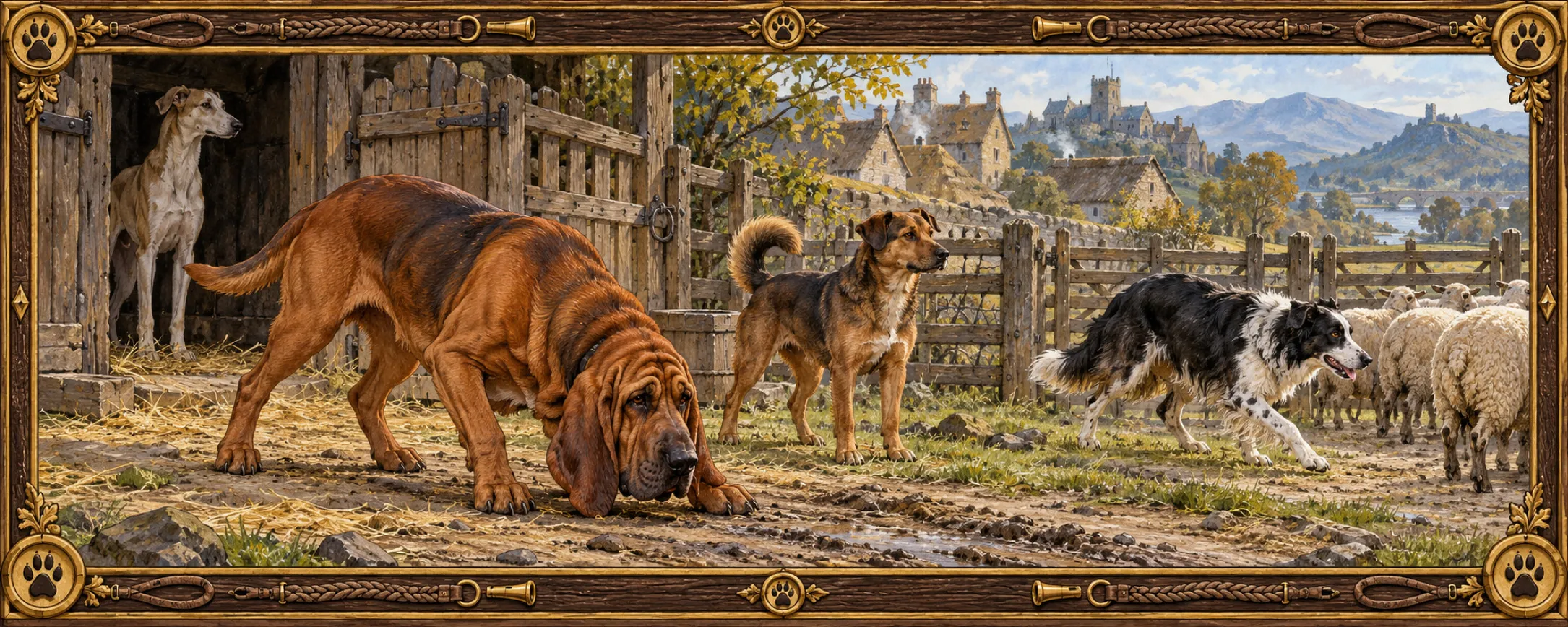
Dogs live wherever people do: they guard yards, turn flocks, clean up scraps, and sleep by the hearth. Hounds are the dogs bred and kennelled to follow a scent or run down game, and in the medieval present they hunt people as often as beasts. A fugitive’s first fear in the Broken Marches is not the bounty-taker’s lamp but the dog beside it.
Appearance
Most village dogs are mongrels of middle size, knee-high to a Human, short-coated in brown, black, or brindle, with pricked or half-dropped ears and a curled tail. Herd dogs are leaner and quicker, often rough-coated black and white. A scent hound is long-eared and loose-skinned, heavy in the head, with a deep chest and a nose held low; the bloodhound, the heaviest of them, has folds of skin hanging about its face, red-brown or black and tan, and a slow, dogged walk that does not stop. Running hounds are taller and lighter, built like a drawn bow.
Dogs bark, growl, and whine; a hound on a hot line gives tongue, a deep belling bay that tells the hunters behind where it runs. A kennel yard smells of straw, meat, and wet dog.
Habitat and Range
Dogs are kept by every people that keeps a house or a herd. Hounds belong to lords, wardens, and hunters, in kennel yards beside a hall or a watch-post, and to the bounty-takers who work the Marches for hire. Strays and half-wild packs live on the edges of towns and ruins.
Behaviour and Temperament
A dog is a pack animal that takes its people for its pack. It is loyal, territorial, quick to learn, and quicker to remember a kick. Herd dogs work to a whistle at long range; guard dogs bark first and bite second. A trained hound, once laid on a scent, will follow it through crowds, water, and night until it loses it or is called off. Strays and pack dogs are bolder and more dangerous than any house dog, and will pull down a lamb or a child.
Abilities
A good hound’s nose follows a trail days old and picks one person’s scent out of many. That is why concealment magic works on smell as much as sight. Scent Unmake scatters a fugitive’s trace so the hounds find no clean line, though fresh blood and heavy musk still leave some; False Trail Burn spoils the obvious ways behind a runner, but expert bloodhounds may still recover the true line. A scout pressed hard may drop a pursuing hound with Splinter Shard.
Life Cycle
A bitch whelps a litter of four to ten in spring. Pups are weaned in two months, and hounds begin training in their first year, coupled to an old hound to learn the line. Most dogs live ten to fifteen years; working hounds are spent sooner.
Uses and Dangers
Dogs guard, herd, hunt, haul small carts in some towns, and turn spits in inn kitchens. Hounds track game and people. In the Broken Marches bounty-takers follow debts and grudges into the tunnels with lamps, fire, and dogs, and the Goblins driven out of revoked ruins have reason to hate the sound of a bay. A dog bite festers, and a sick dog that turns on its people is put down at once.
Lore and Belief
People say a dog sees what its people cannot, and a dog that will not cross a threshold, or growls at an empty corner, is listened to. Fugitives in the Marches pray to Varn the Shadow-Stalker, who hides the hunted, to lose the hounds behind them. A master of Many-Shaping may run as a hound among hounds, and tales of the dog that came home not quite itself are told in many villages.
These hounds are not the Blood-Hounds of the Scourge, the pack hunters of a Deficit plane, though travellers' tales mix the two.
Bounty-takers in the Broken Marches hunt with hounds, and the hound that tracked an outlaw band through three days of rain to its camp is the hero of more than one alehouse song.