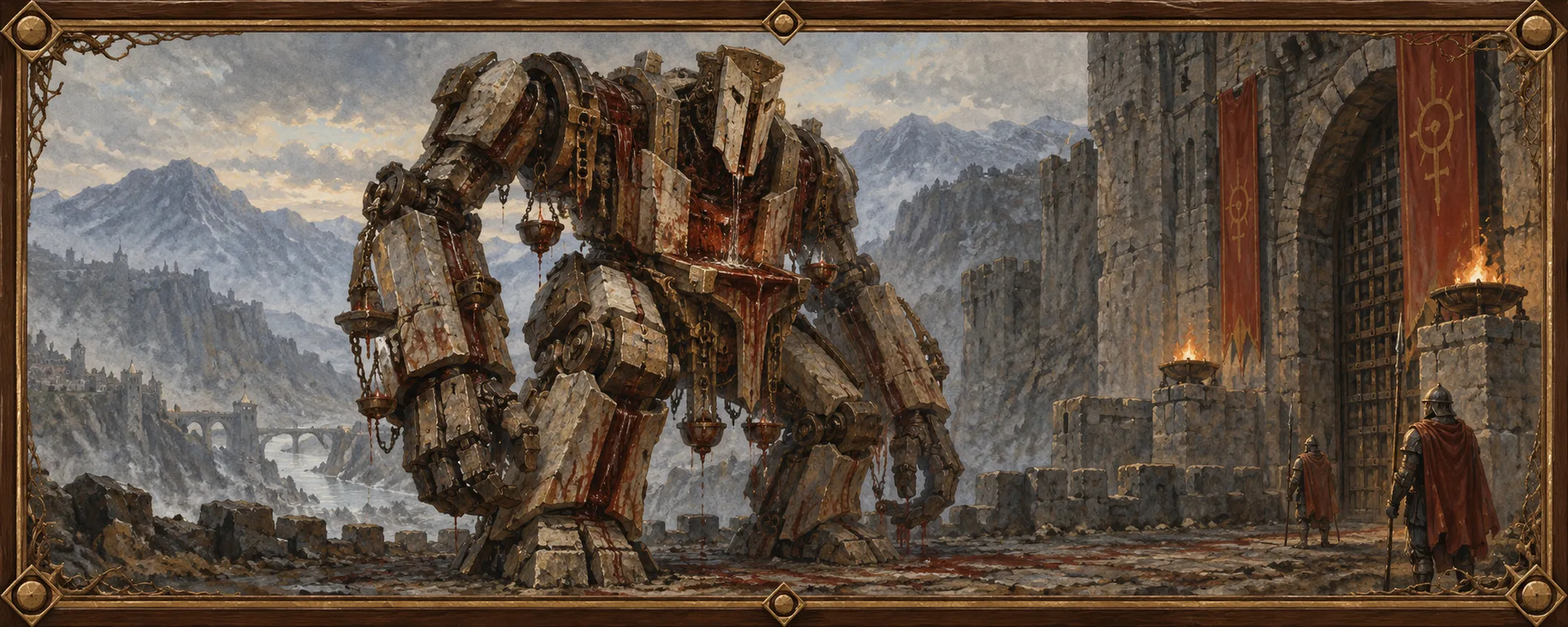
Hunger Engines
A Hunger Engine is a construct that is fed rather than held. Instead of a conjurer’s attention, it runs on offerings, bound to them by the Hunger Engine working of Sacrificial Magic, and as long as the offerings come it stays strong: a guardian that never tires, a labourer that never falls apart. The price is in the binding. An engine always comes to demand more than it was promised, and those who keep one end by feeding it what they never meant to give.
Appearance
An engine is built, not gathered, and looks it: a frame of iron, stone, bone, or bound timber, worked with cut channels and basins, with an altar-mouth or cistern at its centre where the offering goes. Guardians are made heavy and man-shaped or beast-shaped; labour engines are wheels, arms, and presses. Fed, an engine is dark and wet in its channels and moves smoothly; hungry, it dries, grinds, and slows, and its channels show a dull red stain. It smells of old blood, burnt fat, or whatever it is fed, and it hums very low when the offering is late.
Habitat and Range
They stand where somebody has needed a power beyond their means for a long time: in fortresses under siege, in the vaults of rich households, in cult houses of the Knife Choirs and the hunted Hollow Counting Houses, and in the forgotten cellars of all of them. The temple colleges of the Red Altars, which hold sacrificial rites only with consent given before the whole congregation, keep a few under strict watch.
Behaviour and Temperament
An engine does its set task with more strength than any held construct and does not tire, so long as it is fed on time. It has no will, but its binding grows: each offering that keeps it strong also raises what the next must be. Strict binding patterns slow the rise and do not stop it. An engine that is not fed slows, then fails at its task, and some, badly bound, take what they need from whatever is nearest.
Abilities
Fed, an engine has strength drawn from the offering rather than a maker’s reserves: a guardian that holds a gate against a company, a press that drives a mill without water, a frame that keeps a working alive that no caster could sustain. That strength scales with what is given.
Life Cycle
It is made over a long rite and bound to a first offering. It lasts as long as it is fed and its binding holds, which can be generations. Starved, it fails; broken, its bound strength goes out of it all at once, and the place where an engine was broken is often marked by what that release did.
Uses and Dangers
Its uses are what made people build it: power beyond reason, for as long as they can pay. Its danger is the payment. Households have gone from feeding an engine grain and beasts to feeding it their own blood, and then their servants; a fortress feeds its prisoners to the cistern. Lords and the Red Altars hold the keeper of an engine to blame for everything it is fed, when they can reach him.
Lore and Belief
Folk say an engine learns the taste of its keeper, which is not so, and that it can be starved quietly, which is seldom so. Sacrificial teachers tell their students that an engine is only a promise kept too long. The common Human tale of the lord who built a guardian to save his town, and fed it until the town was gone, is told in many valleys with different names.