Lampreys
Lampreys are eel-shaped fish with no jaws, only a round sucking mouth ringed with teeth. They live in the estuaries and lower rivers of the Tidebound Reaches and the estuaries of the Tidelace, and feed by latching onto big fish and rasping into them. Now and then one fastens onto a swimmer in the mouths. The Kavari eat them; the Thaluren loathe them.
Appearance
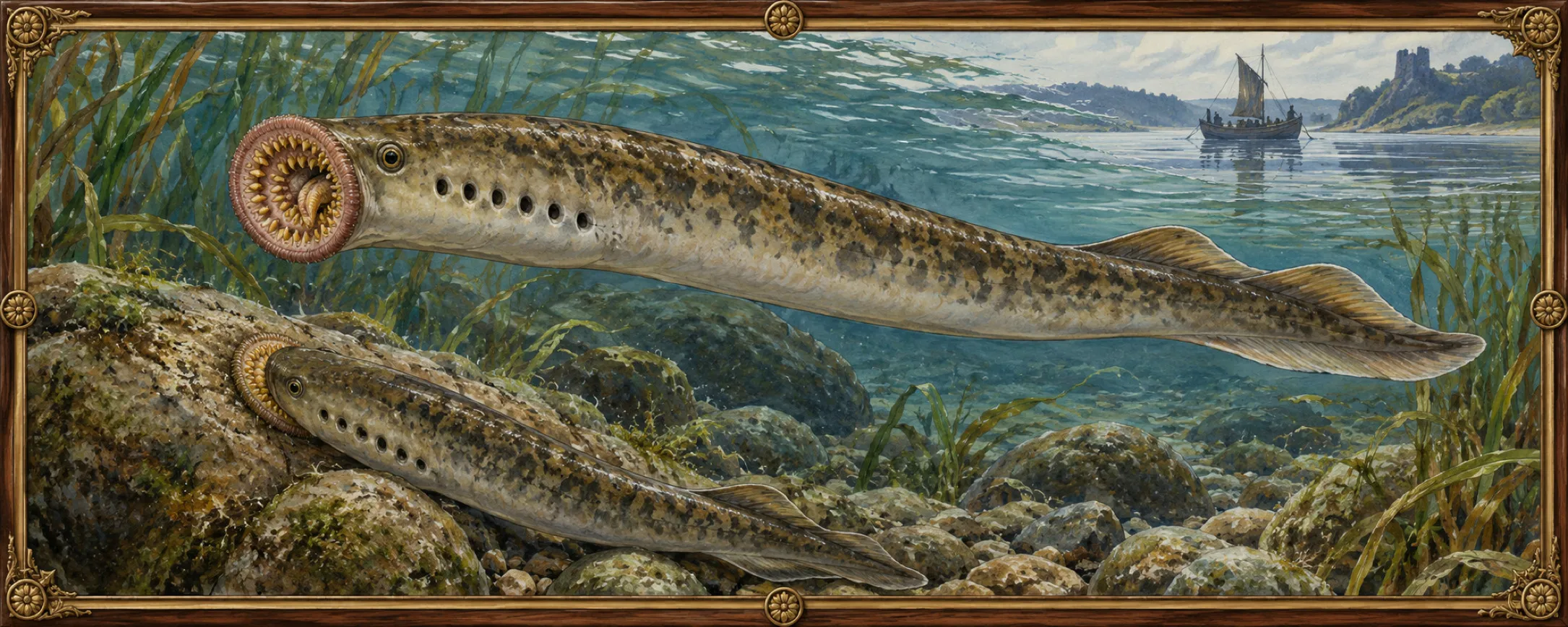
A lamprey is as long as an arm, round and smooth, scaleless and slimy, with two low fins near the tail and a row of seven round gill holes behind each small eye. It is mottled olive-brown to grey above and pale below. Its mouth is the thing people remember: a round sucker as wide as a coin, lined with circles of yellow, horny teeth around a rasping tongue. It swims like an eel and holds onto stones with its mouth to rest against the current. It is silent.
Habitat and Range
Grown lampreys live in the estuaries and the coastal water just off them, feeding on fish; they climb the rivers to spawn on the gravel runs, and the young live for years buried in the silt of the slow river margins. They are commonest in the Reaches' estuaries and less common in the Tidelace mouths.
Behaviour and Temperament
A feeding lamprey fastens its sucker onto a fish, rasps a hole through the skin with its tongue, and drinks blood and flesh for days, until it drops off or the fish dies. It will try any large, slow body in the water, which in the mouths includes a swimmer resting in the current. It is not aggressive in any other way and is easily pulled off, though it leaves a round, bleeding wound.
Life Cycle
In spring grown lampreys stop feeding and climb the rivers to the gravel runs, where they move stones with their mouths to build nests, spawn, and die. The blind, toothless young drift down to the silt and live buried in it for several years, filtering food from the water, before changing into the sucking form and going down to the estuary.
Uses and Dangers
Lampreys scar and weaken the big fish of the estuaries, and fishers find them clinging to their catch. A swimmer bitten in the mouths has a wound that bleeds freely and may fester. The Kavari catch them in baskets on the spawning runs and eat them stewed or smoked, rich and strong, a seasonal dish. Gnome pilots in the Tidelace estuaries think them ugly and harmless.
Lore and Belief
The Thaluren hold the lamprey in horror. A creature that lives on another’s body, taking its strength without killing it, is to them the shape of a broken return: a passage taken without right. A Thaluren who finds one on their body pulls it off at once and goes to clean water. The Kavari laugh at this, and say a lamprey is a fish like any other and better than most. Both peoples agree it should be kept off the spawning gravels, where its nest-building can disturb a clutch.
Kavari tales tell of a lamprey as long as a boat in the deepest pool of an estuary, that fastened to a Thaluren run-leader and was carried with him for a whole season; the Thaluren do not tell this tale.