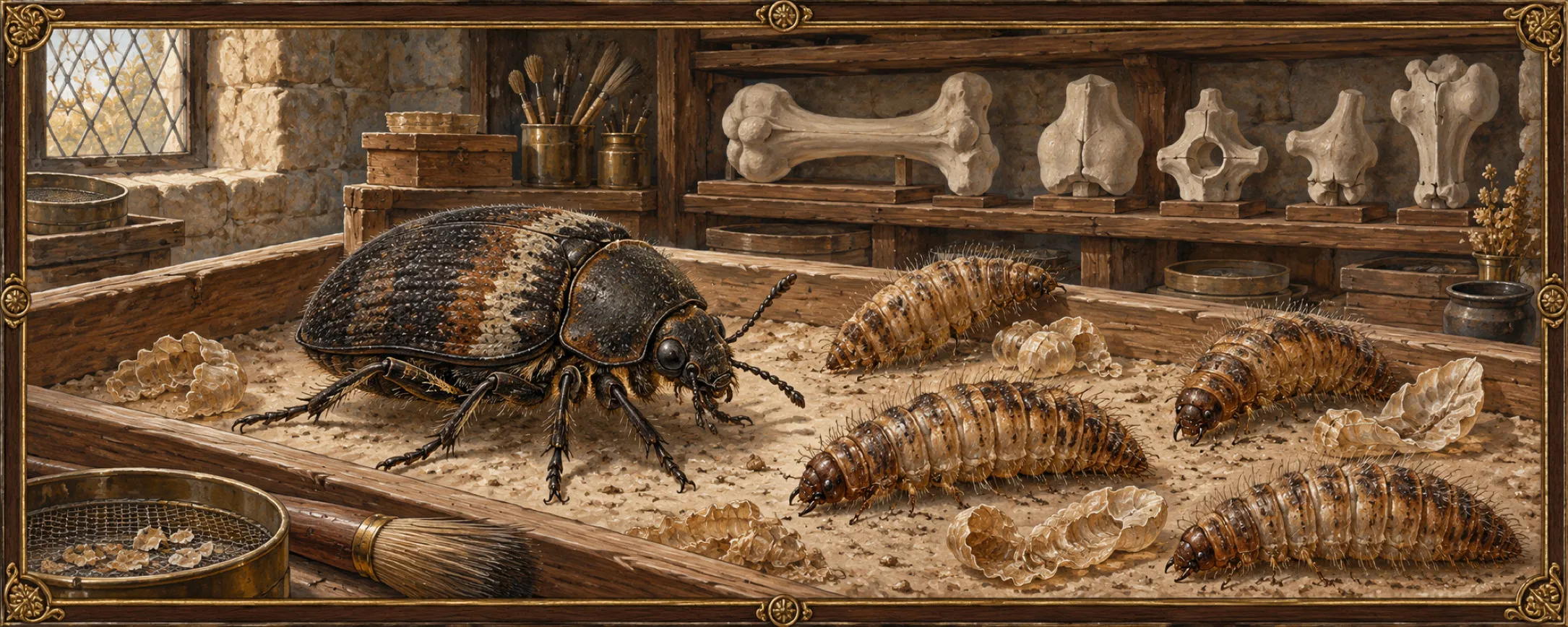
Ossuary Beetles
Ossuary beetles eat dry flesh and leave bone. Wild, they finish what the flies and crows began on a carcass or an old battlefield. Tamed, they are the quiet labour of the ossuary orders, which keep them in closed beetle-rooms to clean the dead down to clean bone for the shelves of an ossuary and for the constructs of the Bonewright Guilds, among them Marrow Sentinels.
Appearance
The grown beetle is small, the size of a grain of barley, oval and blunt, black or dark brown with a faint band of grey or rusty scales across the back. It folds its legs and drops when disturbed. Its larvae do the work: hairy, tapering brown grubs no longer than a fingernail, banded and bristled, that crawl in their hundreds over a body and shed their skins in drifts. A working beetle-room is warm and dry and smells of dust, dried meat, and something sweetish, and in the quiet a keeper can hear a faint dry rustling like sand poured slowly.
Habitat and Range
Wild, they live wherever dry flesh lies: in the hides and carcasses of a dry summer, in the corners of old battlefields, in the nests of birds, in ruins and tombs, and in store-rooms where they get at dried meat and furs. The orders keep them in stone rooms beside their ossuaries in catacomb towns and monasteries, wherever the dead are kept on shelves rather than given to earth, water, or root.
Behaviour and Temperament
They want flesh that has dried a little; wet rot they leave to the flies. A colony set on a body works from the softest parts inward and leaves cartilage and tendon until last, then the bone stands bare, clean, and whole, the small bones of hands and feet still in their places. They do not bite living people.
Life Cycle
A female lays her eggs on dry flesh; the grubs feed for a few weeks, wander off to burrow into something soft, often the wood of the room’s racks, and turn into beetles that mate and begin again. In a warm room the colony never stops. Keepers feed it between bodies with scraps from the kitchens and pick out the dead beetles with brushes.
Uses and Dangers
The orders value them because they do what boiling and burying do worse: they leave bone whole and unmarked. An ossuary keeper sets a body in the beetle-room on a rack, closes the door, and opens it on bone in days or weeks according to its size. Bone that is to be built into a sentinel or an ossuary construct comes from these rooms. Loose, the beetles are a pest of furs, wool, dried meat, and the bindings of old books. A colony that escapes into a monastery’s library is talked about for a generation.
Lore and Belief
Where the dead are kept in ossuaries the beetle-room is a holy, unspoken place, and a keeper of the beetles is a respected and avoided office. Elsewhere it is a horror: many peoples who return the dead to earth, root, or water hear of the beetle-rooms as a desecration, and Wood Elves will not speak of them. A common belief holds that the beetles eat only what the soul has left; the keepers say nothing to correct it.
Grave-robbers fear the beetle-rooms more than the keepers: the story of the thief who hid among the bones from the keepers' torches and was found in the morning picked clean is told to every apprentice keeper as a joke and to every thief as a warning.