Gut Worms
Gut worms are the worms that live inside the bodies of people and their animals, in the bowel and sometimes beyond it. Every people of flesh carries them, every household purges for them, and few think of them as animals at all. The sickness they make, its course and its treatment, is set out under Worms.
Appearance
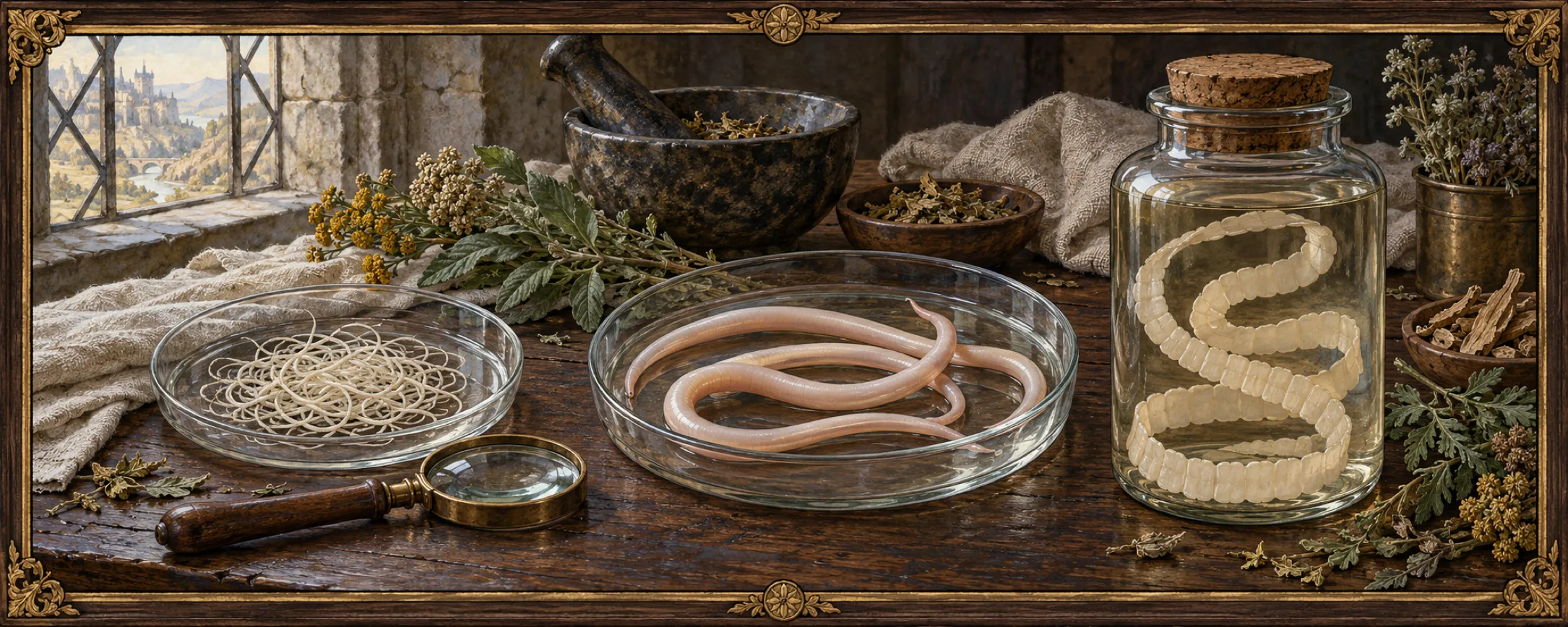
Three kinds are known to every healer, by what passes in the stool:
-
Threadworms: tiny, white, and thread-fine, no longer than a fingernail is broad, that come out at night to lay at the bottom and set a child scratching in its sleep.
-
Roundworms: pale pink-white, smooth, and pointed at both ends, as long as a finger or a hand and as thick as a cord; a heavy knot of them can be passed or, in a bad case, coughed up.
-
Flat worms: ribbons made of many small flat segments, pale and soft, that can grow longer than their host is tall. Segments break off and pass, each like a grain of rice that moves.
None makes a sound or has a smell of its own beyond the dung it lives in.
Habitat and Range
They live wherever dung and food or water meet: in village guts, in herds, in dogs and pigs, and in the fish of the rivers and seas. Flat worms come into people through the undercooked flesh of beasts and fish; the others through dirty hands, fouled water, and unwashed greens. The Wrought, who do not eat, carry none.
Behaviour and Temperament
A gut worm is a quiet lodger. It lies in the bowel and feeds on what its host eats, or clings to the wall and feeds on the host. It does not want to kill, since its life is its host’s. Roundworm young wander through the body before they settle, passing through the lungs, which is why a wormy child may cough.
Life Cycle
Eggs pass out with dung by the thousand and lie in soil or water, some for months, until they are swallowed. Flat worms pass first through a beast or fish, waiting in its flesh as small pale bladders until that flesh is eaten. A worm can live in its host for years, and a host can carry dozens.
Uses and Dangers
They give nothing. They take food from the hungry, stunt children, and add weakness to every other sickness. Herb purges drive them out (see Herbs), and a healer makes the body hostile to them with Parasite Expel, though egg-laying worms need the work repeated. Cooking flesh through, keeping the midden from the well, and washing hands keep them off, and few who do so know why.
Lore and Belief
Many believe worms are born in the belly from sweets or raw fruit, or stir with the full moon. Some old healers keep a passed flat worm in a jar of spirit as proof to doubtful mothers. Fisher peoples hold that every fish has a soul and a worm, and that cooking frees the one and kills the other.