Poultry
Poultry are the birds of the yard: hens above all, and ducks and geese where there is water. Nearly every household that has a yard keeps some. They give eggs every day and meat on feast days, pay small rents to a lord in the Basins, and are the first offering a poor house can make. They are also the fox’s prize, and every keeper’s night is spent half-listening for the hen-house.
Appearance
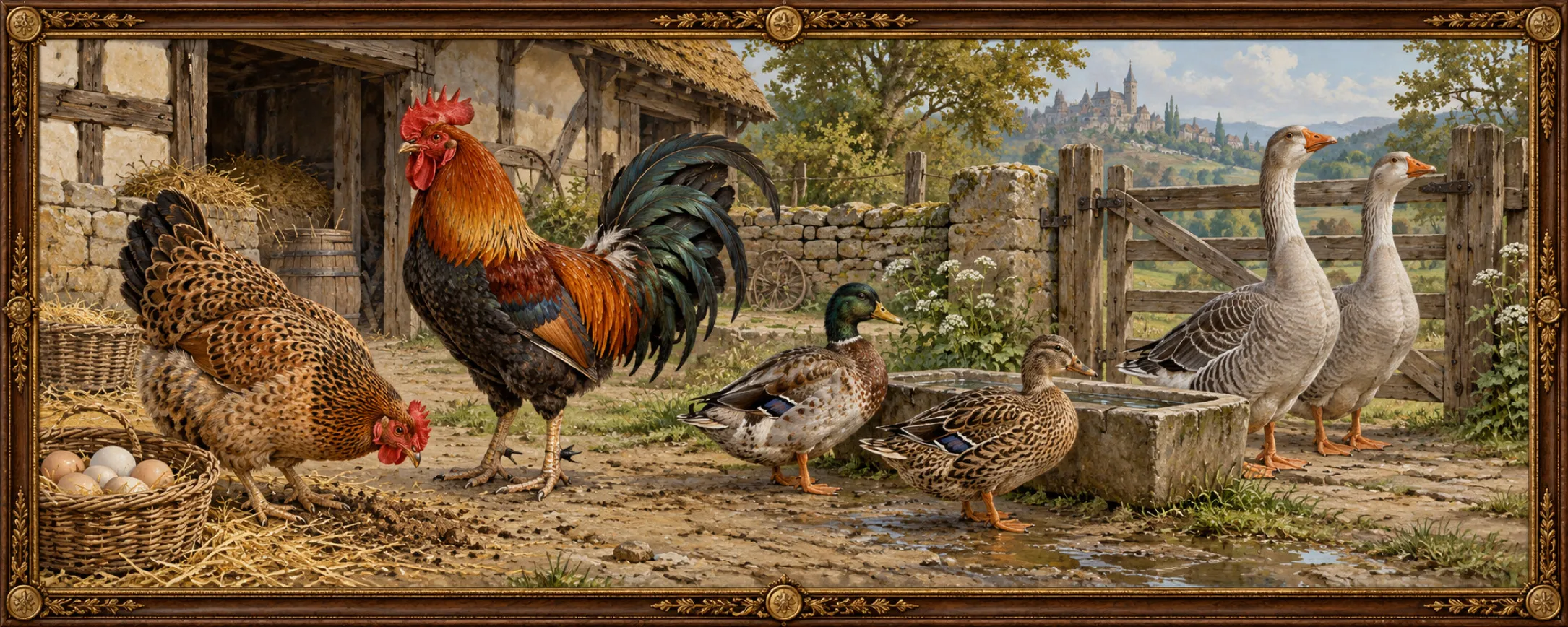
A hen is a plump bird the size of a small cat, with a red comb and wattles, and feathers in every farmyard colour: brown, speckled, black, white, or barred. The cock is larger and gaudier, with arching tail feathers and spurs on his legs, and crows at dawn and at any other time he pleases. Hens cluck, scratch, and announce each egg loudly.
Ducks are flat-billed, waddling, white or mottled brown, and quack. Geese are larger, grey or white, long-necked and heavy, and hiss with outstretched necks at strangers; a gaggle at a gate honks loudly enough to wake a house.
Habitat and Range
Poultry live wherever there are households: in the villages of the Confluence Basins and the foothill towns of the Headwater Marches, on the platforms of Lowbank, on the terraces of the Leeward Folds, and in the yards of most peoples on both sides of Caeldon. Ducks and geese are thickest in the wet basin country and along the Serath. They are fewest in the deep holds and the herding camps.
Behaviour and Temperament
Hens scratch for seed, grubs, and kitchen scraps by day and go into a coop at dusk, where they must be shut in against foxes, weasels, and rats. Ducks dabble in ditches and ponds. Geese graze grass like small cattle and guard their ground. All are flock birds with a strict pecking order.
Life Cycle
A hen lays most days through spring and summer and sits on a clutch of a dozen eggs when left to it; chicks hatch in three weeks and follow her within a day. Geese pair for life and live for many years. Most poultry go to the pot long before they grow old.
Uses and Dangers
Poultry give eggs, meat, feathers for pillows and fletching, goose grease, and quills for every scribe of the Basins and the Serath. Eggs and a hen or two at the turn of the year are a common small rent. Geese are kept as watch-birds as well as for the table. The cost is the feed, and the losses to foxes, weasels, hawks, and owls.