Quenchers
Quenchers are born of the reflection that is the Dissonance, and they feed where light, sound, and warmth go out. Where one has been, the true world is left with a dead spot: a lantern that burns and lights nothing, a shout that makes no sound, a hearth that gives no heat. They are known far better by what they leave than by any sight of them.
Appearance
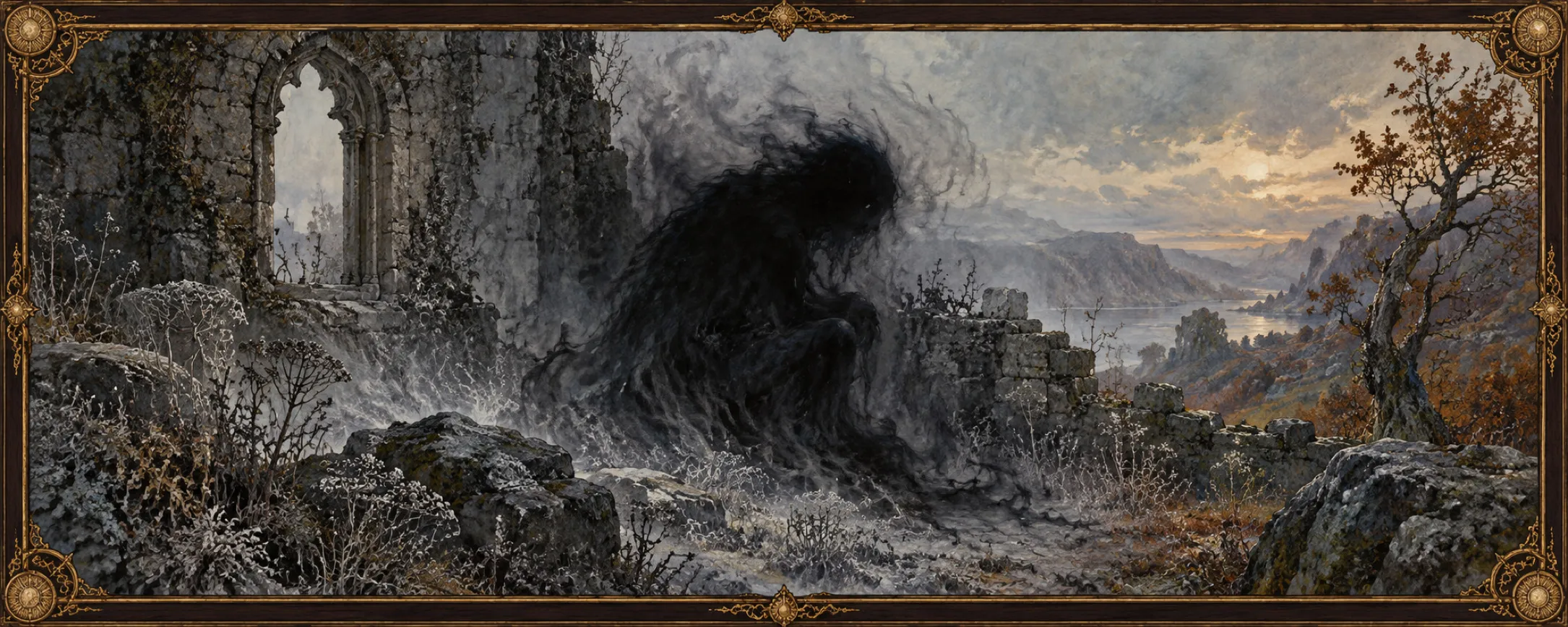
A Quencher is seen, if at all, as an absence: a place where the light stops short, shaped a little like something that crouches, or a little like a person turned away. Its edges do not hold still. Near it colours drain to grey, voices go thin and flat as if heard through wool, and the cold is not the cold of winter but the cold of a room where nothing has ever been warm. It makes no sound, because sound does not reach it.
Habitat and Range
They live in the Dissonance, in its darkest and most drained stretches, and gather where the copy of the world is thinnest. On the surface they come through in off-key places, at the rare door that opens by chance, and, folk say, where a place has already begun to go quiet.
Behaviour and Temperament
A Quencher feeds slowly and returns. A byre gets one dark corner, then two; a hamlet’s evening songs grow shorter each winter; a count at the year’s end turns up fewer voices than names, and no one can say who is missing. Whether it takes the people, or only their light and voice and warmth until nothing is left to take, is not agreed. It seems to prefer the small and the steady: a lamp kept every night, a hearth never let out, a voice that always sings at the same hour.
Abilities
Light, sound, and warmth go out in its presence and stay out where it has fed. A torch carried into a dead spot burns on and lights only the hand that holds it. The dead spots last for seasons or years and grow if the Quencher comes back. Those who stand in one too long go quiet themselves: slow to speak, cold to the touch, hard to rouse.
Uses and Dangers
It gives nothing. Its danger is that it is noticed late: a dead spot looks at first like a draughty corner or a bad wick. Fire does nothing, and more fire only feeds it. What thins it is the true note held against it: names spoken aloud into the dark corner, the count kept right, a hearth tended in the old way, a song sung true where the sound has gone. Folk who have cleared a dead spot say it took many nights of singing to do it, and that it came back where anyone stopped.
Lore and Belief
Country folk speak of the quiet ones, or the hearth-thieves, and blame a cold corner on one long before they would blame the chimney. A common belief holds that a Quencher is drawn by silence and kept away by noise, so some villages bang pots through the night; noise does nothing, and the few who know more say only a true note does. Others believe a Quencher is a dead person’s last breath that never found its song. Nothing of that is known.