Sheep
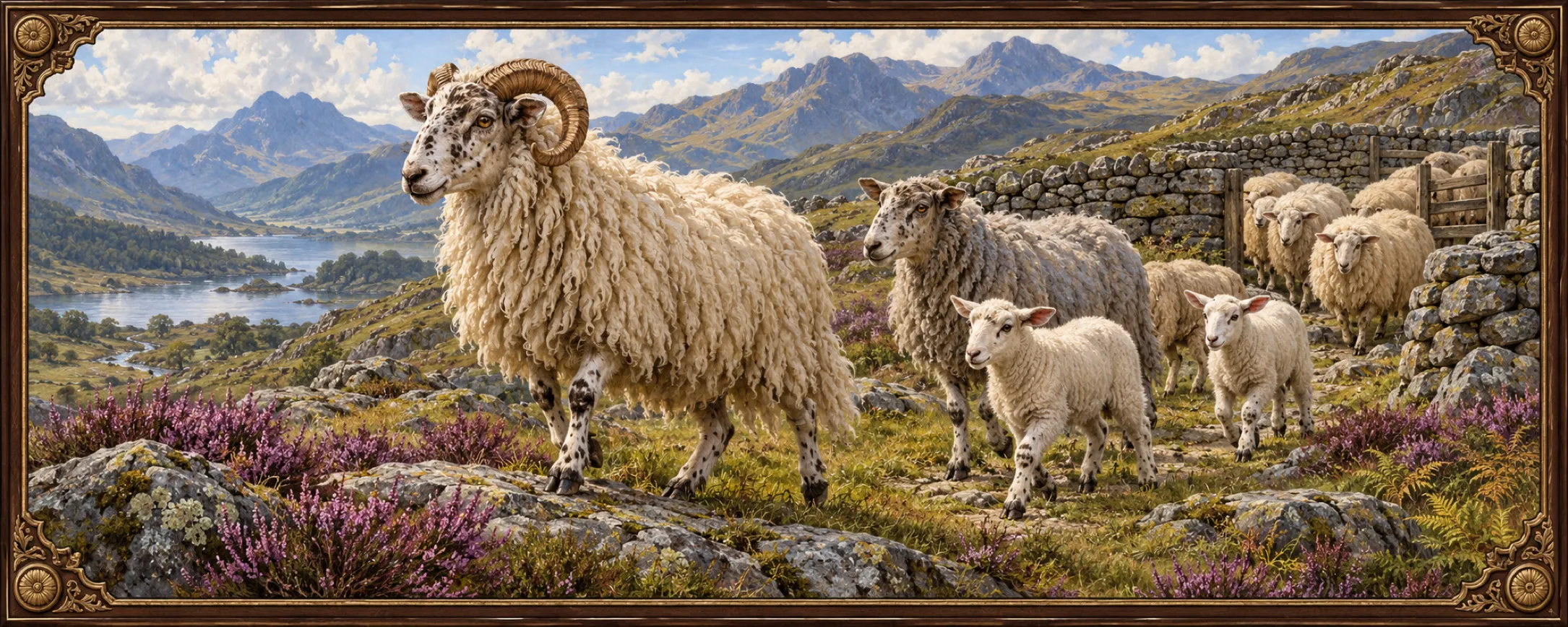
Sheep are the wool beasts of the Human uplands. Headwater households send them up to the summer slopes, and the herders of the basin edge graze them on the thin country towards the Witnessfields. Their wool clothes the Cradle web and goes up the Headwater roads to the Dwarven holds, which cannot grow their own, and their mutton is the broth of every carters' inn. The fleece that comes down the Windscar stairs to the far-side coast is not from these flocks but from the kindreds' herd animals.
Appearance
A Headwater sheep is small and hardy, knee-high to a Human at the shoulder, with a dense, crimped fleece of off-white, grey, or brown that grows thick by spring and hangs in ragged locks if it is not shorn. Its face and legs are bare, pale or speckled, and most rams and some ewes carry curled horns. Basin-edge sheep are larger and heavier in the fleece, and polled. A flock moves in a tight, flowing mass behind its lead ewe, bleating continually, the lambs high and thin and the ewes answering low. Sheep smell of lanolin and wet wool, and a fold smells of it all year.
Habitat and Range
In the Headwater Marches a valley household grazes sheep with its cattle on the summer slopes, and high villages such as Notchfield send their flocks up as soon as the snow clears and bring them down before it returns. In the Confluence Basins sheep belong to the drier uplands at the inland edge, where the fields thin towards the Witnessfields and hamlets such as Flockturn keep sheepfolds and graze their flocks up to the boundary markers.
Behaviour and Temperament
Sheep are timid, gregarious, and easily led. They follow one another, which a herder and a dog can use, and panic as one, which a fox, a stray dog, or a sudden storm can use against them. A ewe knows her lamb’s voice among hundreds. A ram in the autumn will butt anything that crosses him. Left to themselves on rough pasture they keep to familiar paths and graze the slope in lines.
Life Cycle
Ewes lamb in early spring, one or two at a time, and the lambing season keeps herders out in the folds at night. Lambs go up to the summer slopes with their mothers. Sheep are shorn in early summer; surplus lambs and old ewes are sold or slaughtered in autumn. A ewe gives lambs for six or seven years.
Uses and Dangers
Sheep give wool above all, then mutton, milk and cheese, skins for parchment and fleeces, tallow, and dung for the terrace fields. Wool and cloth go up the Headwater roads to the holds of the Ironspine, who sell ore and tools and buy back the wool they cannot grow. Flockturn’s herders sell wool and mutton at the march-towns, and mutton broth is eaten in the carters' inns at Greyford.
Sheep cost little but care. They fall to rot and fly in wet years, to foxes and dogs at lambing, and to snow when a flock is caught high late in the year.
Lore and Belief
The herders of Flockturn graze up to the Grey Line of the Witnessfields and turn their flocks back there, saying the land inside is already spoken for; they do not cross the markers, and they say their sheep stop at the last stone before they do, without being whistled back. Whatever lies inside the markers, no flock has been seen to graze it. Elsewhere, a black lamb born first in the season is thought lucky, and herders swear oaths with a hand on a fleece.
Sheep-raiding is the oldest quarrel in the Headwater Marches, and every valley keeps the tale of its night raids, the flocks driven over the passes in snow, and the shepherds who followed with slings.