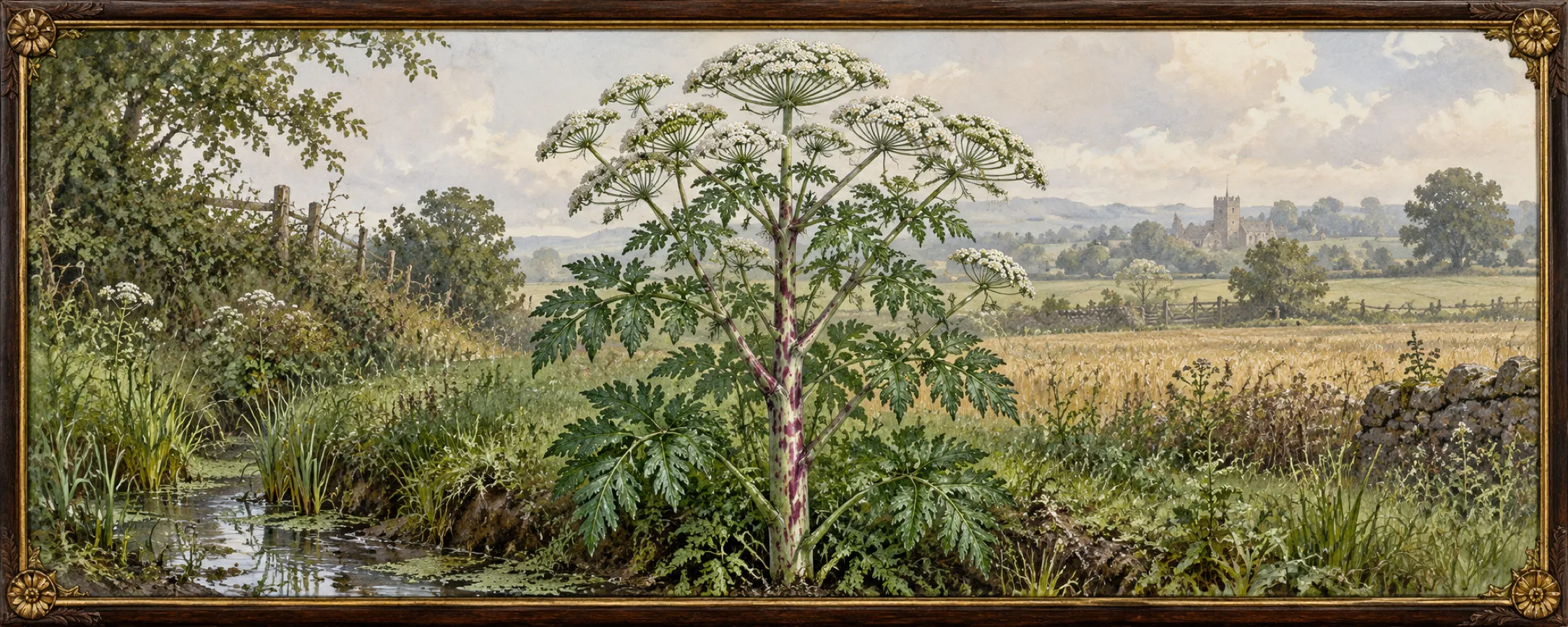
Hemlock
Hemlock is the commonest killer among the plants of the basin ditches. It belongs to the spotted umbels that look like the wild parsleys and carrots foragers gather, and every spring in the Confluence Basins someone gathers it for the pot. What it does to the eater is told under Poison Herbs.
Appearance
In its first year hemlock is a low clump of fine, lacy, fern-like leaves, bright green and glossy, very like parsley or the young leaves of wild carrot. In its second year it shoots up fast, to head height or higher, on a smooth, hollow, pale-green stem blotched and streaked with dull purple-red, as if bruised, and dusted with a white bloom. At the top it spreads flat, lacy umbrellas of tiny white flowers. The whole plant, bruised, gives off a rank smell like mice, and that smell is the surest way to know it; a forager who does not stop to smell is the one who is poisoned.
Habitat and Range
It grows on damp, rich, disturbed ground: ditch sides, the wet edges of fields and meadows, river banks, middens, and waste ground near villages, in the Basins and down the flood-ground of the Lower Serath. It is thickest where the soil has been turned and left.
Behaviour and Temperament
It grows fast and seeds heavily, and a ditch cleared one year is full again the next. The danger is in spring, when its leaves stand among the pot-herbs, and in a lean spring, when cattle and sheep graze the ditches.
Life Cycle
A two-year plant: a leafy rosette the first year, a tall flowering stem the second, then death after seeding. The seed lies in the soil for years.
Uses and Dangers
Its only use is as poison, and in the hands of a few healers, in tiny measure, as a calming draught for spasms and fits, given so rarely that most healers will not risk it. Every part kills, the seed and root most. Its poison weakens from the feet upward while the mind stays clear, until the breath fails. Livestock that graze it in a lean spring die the same way.
Herders clear it from ditches before turning stock out, and mothers teach children to smell a plant before they pick it.
Lore and Belief
Herb-wives say the purple spots on the stem are blood spilt where it grows, and that hemlock follows a murder; it follows damp ground and middens. Basin folk call it mouse-weed and the dead man’s parsley. In some villages a hemlock death in spring is held to be a judgement on the house that let the ditch go uncleared, and the lord’s reeve is asked about it.
Poisoners in the basin towns buy hemlock by the bundle from the ditch-gatherers, and the gallows songs of the river towns have more than one wife in them who fed it to a husband in his broth.