Sturgeon
Sturgeon are the armoured fish of the big river. Each spring, after the rise, they come up the Serath from downstream, from water nobody in the corridor has followed to its end, to spawn on the gravel beds above. Its roe is the costliest food the river gives.
Appearance
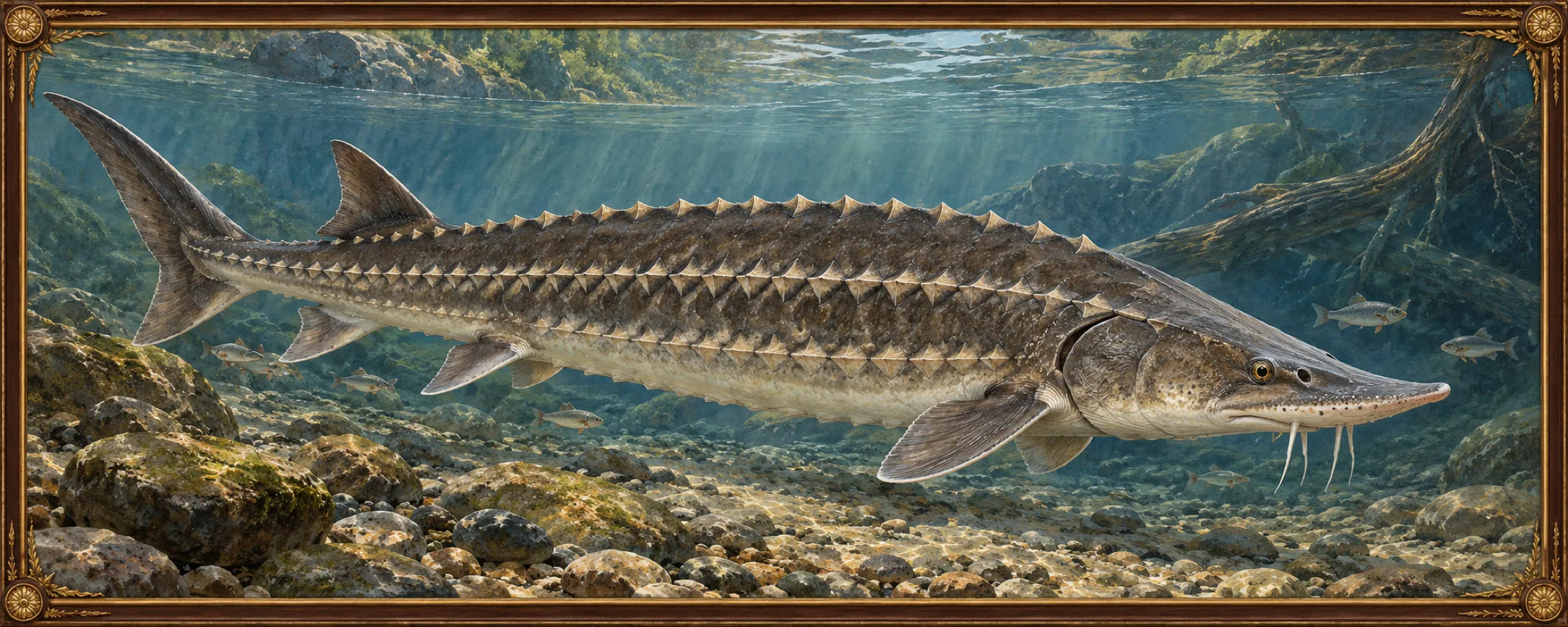
A sturgeon is long and shark-shaped, from the length of a Human to two or three times that, with a long pointed snout, four whiskers under it, and a small toothless mouth that pushes out like a tube to suck food from the bottom. Instead of scales it carries five rows of bony plates along its back and sides, each with a hooked point, so a young sturgeon is as rough as a rasp. It is dark grey-brown above and pale below. The tail is lopsided, the upper lobe longer.
It cruises slowly near the bottom and now and then leaps clear of the water, falling back with a slap heard across the river.
Habitat and Range
Sturgeon live in the deep reaches of the main channel of the Lower Serath, and in spring run up into the lowest rivers of the Confluence Basins to spawn on clean gravel. Where they spend the rest of the year is downstream, beyond any reach the corridor knows, and whether that is a sea, a lake, or the river’s own deep water nobody can say.
Behaviour and Temperament
A sturgeon feeds on the bottom, sucking up worms, shellfish, crayfish, and small fish. It is placid and slow to flee. Spring runs come in a few weeks after the rise has fallen, and the fish travel in loose groups.
Life Cycle
Sturgeon grow very slowly and live a very long time: the largest are older than any person in the corridor. A female does not spawn until she is many years old, and then not every year, laying great masses of dark roe on the gravel. The young go downstream.
Uses and Dangers
A sturgeon gives firm meat, eaten fresh or smoked, roe salted in kegs and sold dear to the market-houses and the lords, and from its swim bladder a fine glue that bookbinders and joiners prize. It does no harm. The danger is to the fish: corridor fishers know a reach fished too hard does not fill again in their lifetime.
Lore and Belief
Corridor towns claim the first sturgeon of the season as a toll fish, carried up the quay to the toll-house and weighed before the crowd, and the size of it is read as a sign of the year’s trade. Reedfolk say the sturgeon remember the river’s old channels and follow them even where the river has moved. Basin Humans say the sturgeon come from the edge of the world, and nobody in the corridor can say they do not.
Roe-thieves who raid the spawning beds by night are hanged from the quay cranes when the towns catch them, and the river songs make heroes of the few who were never caught.