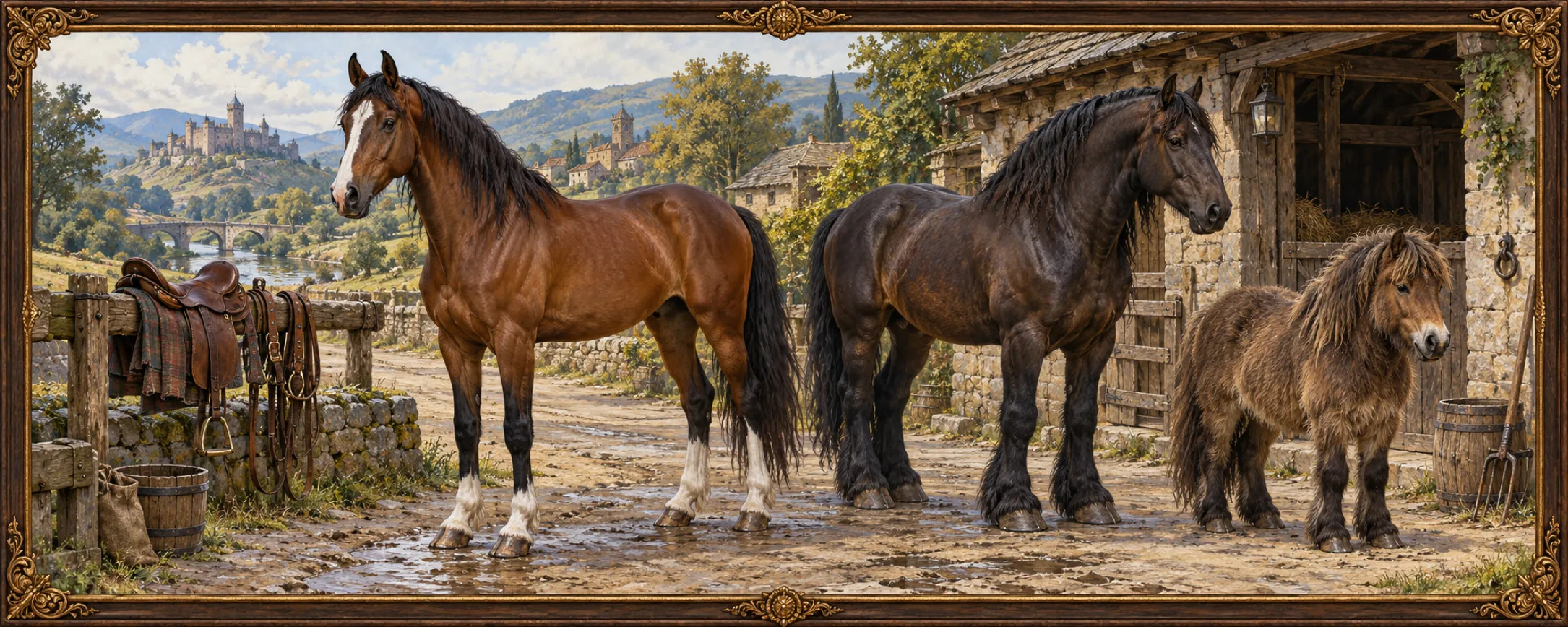
Horses
Horses are the riding beasts of the Cradle web. A horse is speed and rank: couriers ride them on urgent dispatch, lords and their sworn riders go to war on them, and a clerk who can borrow one for a day’s journey counts himself lucky. Few ordinary farmers own one; the plough is the ox's work, and the mountain road is the mule's.
Appearance
A riding horse stands about as tall at the withers as a Human’s shoulder, long-legged and deep-chested, with a long head, a flowing mane and tail, and a coat of bay, chestnut, brown, grey, or black, often with a white blaze or white socks. War horses are heavier in the neck and haunch and bred for nerve rather than speed. The hill ponies of the Headwater valleys are a hand or two lower, thick-maned, and shaggy in winter.
A horse walks with a nodding head, trots in a two-beat jog, and runs at a gallop that shakes the ground. It whinnies across a field, snorts at what it does not trust, and blows softly into the hand of someone it knows. A stable smells of hay, sweat, leather, and dung.
Habitat and Range
Horses are kept in stables and paddocks wherever there are roads and lords: in the towns and lordships of the Confluence Basins, along the Serath, at the carters' inns of the Greyford Reach, whose big yards have stabling, and in the foothill towns of the Headwater roads. The outer halls of the Ironspine holds keep stables for visitors' beasts. There are no wild horses in the Cradle web.
Behaviour and Temperament
A horse is a herd animal and a prey animal. It is alert, quick to startle, and calmer in company than alone. Trained well, it is willing and steady and learns its rider’s voice and weight; trained badly, it bites, kicks, and bolts. It will not willingly walk onto a surface it does not trust, which is why riders lead their horses over bad bridges. A frightened horse forgets all training.
Abilities
A horse can be bonded to its rider closely enough for magic to use the bond. Beast Tether, a whistled bond call, brings a trained mount by the safest route, so a rider trapped in a ravine can summon her horse after a skirmish scatters the column; it cannot override terror, injury, or a severed bond. Slipstream lightens the drag on a moving mount so dispatch riders cover ground with less fatigue, and Thunderwake trails rolling shock behind a cavalry charge to break pursuit.
Life Cycle
A mare carries her foal for eleven months and drops it in spring. Foals stand within the hour and are weaned at half a year. A horse is broken to saddle at three or four, is in its prime from five to fifteen, and may live to twenty-five or more if it is not worked to death first.
Uses and Dangers
Horses carry riders, messages, and small loads, pull light carts and coaches, and win battles. Their hides, hair, and hooves are used when they die; their meat is eaten only in hard times in most places. A horse is costly: it eats grain as well as grass, needs shoeing, and falls sick easily.
Cavalry is feared enough that several schools keep answers to it. Backbone Magic can turn a cavalry lane into a field of stone fangs, and Crucible Magic’s Glassflash fuses sand into blinding flashes, a desert fighter’s answer to riders. At Greyford the toll is taken by the head, so a rider pays for herself and her mount alike, and pays again if the men at the ford think she can.
Lore and Belief
Humans name their horses, and a good horse’s name is remembered after its rider’s. A horse that shies at nothing on an empty road is believed to have seen what the rider cannot, and riders turn back rather than force it on.
Horse-thieves are the commonest outlaws of the roads and are hanged where they are caught, and the great raids of the march country are remembered by the horses taken. A good horse is sung too: the grey mare that carried her dying rider home through a raider ambush and would let no one else near him.