Oxen
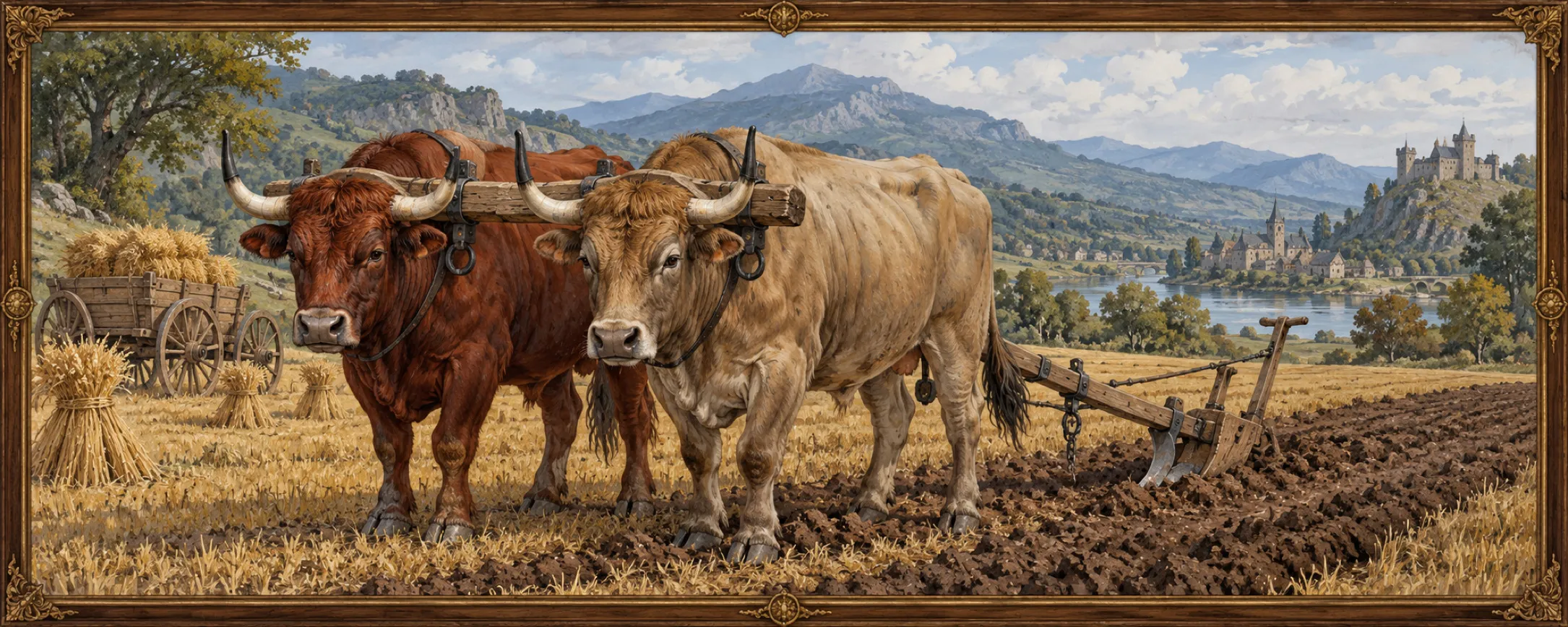
Oxen are cattle gelded and trained to the yoke, the plough-beasts of the Human farmlands. Every spring the basin fields are turned behind them, and at harvest they draw the grain carts along the Sheaf Road to the granaries. A village’s oxen are often held in common or lent between households, and a farmer without a share in a plough-team is a poor one. They are reckoned apart from milk and beef cattle, though they come from the same herds.
Appearance
An ox is a big steer grown to full size: taller and heavier than any cow, broad across the shoulder and the brow, with a thick neck worn bare where the yoke sits and long horns, sometimes tipped or tied to keep them from goring a yokemate. Most basin oxen are red-brown or dun, a few pied; a matched pair is prized. They walk at a plodding, even pace that never quickens, heads low, breath steaming in the cold. They low and grunt rather than bellow, and the creak of the yoke and the drover’s call carry further than any sound of theirs. A plough-team smells of turned earth, sweat, and dung.
Habitat and Range
Oxen work wherever the ground is ploughed: the open fields of the Confluence Basins above all, the terraced fields of the Headwater valleys in smaller teams, and the farm roads and grain roads that link them. They are stalled in winter beside the cattle and grazed on the common meadows in summer.
Behaviour and Temperament
An ox is calm, slow, and stubborn. Trained young, it learns a handful of calls and the touch of the goad, and works steadily for hours without complaint; driven too hard or too long, it lies down in the furrow and will not rise. A pair yoked together for years will pull badly with any other partner. Oxen do not startle as horses do, which is why they are trusted with heavy loads on soft ground.
Life Cycle
Oxen are chosen as calves from the herd, gelded in their first year, and broken to the yoke at three or four. They work for eight to twelve years, and when they are too old to pull they are fattened and slaughtered for beef and hide.
Uses and Dangers
Oxen plough, harrow, and draw heavy carts, stone, and timber. They are slower than horses but cheaper to keep, eat rough grass and straw, and give meat and leather at the end. At harvest the basin grain goes out behind them, and the road from granary to march-town is a line of ox-carts; heavier loads still go to Ogre bands. Their cost is time: a team ploughs only so much in a day, and a sick ox in spring can lose a household its sowing.
Lore and Belief
Basin farmers bless the plough-teams at the first ploughing, and the Festival of the First Sheaf, given to Anvelle the Harvest-Mother, ends with the oxen garlanded and fed first. "Patient as an ox" is praise in the Basins and an insult in the towns.
Battle tales tell of a transmuter who turned a siege ogre into a plodding ox with Other-Form long enough to break an assault. The working is real, risky to body and mind, and much less often done than told.