Otters
Otters are the river’s own hunters, at home in the water on both sides of Caeldon. They fish the side channels and the weirs, rob traps, and play on the banks. Lowbank’s Goblins skin them for their fur; Kavari pool-keepers argue with them about the fish as with neighbours; and Gnome fishers on the far-side coasts find them in the kelp.
Appearance
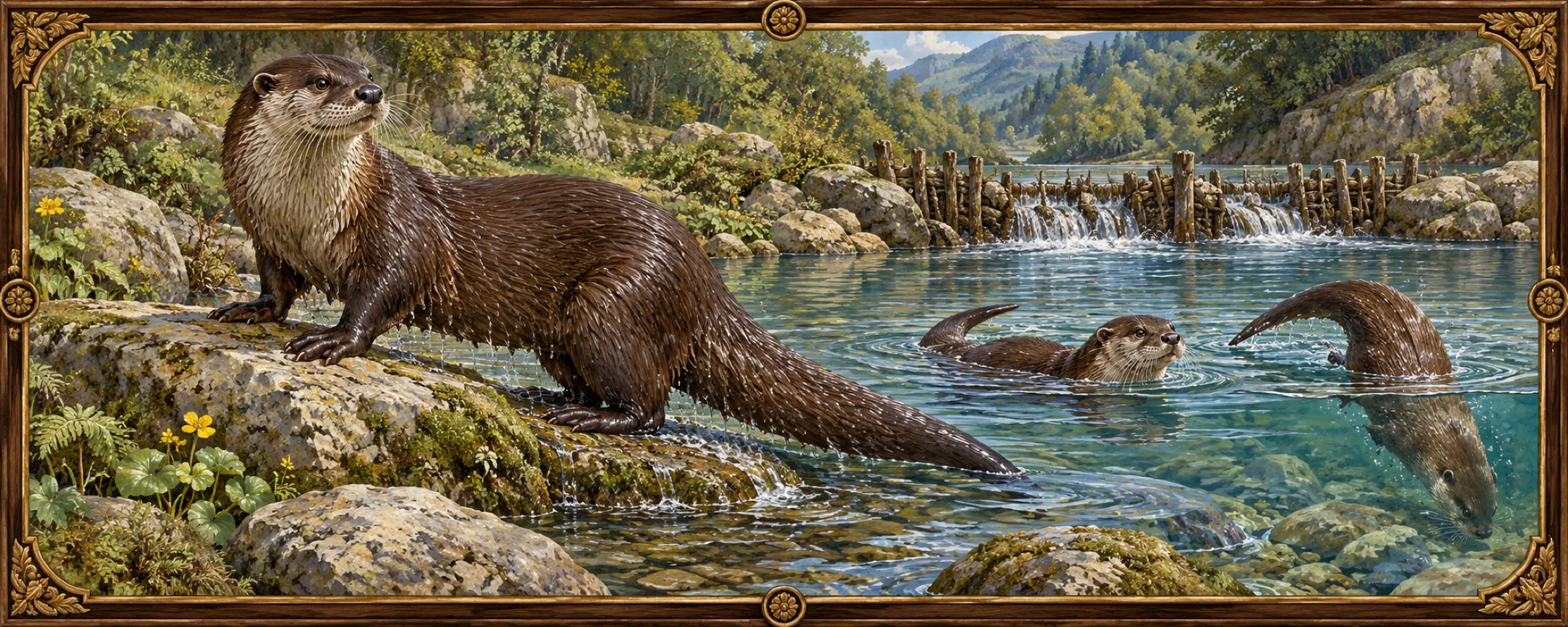
An otter is as long as a Human’s arm, with a thick tapering tail as long again, a flat broad head, small ears, and a whiskered muzzle. Its body is long and supple, its legs short, its feet webbed. The fur is dense, rich dark brown, paler and silvery at the throat, and so close that water runs off it. Wet, an otter looks sleek and black.
It swims low, with only its head showing, and dives with a roll that leaves hardly a ripple. On land it lopes with an arched back. It whistles shrilly to its kin, chitters, and hisses. Its spraints, the dung it leaves on stones, smell oddly sweet, of fish and new-mown hay.
Habitat and Range
Otters live along clean rivers with fish and cover: the side channels and willow islands of the Greyford Reach and the rivers of the Confluence Basins. On the far side they live in the gravel rivers of the Kavari in the Tidebound Reaches and the rocky shores and kelp of the Tidelace Coasts. Each holds a long stretch of water.
Behaviour and Temperament
An otter hunts fish, eels, crayfish, frogs, and on the coast crabs, mostly at dusk and by night. It robs eel traps and fish weirs and learns which traps are easy. Otters are playful, sliding down mud banks and wrestling in the water, and curious about people when they think themselves unseen. A mother with cubs is fierce.
Life Cycle
A female bears two or three cubs in a holt, a den among tree roots or rocks at the water’s edge, and teaches them to swim and fish over a year. Otters live perhaps ten years.
Uses and Dangers
Otter fur is the warmest and most waterproof the river gives, made into caps, collars, and mittens. Lowbank Goblins trap and skin them, as much to protect their eel traps as for the pelts. The cost is fish and eels taken from the traps. They are harmless to people.
Lore and Belief
Kavari pool-keepers treat otters as neighbours who keep no agreements: they speak to them, scold them, and set aside a share of the catch to keep them from the nursery pools, and they do not kill them. Goblins say an otter can always find the way out of a trap, so a trap that holds one is a trap that needs mending. Gnomes say an otter floating on its back among the kelp at dawn means fair weather.