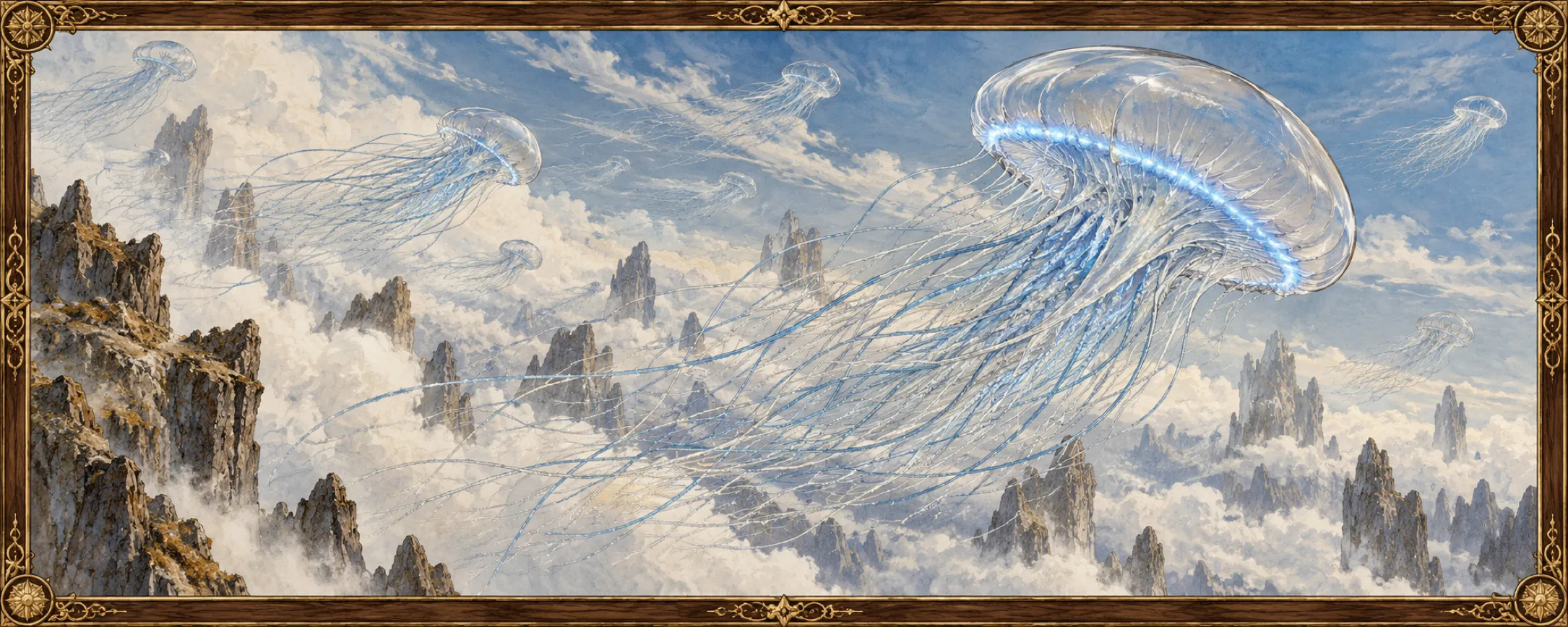
Gale Jellies
Gale Jellies drift on the winds of the Unbound Gale as jellyfish drift in the sea. Their bells are filled with air and their threads trail far behind them, and anyone the wind sweeps into a swarm is stung.
Appearance
A Gale Jelly’s bell is the size of a shield, clear as glass and almost invisible against the plane’s pale sky, with a faint silver rim and a pulse of blue light that runs round it as it breathes. Beneath it hang threads, fine as hair and many times the length of a rope, pale blue and glittering. The bell swells and shrinks as it rides the wind. A swarm sounds like nothing at all until it is close, when the threads hum faintly in the gusts. They smell of ozone and of the sea, though there is no sea on the plane.
Habitat and Range
They drift across the open air of the plane in swarms of dozens to thousands, carried by the currents, and gather thickest where currents meet and slow.
Behaviour and Temperament
A jelly does not hunt. It drifts, and its threads take whatever the wind blows into them: the small creatures of the air, flying things, and travellers carried helplessly along. The threads sting, the prey stops struggling, and the threads draw it up to the bell. They cannot turn against the wind, only rise and sink a little by filling and emptying their bells.
Abilities
Their sting numbs. A light brush leaves a burning line and a dead arm for hours; a wrapping can stop a body’s breath. On a plane where a traveller stays aloft by the will to move, a stung traveller who loses the will can be scattered by the turbulence or held still, and stillness on the Gale is its own danger.
Life Cycle
They bud from the rims of older jellies, and a swarm is mostly one family. They live as long as the wind keeps them aloft. A jelly that is held still too long, caught on a floating island or in a Gust-Caller’s barrier, collapses into a glassy skin and is blown away.
Uses and Dangers
Their threads, dried, are said to numb pain, and some travellers bring them home for healers; they lose their sting within days. The Wind-Walkers read swarms as weather, since a thickening swarm shows where currents are about to meet, and travellers learn from them to look for the silver rims and the blue pulse, and to steer by will around a swarm while there is time.