Root-Borers
Root-borers are grubs that live inside the living root that carries the ceilings and walls of the Roothollows. Where they feed, the root dies: it stops glowing, goes grey, and stops holding, and its chamber loses its bracing and its air together. A Dark Elf house fears them more than flood, because flood comes and goes and a borer stays. Houses pay finders to hunt them.
Appearance
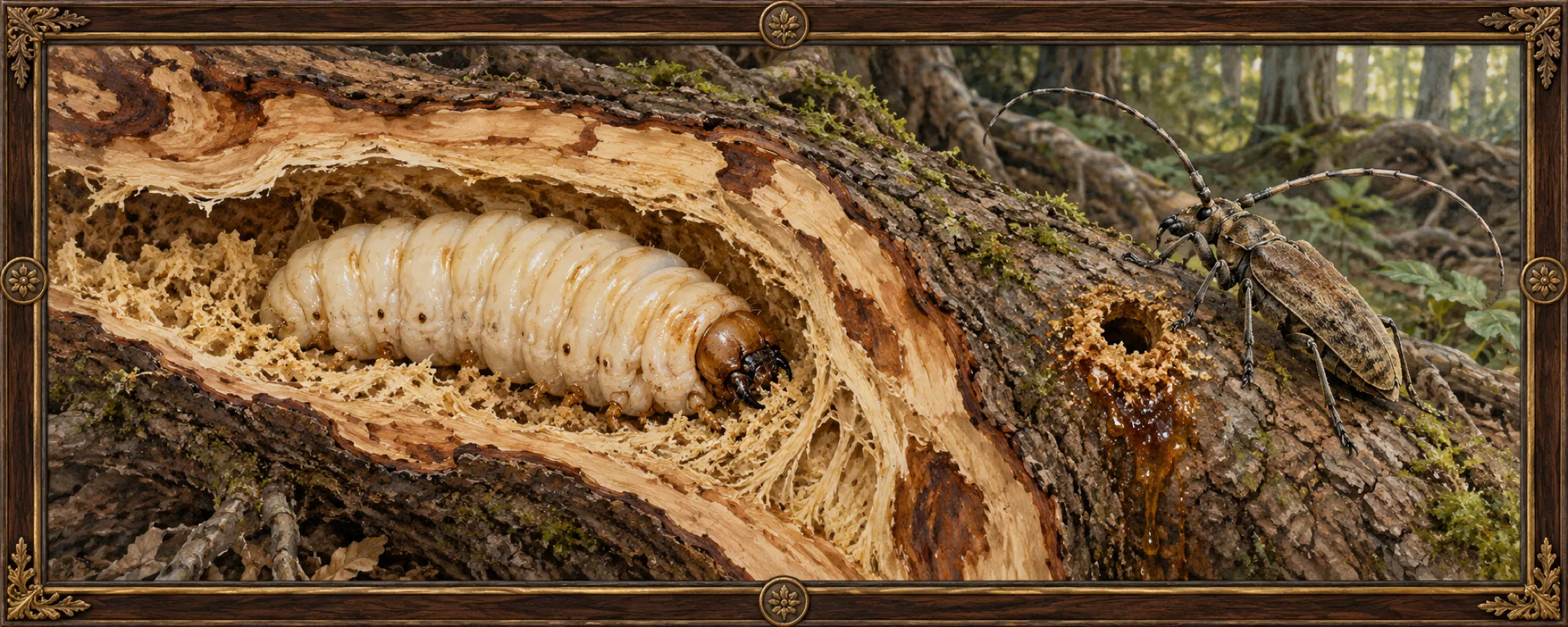
A root-borer is a fat, soft, legless grub as long as a finger and as thick as a quill, ringed and creamy-white, with a hard brown head and black jaws. It lies curled in a tunnel the width of its body, packed behind it with pale chewed fibre. The grown insect, seldom seen, is a long-horned beetle the length of a thumb, dull grey-brown and velvety, with feelers longer than its body. Its sign in the root is small: a hole ringed with damp frass, a patch where the gloam has faded, and sap that weeps and darkens. A finder with an ear to the root can hear a big grub chewing, a faint wet crunch.
Habitat and Range
They live only in living root, and only in the Roothollows' upper chambers where the root still carries sap. Dead root, bare stone, and the Deeps below are free of them. They are thickest where root is old and stressed: chambers near failed seeps, root bruised by a collapse, and the edges of the Sealing bars, where no one has tended the root for ages.
Behaviour and Temperament
A grub bores along the root’s sapwood, eating as it goes, for years. One grub does little. A brood in the same root cuts the sap from everything beyond it, and that length of root dies. The beetles fly to old wounds in the root to lay, so a root that has once been bored is bored again.
Life Cycle
The grub lives three to five root-years, by Dark Elf count, in its tunnel, then cuts a chamber near the surface and turns to a beetle, which chews its way out in the rising sap of the forest’s spring, mates, lays in a scar of living root, and dies within the season.
Uses and Dangers
They give nothing. Their cost is root, and root is a house’s chambers, its air, its fungus beds, and its dead, who lie in the root-chamber against the living root. A wall going grey can take years to fail. Finders, who are paid by the grub, walk a house’s chambers with lamps hooded low, listen at the root, and dig the grubs out with hooked irons, then seal the wound with fungus paste. A good finder is welcome in any threshold chamber and is admitted further than most guests. Grubs are fried and eaten in lean years.
Lore and Belief
Dark Elf children are told that borers come to a house that has forgotten its dead, and the dead in the root-chamber are spoken to whenever a grub is found near them. Some houses say a finder who takes too many grubs from one root has been feeding them elsewhere to keep the work. Most believe the gloam fades before the borer comes, as a warning; in truth it fades because the borer is already there.
A root that the borers have hollowed can fall in a night and take a sleeping house with it, and the old tale of the house that woke to the root’s groan and got out with nothing but its children is told whenever a grub is found.