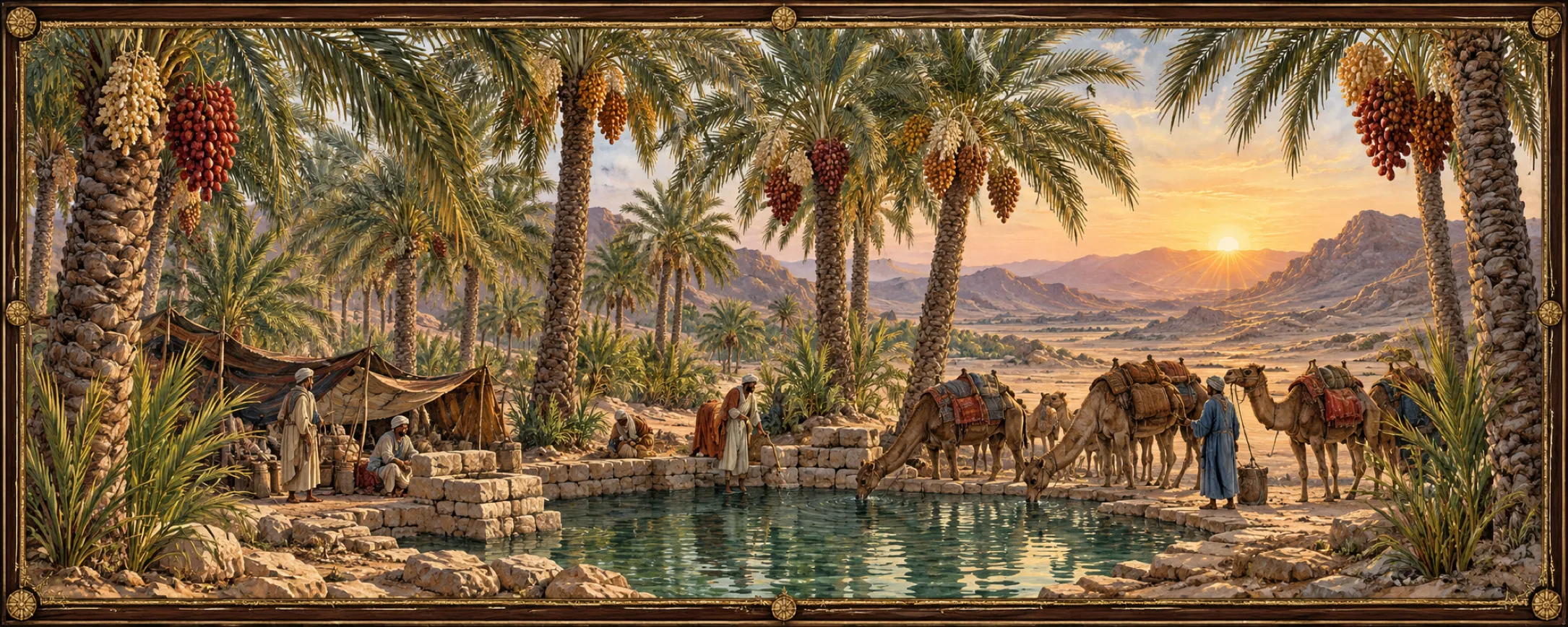
Well Palms
Well palms grow only where their roots reach water, and so they mark it. A stand of their feathered crowns on the horizon of the Glassbelt means a caravan well or a spring, and the end of a hard day; a dead stand, grey and headless, means the well has failed. They give the crossers dates, shade, fibre, and wood, and they stand over the shade sanctuaries where crossers rest through the heat.
Appearance
A well palm is a single, unbranched, rough-ringed trunk, grey-brown and covered in the stubs of old leaf-bases, rising three to six storeys and topped by a crown of long, stiff, feather-shaped fronds, grey-green and rattling in the wind. Young palms throw suckers round their foot, so a stand is often a thicket of trunks of every height. In spring the female trees hang heavy sprays of small cream flowers among the fronds, and by late summer these are bunches of oblong dates, as long as a thumb-joint, ripening from yellow and red to a sticky, wrinkled brown. A stand’s shade is cool and smells of dust, sweet fruit, and water.
Habitat and Range
They grow round the caravan wells and the rare springs of the Glassbelt, round its shade sanctuaries, and at the springs and deep wells of the rim spurs of the Rimward Basins, the Lastwater Wells among them. Each stand is small, a few dozen trees at most, and every one on the crossing is known and named.
Behaviour and Temperament
A well palm drinks deep and much. Its roots go down to the water under the well and keep its crown green through the hottest months, and when the water drops beyond its reach the stand dies from the top, the fronds browning and falling first. Crossers read that as surely as the well-rope.
Life Cycle
A palm grows from a stone or from a sucker, bears within some years, and can bear for a century. Female trees bear dates; male trees bear the pollen, which keepers carry by hand to the female flowers to be sure of a crop. A dead trunk stands for years.
Uses and Dangers
Dates are the crossers' food: sweet, dense, and keeping for months dried and pressed into blocks. Custodians and well keepers tend the stands at the wells, climb them to pollinate and harvest, and share the dates under the same counted rules as the water. Fronds roof shade shelters and are woven into mats and baskets; the leaf-base fibre makes rope for well buckets; the trunk of a dead palm gives the only timber for days. Crossers of the Edgeway Kindreds plant a date stone at a well they have drunk from.
They harm no one, though a frond-base spine through the foot of a careless climber festers, and a falling bunch of dates has broken a head.
Lore and Belief
Crossers say a well palm is a promise made by those who crossed before, and cutting one is held a great wrong anywhere on the crossing. A dead stand is not cut down but left standing as a warning. Rimward Orcs count a well’s palms among its custodians, and a custodian line is said to keep its water as long as its palms keep their heads.
Raiders who cut a well’s palms to break a rival line are hunted by every line on the crossing, and every well-line knows of one who did and was staked out under the dead stand he made.