Seabirds
Seabirds crowd the cliffs and isles of the far-side coast. On the Tidelace Coasts and along the Soundchain Roads their eggs are part of ordinary food, beside fish, shellfish, kelp, and terrace crops, for Gnome households and the Orc escort parties that camp above the beach yards. Their names are on the coast itself: the Gullstair, the corridor’s busiest cliff descent, and Gullhead, the camping ground at its top.
Appearance
Gulls
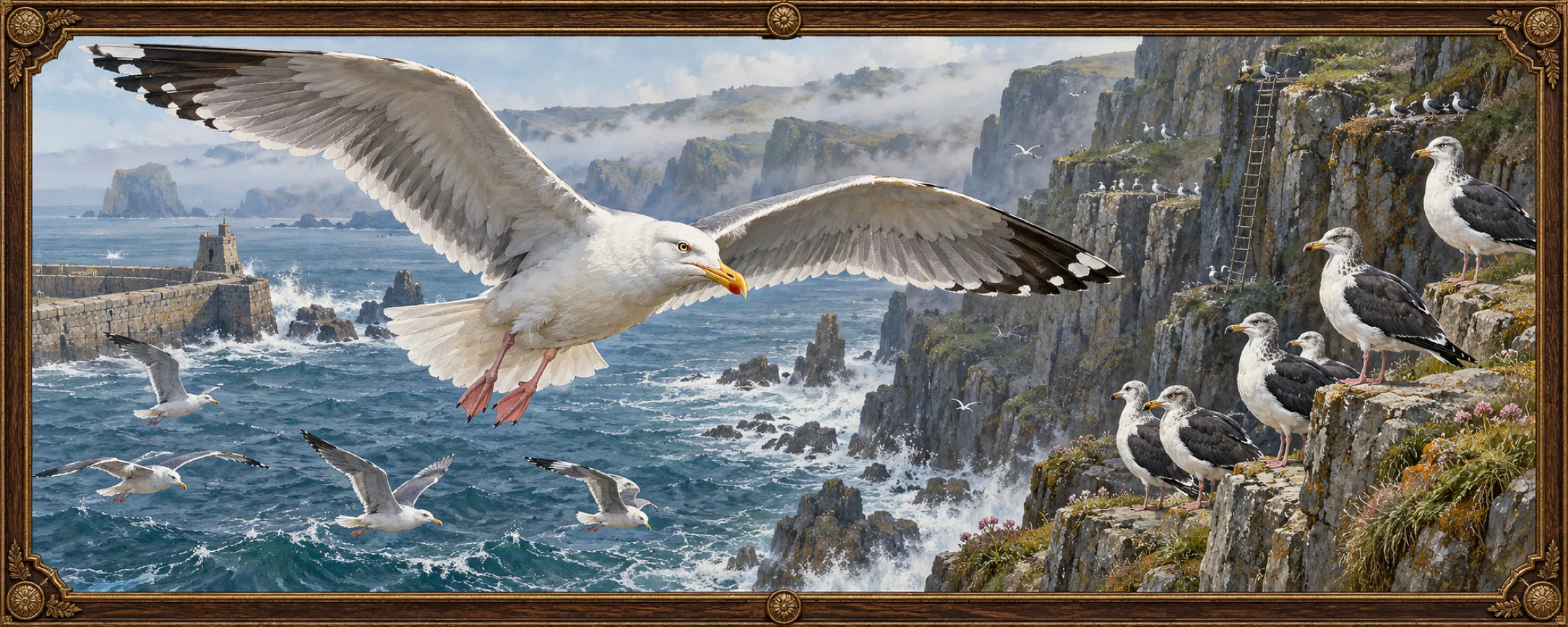
The gulls are big, loud, and everywhere: white-bodied birds with grey backs and black wingtips, a heavy yellow bill with a red spot near its tip, pale fierce eyes, and pink legs. A grown gull spans more than a Gnome’s height from wingtip to wingtip. They wheel over quays and drying racks, stand in rows on breakwaters, and call in long, laughing cries that carry through fog.
Cliff Birds
Below them on the ledges nest the smaller cliff birds, upright and dark-backed with white breasts, the size of a large hen, standing shoulder to shoulder on rock so narrow their eggs are pointed at one end so they roll in a circle and not off the edge. They fly low and fast over the water on whirring wings and dive for fish. A colony’s noise is a steady growling, and its smell, of guano and old fish, reaches a boat long before the cliff comes out of the fog.
Habitat and Range
Seabirds nest on the sea-cliffs and sea-cut terraces of the Tidelace and on the offshore isles, in colonies of thousands, and feed in the sounds and straits and on the shoals. Gulls follow people and live off quays, boats, and racks as well as the sea. The Long Grey, the great fog belt of the outer coast, does not drive them off; they call through it.
Behaviour and Temperament
Gulls are bold thieves, quick to take fish from a rack or a hand, and quarrelsome among themselves. Cliff birds are shy of people except at the nest, where a colony will rise in a shrieking cloud around anyone on the ledges and strike at the head. All of them follow the fish, and a sound full of diving birds is a sound full of fish.
Life Cycle
The birds return to the same ledges each spring and lay a single egg or a small clutch. The young grow fat on the ledge and leave it in late summer, and by the storm season most of the cliff birds have gone out to sea, leaving the gulls behind.
Uses and Dangers
Their eggs are a spring food, gathered from the ledges by climbers on rope and hand-hold. Gnomes, sure on stairs, quays, and wet rock, take them from the nearer cliffs; gatherers keep to known ledges and take only part of each colony’s laying, so that it returns. Eggs are eaten fresh in season and are not a trade good. The danger is the cliff, not the bird: a slip on guano-wet rock, a rope frayed on an edge, or a colony rising at a climber’s face.
Lore and Belief
Gnome pilots read birds as they read water, and a sound where the birds sit thick is noted in a pilot’s mind if not in the ledger. Coastal Humans say the gulls' cry before dawn means wind, and they leave a fish on the shingle for them at the shrine of Maris of the Tides after a hard passage. Orc escorts coming down the Gullstair know they are near the sea by the birds before they see it.
Egg-gatherers go down the cliffs on ropes every spring, and every colony has its tale of the gatherer whose rope was cut by a rival and of the feud that followed for three generations.