Grain
Grain is the wealth of the Confluence Basins. On their deep soil a good year feeds far more than the village that grew it, and the surplus becomes bread, porridge, and ale for the corridor towns, the levy on which lords' power rests, the cargo of the Sheaf Road and the Serath barges, and the stores the Headwater towns send up to the Dwarven holds. When basin people say grain without a name they mean the bread wheat of the lowlands, though rye and other grains are sown beside it on poorer ground. The hill valleys grow barley and oats instead. On the far side, the Halfling folds and the Rimward strongholds grow small hardy grains of their own on watered terraces.
Appearance
Basin wheat
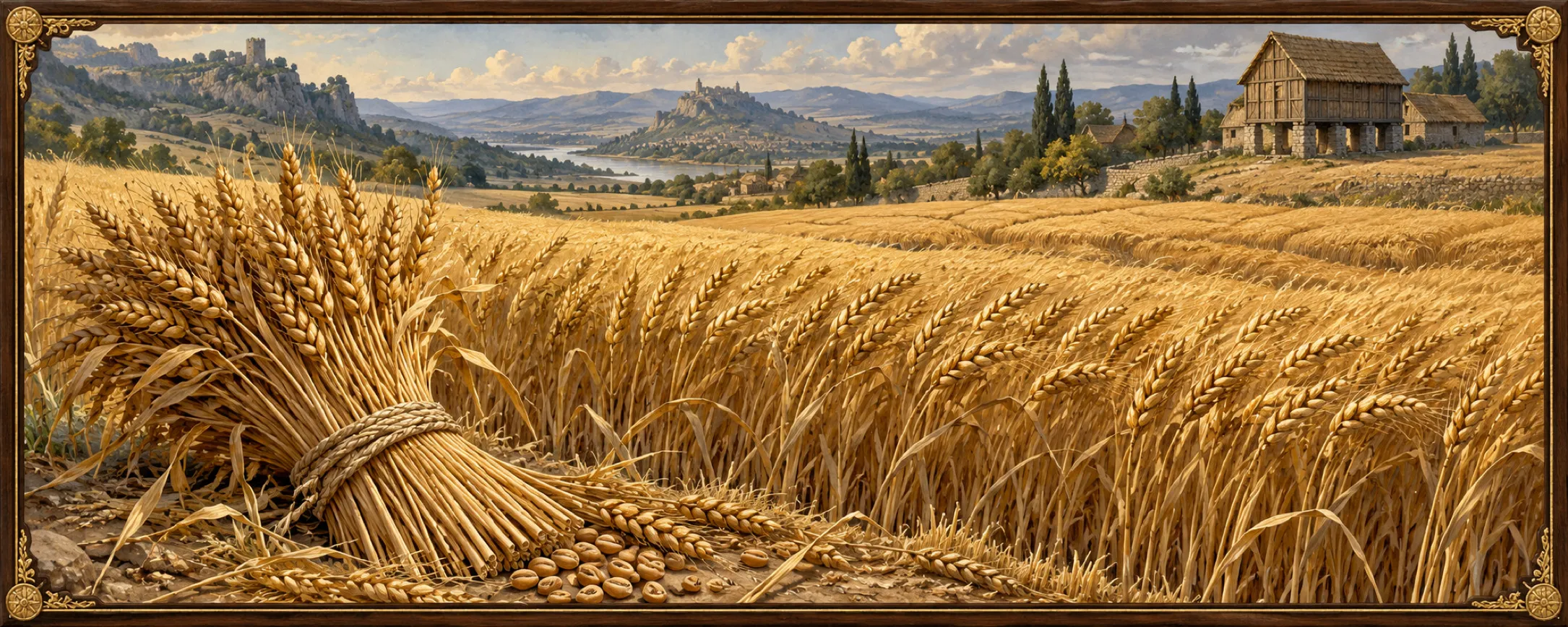
Basin wheat stands waist high on a jointed golden straw, with long narrow leaves that are blue-green in spring and dry to rustling paper by harvest. Each stalk carries a single close ear, plump and four-sided, beardless or short-bearded, ripening from green through gold to a deep tawny brown. A field near harvest moves in long waves under the wind and makes a dry, continuous hiss, the sound the basin says is the Harvest-Mother’s voice. The grain itself is hard, oval, and creased down one side, pale gold to reddish, and threshes clean of its husk.
Rye and the poorer grains
On sandy rises and tired ground farmers sow rye, taller than wheat, with a thin bearded ear and a grey-green bloom on the stalk, and dark heavy bread to show for it.
The far-side terrace grains
The grain of the Leeward Folds grows on the valley floors below the orchards, short and stiff-strawed, sown thick and reaped by hand. Below the cisterns of the Rimward Basins the hardy grain is shorter still, a tough, small-eared grain that ripens on little water and is cut green-gold before the dust storms, grown beside fodder on strict water shares.
Habitat and Range
Basin wheat grows across the broad valleys of the Basins, on fields running down from the village rises towards the water. Most villages keep a granary at their centre with the threshing floor beside it, and the great march-towns, Sheafmeet above all, with its three mills and a granary larger than some villages, are where the harvest is reckoned, sold, and shipped. It goes downstream by barge at harvest to the Lower Serath, which eats the Basins' grain, and up the Sheaf Road to the Headwater Marches and the holds of the Ironspine. Stored grain goes out from the Leeward Folds only from what lies beyond the counted reserve, to the Gnome harbours, the Rimward strongholds, and the escort trade of the High Scars.
Behaviour and Temperament
Wheat is demanding. It wants deep soil, steady rain in spring, and dry heat at harvest, and it gives most on ground that has rested. Sown again and again on the same field, it tires the soil: yields fall, the ears come thin, and the field fills with weeds and blight. Basin custom answers with the fallow year, the rest-year that the farmers who keep the Harvest-Mother hold to. The second harvest that corridor demand forces on basin fields is that tiring made policy, and the failing districts show it.
Life Cycle
Basin wheat is sown once the spring rise falls back from the fields, weeded through the summer, and reaped in late summer with sickles, bound in sheaves, stooked in the field to dry, and carted to the threshing floor. Threshing with flails and winnowing in the wind run into the autumn. Seed for next year is kept back first, before the lord’s share is counted, and farmers prove after a hard winter which of their seed still lives.
Uses and Dangers
Grain is bread, porridge, and ale: the staple of Humans across the river country, and of most of the corridor. It is also money. Lords hold land and levy a share of every harvest, counted on the same threshing floor as the village store, which is where most basin quarrels start. The corridor’s appetite outruns what the fields can safely give, and lords sell to the highest buyer. A Headwater town that has sworn grain to its hold in the hold’s oath-yard can be ruined by a short basin harvest.
Its dangers are the dangers of stores and of hunger. Rats and mould take a granary from inside; fire takes it whole. Warders put the Pest Bar on grain stores to keep the rats out through the winter, Nature Magic wakes a seed in the palm to show whether a store is still viable, and merchant houses buy and sell on the strength of an augur’s auspice. A failed harvest means hunger before spring, and the basin’s oldest tale is of the winter when half the villages starved.
Lore and Belief
Anvelle the Harvest-Mother is the grain’s god. Her symbol is a sheaf of golden wheat bound with a ribbon of living green vine, her hair is ripening wheat, and at the Festival of the First Sheaf, at the beginning of harvest, the first stalk of wheat is cut and offered to her in every village that keeps her; if the offering is sincere, she will see the year’s harvest through. Her farmers read crops that wither overnight as her warning against the second harvest, and in some of the oldest basin fields the wheat grows in patterns that form faces and symbols, which locals call her signs. The Starving Winter, when the people refused to rest the land and she withdrew her blessing, is told more often wherever levies rise.
On the far side, Tamsel the Season-Weaver wears summer grain in their hair, and Halflings name grain beside fruit among what a fold must hold back.
A granary is the first thing raiders burn and the last thing a besieged town eats, and the songs of the Basins remember the famine years after a war more bitterly than the war.