Ward-Hounds
A Ward-Hound is a guard dog made of conjured force and bound to a threshold. A ward-maker first defines the doorway or boundary with a Threshold Mark of Warding, and a conjurer then binds a hound-shaped construct to that clean edge. It sleeps in the mark until someone crosses without leave, and then it is there.
Appearance
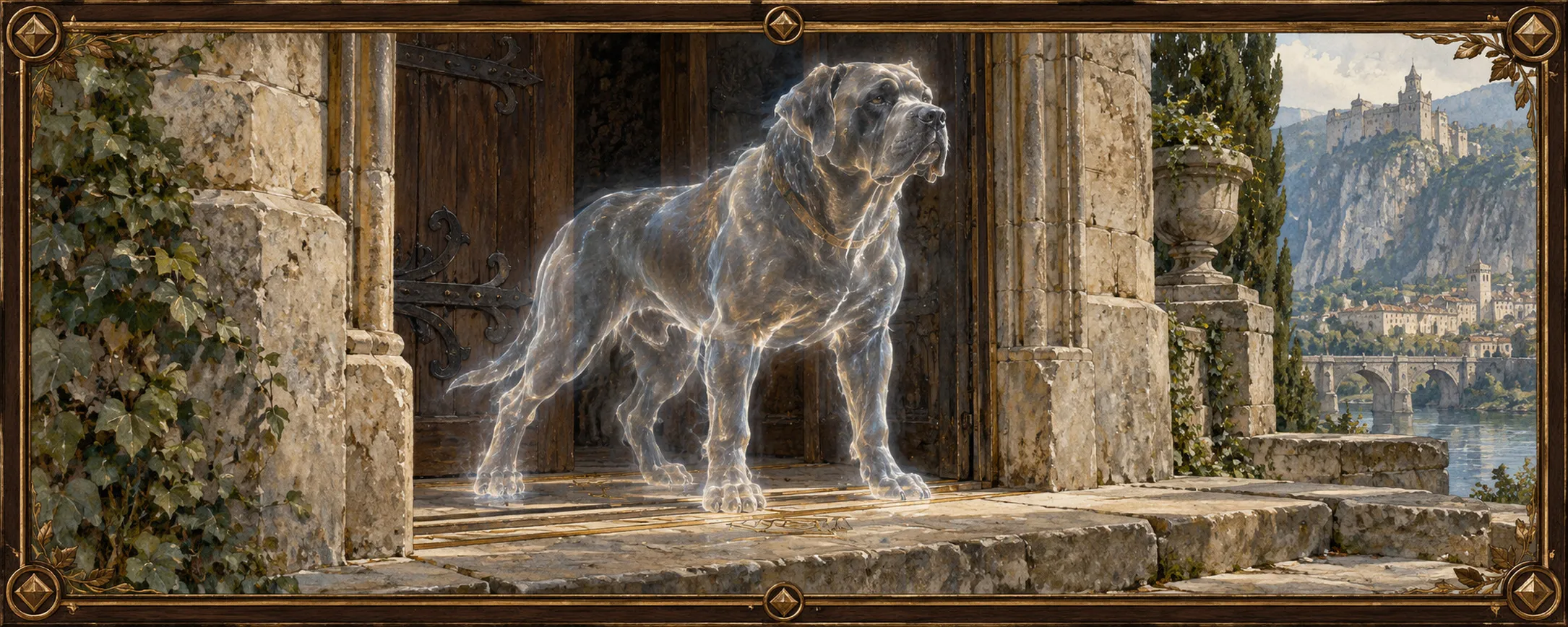
At rest there is nothing to see but the mark itself, cut or inlaid in the sill or the stones. Roused, the hound gathers out of the air above the mark in a breath: the shape of a big mastiff, shoulder-high to a man’s hip, made of a faint, shifting shimmer like heat over a road, with a darker density where the jaws and forequarters are. In dim light it shows as a pale outline; in bright light it is hard to see at all. It makes no bark, only a low sound like a growl heard through a wall, and it has no smell, which dogs find terrifying.
Habitat and Range
They guard the thresholds of those who can pay ward-makers: mage households, the vaults of merchant houses and temples, archives, strongrooms, and Dwarven treasuries, wherever the House of Thresholds, the Vaultward Archive, or their like are hired.
Behaviour and Temperament
A Ward-Hound knows who has leave by the terms its makers set, a token, a word, a person, and ignores everyone who has it. Anyone else who crosses the mark it bars, knocks down, and holds, pinning them at the threshold until the household comes. It never goes beyond the boundary it is bound to: an intruder who gets back over the mark is free of it, and it fades.
Abilities
It strikes with the weight of a large dog and holds like a vice, and blades and arrows pass through it with little effect, though it weakens when the mark under it is damaged. It needs no feeding and does not sleep; it rests in the mark and draws on the mark’s stored charge.
Life Cycle
It lasts as long as the Threshold Mark holds and is renewed, which for a well-kept ward is years. When the mark fades, is broken, or is left unrenewed, the hound goes with it, and a neglected ward’s hound grows faint and slow before it fails.
Uses and Dangers
It is a guard that cannot be bribed, poisoned, or distracted, and a household with a good one sleeps easily. Its dangers are its terms. A servant whose token is lost, a child who wanders in, or an heir after a death whose leave was never written are treated as thieves, and many a lord’s hall has heard of ward-hounds that held the wrong person all night, and of the household that paid nothing for it. Thieves learn to break the mark rather than face the hound.
Lore and Belief
Folk call a house with ward-hounds "a house with quiet dogs". They say a ward-hound is the ghost of a real dog that died guarding the house, and some households bury their old dogs under the sill for that reason; the hound is a construct, and nothing of any dog is in it. Real dogs will not cross a ward-hound’s mark, and a dog that whines at a door is often the first sign a household gets that the ward has been laid.
Thieves say a warded strongroom is the one job not worth the gold, and the tale of the burglar found at dawn on a merchant’s sill with silent teeth-marks in his throat and nothing taken keeps most of them honest.