Sparrows
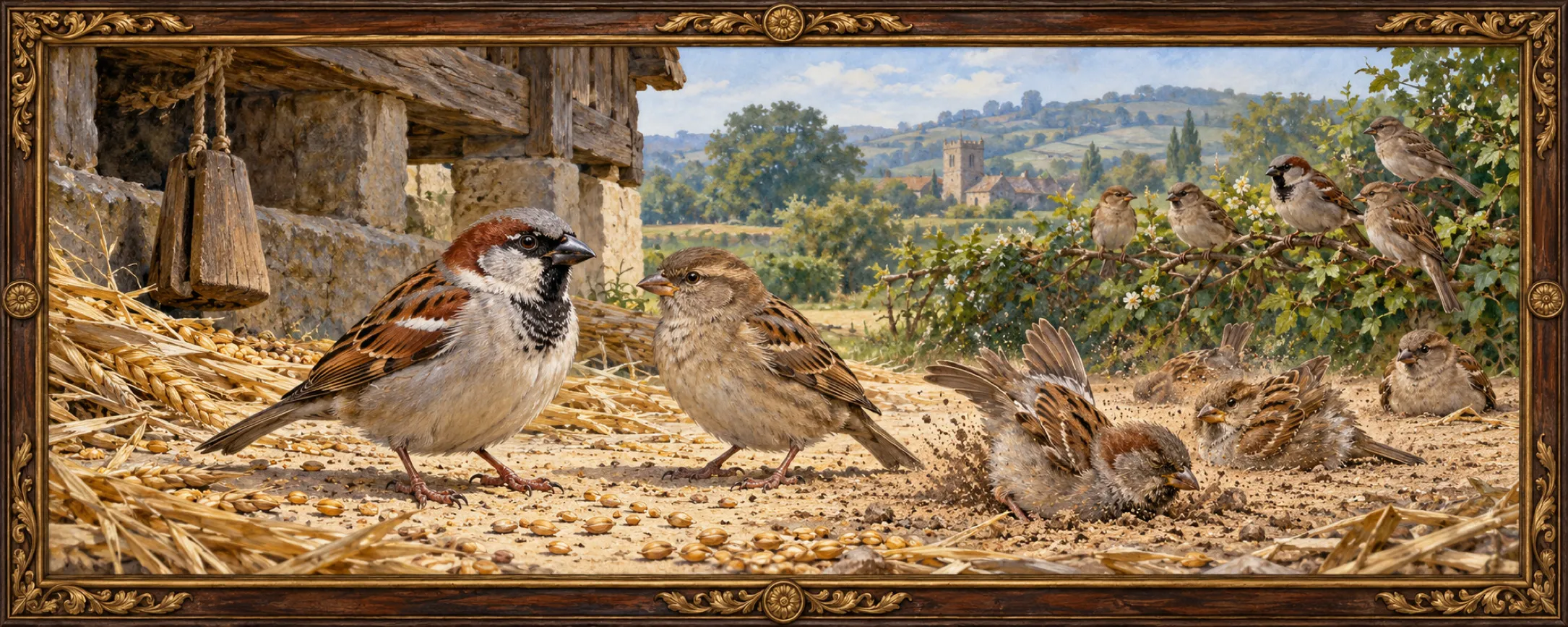
Sparrows live wherever people grow and store grain, and nowhere else in such numbers. They nest in eaves and thatch, steal from the threshing floor, and squabble on every farmyard wall. In the Confluence Basins, where the granary is the centre of village life, keeping sparrows off the floor at threshing time is children’s work.
Appearance
A sparrow is a small, round, stout-billed bird that sits easily in a palm. The cock is chestnut and grey with a black bib under his chin and a grey cap; the hen is plainer, streaked buff and brown. Both have short tails, quick legs, and an unending, cheerful racket of chirps that rises to a roar when a flock settles in a hedge. They hop rather than walk, fly in short whirring dashes, and take dust baths in dry corners of the yard.
Habitat and Range
They live in villages, towns, farmsteads, and around mills and granaries, in every farmed country of the cradle-web and the far side. Wherever a village is abandoned, the sparrows leave soon after the people do.
Behaviour and Temperament
Sparrows eat seed above all, the spilt grain of the threshing floor, the yard, and the field at harvest, and feed their young on insects. They are bold, sociable, and noisy, live in flocks outside the breeding season, and will come within arm’s length of a quiet person. A flock settles on a threshing floor in moments and lifts off together at a clap.
Life Cycle
A pair builds an untidy nest of straw and feathers in a hole under the eaves, in thatch, or in a wall, and raises two or three broods a summer of four or five eggs each. Most live only a year or two.
Uses and Dangers
In a big flock sparrows take a share of every harvest, from the ripening heads in the field to the grain on the floor and the open sacks in the granary. Children are set to scare them with wooden clappers and shouts through the threshing days. Poor households net them in winter and roast them a dozen at a time, and a sparrow caught with a hair snare is often a child’s first catch.
Lore and Belief
A sparrow is a common small offering at field shrines, given whole at the threshing in thanks for the grain the flock did not take. Basin villages that keep Anvelle the Harvest-Mother say the sparrows are her poor, and that a household which never leaves them a scatter of grain will find its own store short. A sparrow nesting in a new house is taken as a sign that people will live in it long.