Barley
Barley is the grain of hard ground. Where the basin valleys narrow into foothills and mountain terraces, the deep-field wheat of the lowlands gives way to a shorter, quicker crop that ripens in a high summer and stands up to a thin soil, and barley is the one the uplands live on. Human households of the Headwater Marches grow it beside oats, Dwarven farmsteads below the holds of the Ironspine grow it beside roots, and the bread and pottage made from it feed the roads between them.
Appearance
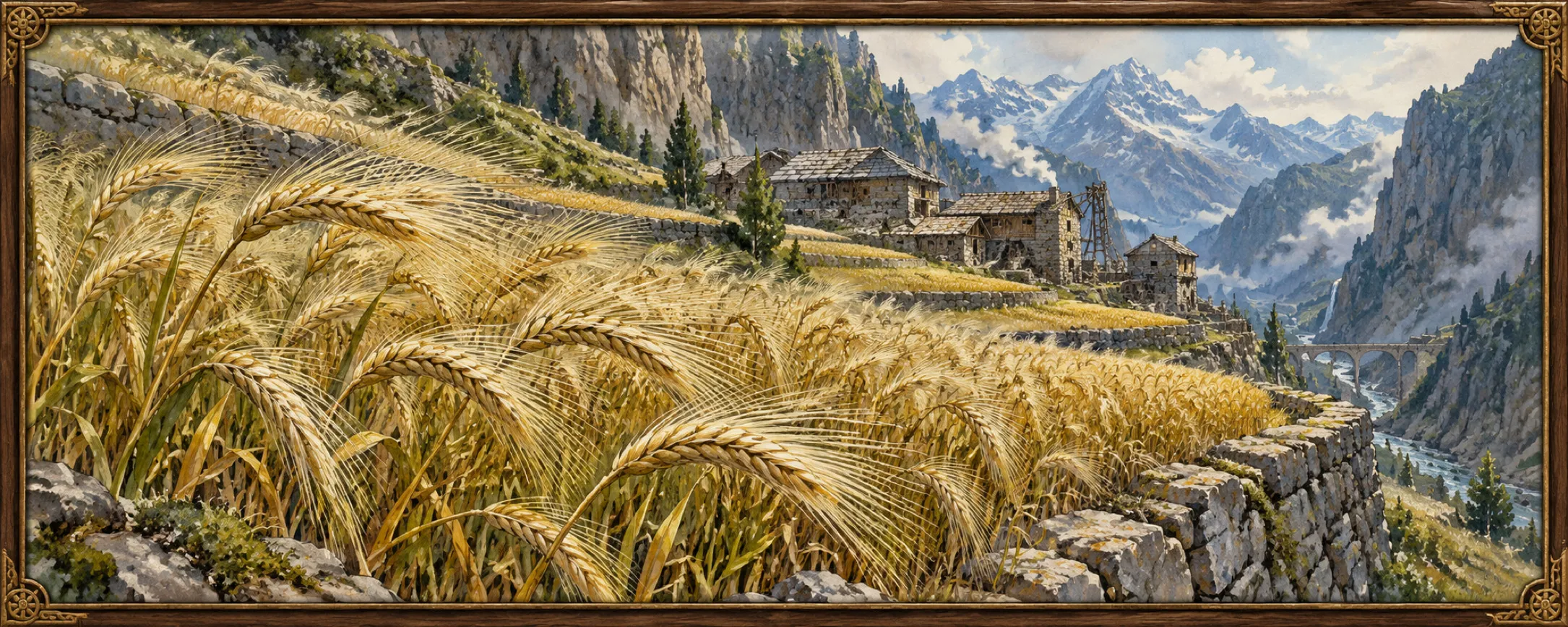
Hill barley stands knee to hip high on a stiff, hollow straw. Its leaves are broad at the base and blue-green in spring, wrapping the stem in a pale collar. Each stalk ends in a single ear, the grains set in close rows and each one tipped with a long, stiff bristle, the awn, so that a ripening field looks bearded and catches the light like fur. Green in early summer, the ears turn to straw-gold and then to a bleached, almost silver pale, and as they fill they bow on their stalks until a field ready for the sickle nods all one way in the wind.
A barley field rasps rather than rustles. The awns are rough enough to scratch bare arms at harvest and to work their way into sleeves and collars, and the threshing floor smells of dust and dry straw. Each grain is clad in a tight husk that must be beaten or parched off before it is eaten.
Habitat and Range
Barley is grown on narrow terraced fields in the sheltered valleys of the Headwater Marches, where it is sown as soon as the snow leaves the terraces and cut before the passes close. High villages such as Notchfield plough it on colossal terraces whose retaining walls no living people could raise. In the Ironspine it grows on the valley terraces below the holds, at farmsteads such as Barleystep. It comes down to the Greyford Reach as trade grain rather than as a crop of the river flats.
Behaviour and Temperament
Barley forgives what wheat does not: poor stony soil, a late spring, a short dry summer, cold nights. It cannot forgive hail or an early snow, and a whole terrace can be flattened in the space of a storm. It ripens fast, which is the whole of its virtue in the mountains, and it shatters easily once ripe, so a harvest held back a week loses grain to the ground.
Life Cycle
Hill barley is sown in spring and reaped in late summer, a season of some three to four months. A share of the best ears is kept back each year as seed, and households in the high valleys keep their own seed lines for generations, trusting them over grain bought from below.
Uses and Dangers
Barley is eaten more than it is sold. Ground coarse, it makes the dense, dark barley bread of the hill country and the carters' inns. Whole or cracked, it goes into pottage, and the big pots of barley and beans an employer must set before an Ogre band before any job, under the food-right custom of the Hearth-Weight Compacts, are the best-known meal on the Headwater roads. Some of it is malted and brewed. The straw beds animals, thatches sheds, and packs goods for the climb.
Dwarven holds buy what the valleys can spare and send their own terrace crop straight up to the gate, so that every barley harvest below a hold is also part of the hold’s stores. A poor barley year at Barleystep is felt a long way down, and a poor year across the Headwater valleys means that more basin grain must come up the Sheaf Road.
The danger lies in storage. Barley put away damp heats and spoils, and a granary full of it draws rats.
Lore and Belief
Headwater folk say the colossal terraces hold the sun’s warmth in their old stones longer than any wall a living people builds, and that barley sown against them ripens a week earlier. Nobody has measured it. Dwarves, who rarely praise anything that grows, say of a steady worker that he is "barley, not wheat": he will stand in poor ground.