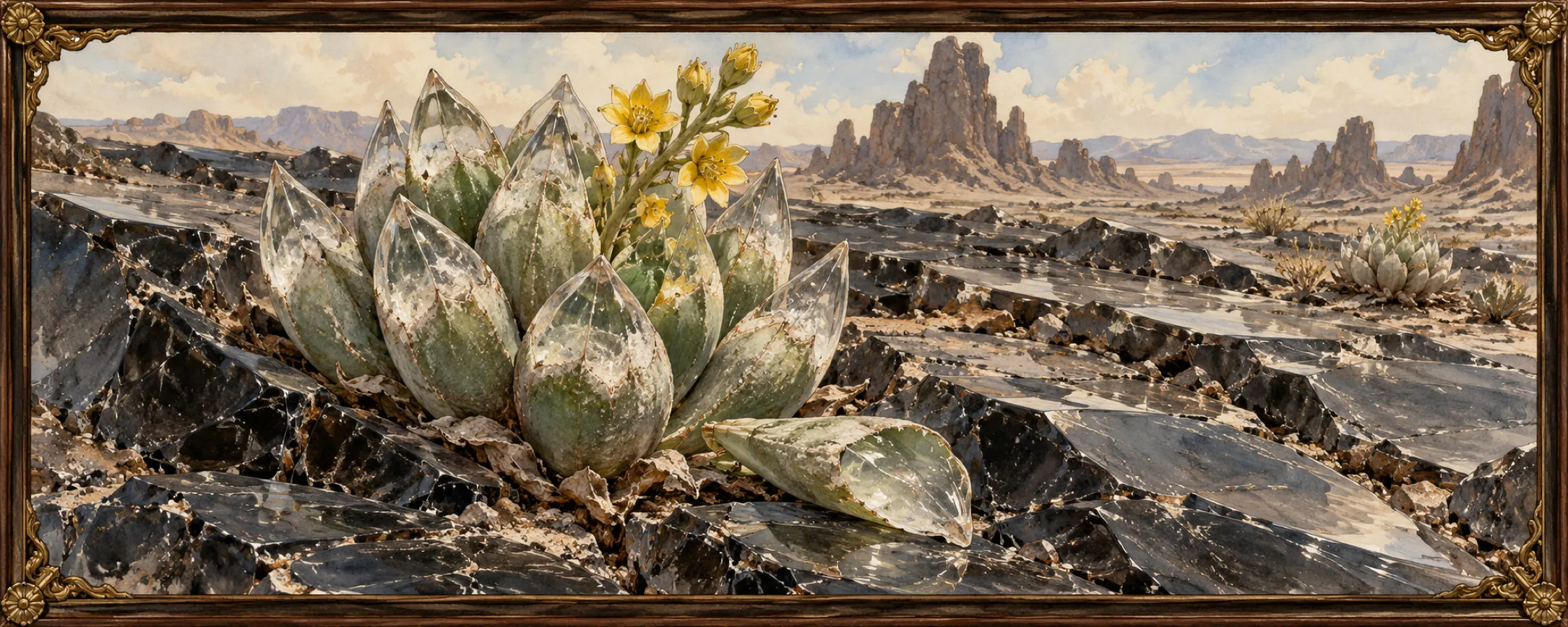
Glasscup
Glasscup is the one plant a crosser of the Glassbelt is glad to see on the glassed ground. It grows in the cracks of the old scars and holds water in its swollen leaves, and a crosser can cut one for a mouthful when the flasks are low. A second kind, which crossers call bitter glass, looks the same and is poison. The Salvage Peoples who cross teach the difference before anything else about the plant.
Appearance
A glasscup is a low rosette, no wider than a cupped pair of hands, of thick, fleshy, blunt leaves packed tight and curving up like the petals of a closed flower. The leaves are grey-green, dusted with a white bloom against the sun, and their tips are clear and glassy, like little windows, so that light passes into the plant from above; that, and the glassed ground it grows in, gave it its name. Cut, a leaf is full of a clear, cool, faintly salty jelly. After the rare rain it sends up a short stalk of small yellow flowers that last a day. Bitter glass is the same in shape and colour; its leaf tips are a shade less clear, and its jelly is cloudy, smells faintly of almonds, and tastes bitter at once.
Habitat and Range
It grows only where it can root deep in a crack: in the fissured glass of furnace and impact scars, in the joints of stony desert, and along the edges of buried road-lines. Most stands are a few plants in a crack; a good crack may hold dozens. Bitter glass grows among it, more often near the dead furnace zones.
Behaviour and Temperament
It lives on almost nothing. Its roots run far down the cracks to damp beneath, its windowed leaves take light without opening to the heat, and in the worst months it shrinks into the crack until only the tips show. It does not grow back quickly once cut, and a stand cut bare by one party may give nothing to the next for years.
Life Cycle
Seed lies in the cracks for years until rain. A rosette grows slowly, flowers after rain, and can live longer than a Human lifetime, dividing into clumps.
Uses and Dangers
A single cup gives a mouthful of water and a little food, enough to wet a throat or keep a body going between wells; crossers do not live on it, and the deep-desert circuits of the Edgeway Kindreds cut only one from a stand and leave the rest for whoever comes after. Its jelly soothes sun-cracked lips and burns.
Bitter glass brings vomiting, a racing heart, and cramps within the hour; to a thirsty crosser that is often death. The rule taught is to break a leaf, smell it, touch the jelly to the tongue, and wait, and never to cut in the dark.
Lore and Belief
Salvagers say glasscup grows where the old fire wept, and that the clear tips are the tears of the glass. Some hold that bitter glass grows only where someone took more than one cup from a stand, and that it is a punishment; that is a teaching story, and a good one. Crossers will not carry glasscup out of the Glassbelt, keeping to the old rule about carrying out what belongs to the scars.
Crossers tell of the thirsty salvager who drank from a bitter stand on a crossing and died before the next well, his pockets full of the relics he had dug from the scars.