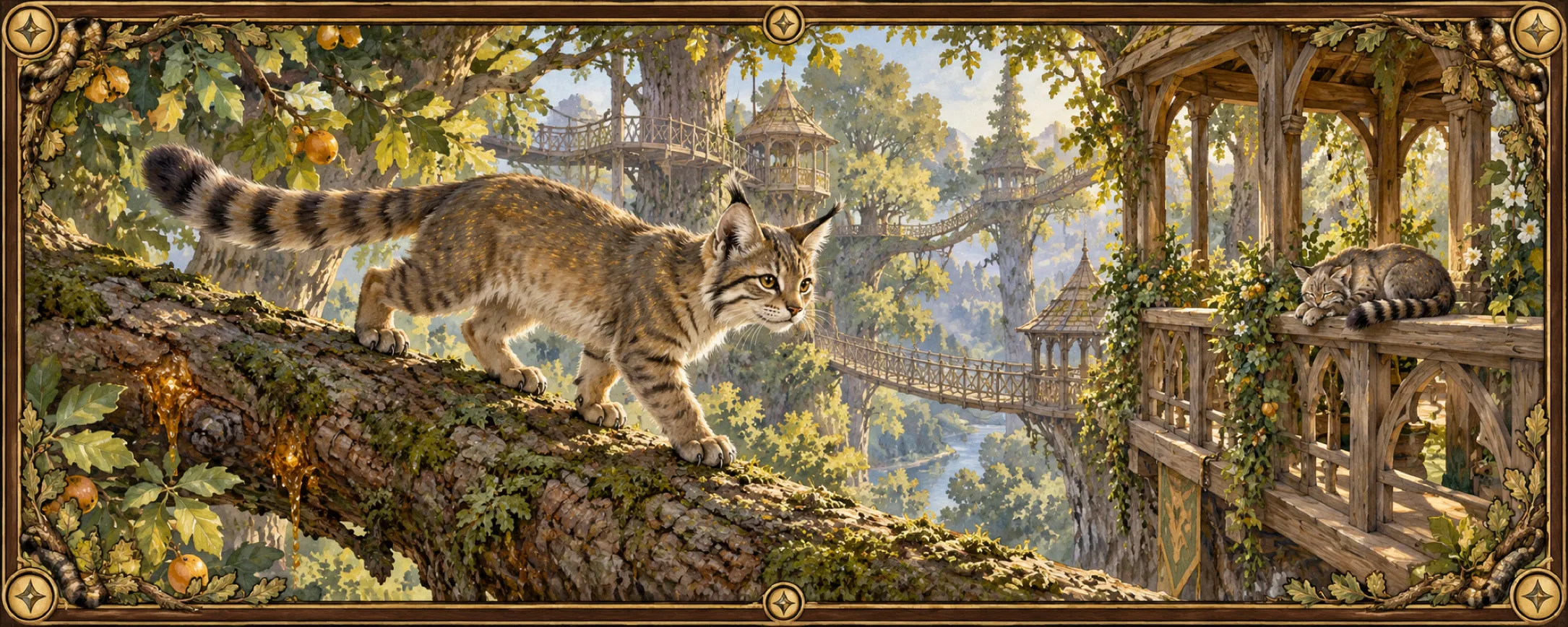
Bough-Cats
Bough-cats are the small wild cats of the high canopy of the Crownboughs. They were never tamed, but the High Elf houses have let them live in their galleries and garden-walks for so long that they keep the halls clear of mice and dormice and sleep on the sunny terraces as if they owned them. A house watches its bough-cats, because they know before anyone else when a bough has begun to fail.
Appearance
A bough-cat is smaller than a house cat, with a long, thick, ringed tail that it uses for balance and wraps round itself to sleep. Its fur is soft and grey-brown, flecked with gold, paler on the belly, with tufts of longer hair on the ear-tips and dark stripes running back from the eyes. Its feet are broad, with hooked claws, and it can climb head-first down a trunk.
It moves along a bough like water along a gutter, quick and sure, and leaps between limbs a Human would need a ladder for. It mews, chirps at birds, and growls when cornered. It smells faintly of resin.
Habitat and Range
Bough-cats live in the trained canopy and the old trees around it, throughout the Crownboughs, in the galleries, boughways, and suspended garden-walks the houses keep. They do not come down to the cleared understorey if they can help it.
Behaviour and Temperament
A bough-cat hunts mice, dormice, roosting birds, and fledglings, and eats fruit from the canopy gardens. It is solitary, curious, and unafraid of the houses, and will sit on a terrace rail and watch a gathering, but it does not like to be touched. It keeps to ground that carries it well: a limb that has begun to give, a walk that flexes wrongly, it leaves.
Life Cycle
A female bears two or three kittens in a hollow in a trained bough in spring. They follow her through the canopy within weeks. Bough-cats live about ten years.
Uses and Dangers
They keep the halls clear of vermin, which the houses value, and take the gardens' fruit and the songbirds' fledglings, which garden-tenders resent. They are harmless to people. Their use the houses value most is the warning: a bough-cat that will not cross a walk it used to cross is reason to look at the walk.
Lore and Belief
A house whose bough-cats leave a hall reads it as a sign that a boughway is beginning to sag, long before it shows to the eye, and sends tenders up at once; it is usually right. Courtiers, who care little for the beasts, still count it an ill omen if the cats leave a hall during a presentation. Children of the houses are told that a bough-cat remembers every hand that was ever unkind to it.
Fruit-thieves in the canopy are called bough-cats too, and the houses say both kinds are hunted the same way: patiently, from above.