Samphire
Samphire is the green that grows in the sea’s own edge, on the mud the tide covers twice a day. Coastal households of the Tidelace Coasts gather it at low tide with their shellfish and weed, eat it fresh in summer, and pickle it for the storm season.
Appearance
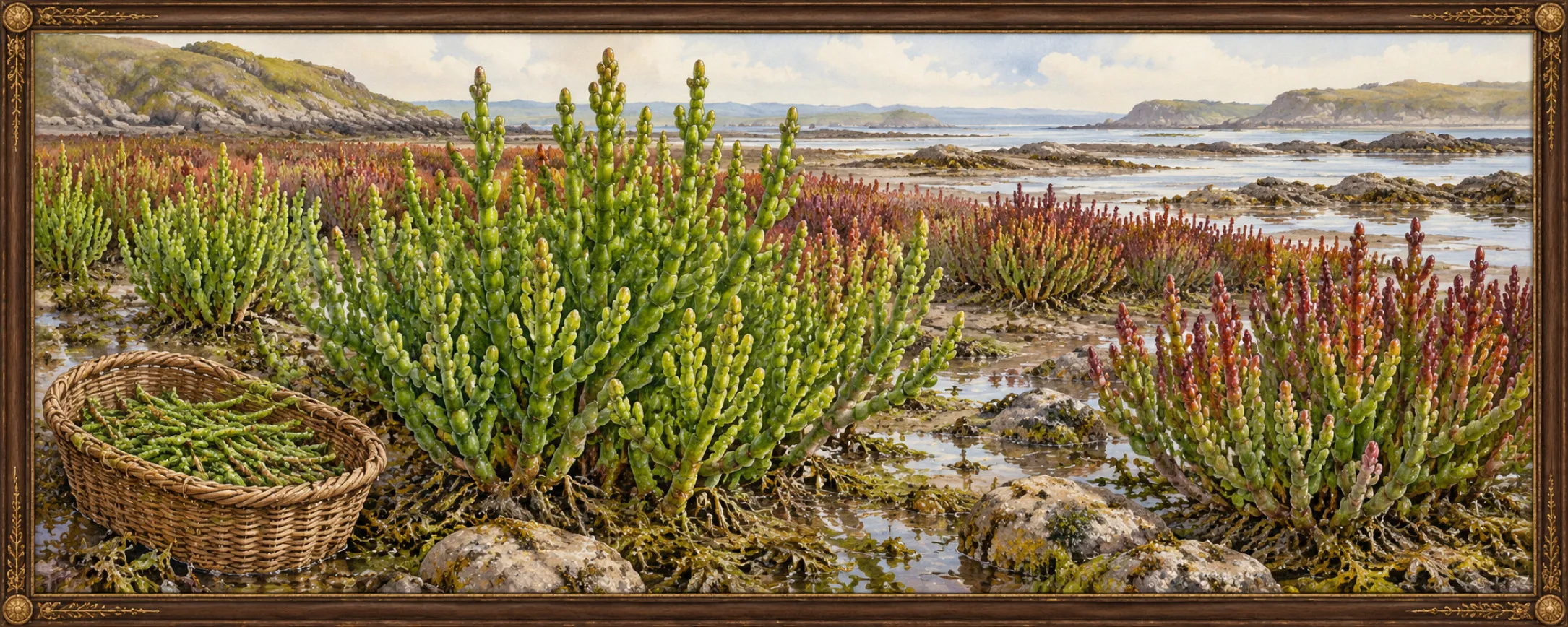
Samphire stands a hand to a forearm high: a little bushy plant of jointed, fleshy, leafless green stems, each like a row of tiny beads or a branching candelabrum, glossy and bright green in summer. In autumn it flushes red and purple from the tips down, and a marsh full of it turns the colour of wine. Its flowers are almost invisible, sunk in the joints. Bitten, it snaps crisply and tastes of salt and the sea.
Habitat and Range
It grows on the soft mud of salt marshes, the edges of creeks and inlets, and the flats at the heads of the estuaries, below the reach of ordinary land plants and above the open water. It is commonest in the sheltered inlets of the Tidelace, in the lee sounds of the Soundchain Roads, and on the brackish margins of the mouths of the Tidebound Reaches.
Behaviour and Temperament
It is one of the first plants to take new mud, and its stems slow the water and catch silt, so that a samphire flat slowly builds itself up into marsh.
Life Cycle
It lives one summer, sprouting on the mud in spring, swelling through the summer, turning red in autumn, and dying back in the first storms after shedding its seed onto the next year’s mud.
Uses and Dangers
In early and midsummer the green tips are picked by hand or cut with a knife, rinsed of mud, and eaten raw or boiled, often with fish or shellfish; later in the year they grow woody. Pickled in brine or vinegar, they last into winter, and a jar of samphire is one of the small stores a harbour household counts. Burned, the plant gives an ash rich in soda for glass and soap, and the gauge houses that make glass for their instruments buy it. Thaluren graze it from the water at the mouths and think of it as a taste of the river’s edge.
It does no harm. The danger of gathering it is the tide, which comes back over the flats faster than a walker in mud can go.
Lore and Belief
Gnome children are sent out for samphire to learn the tide table, and a child cut off by the tide is said to have read it wrong; the harbour expects the child to say so. Coastal Humans call it sea-bread and hold that samphire picked before midsummer brings a good year’s fishing. Some say it grows only where the sea has kept a promise.
Every coast has its tale of the gatherer cut off by a spring tide on the flats, and of the one who walked the mud by moonlight to reach a stranded child and carried her back on his shoulders through the rising water.