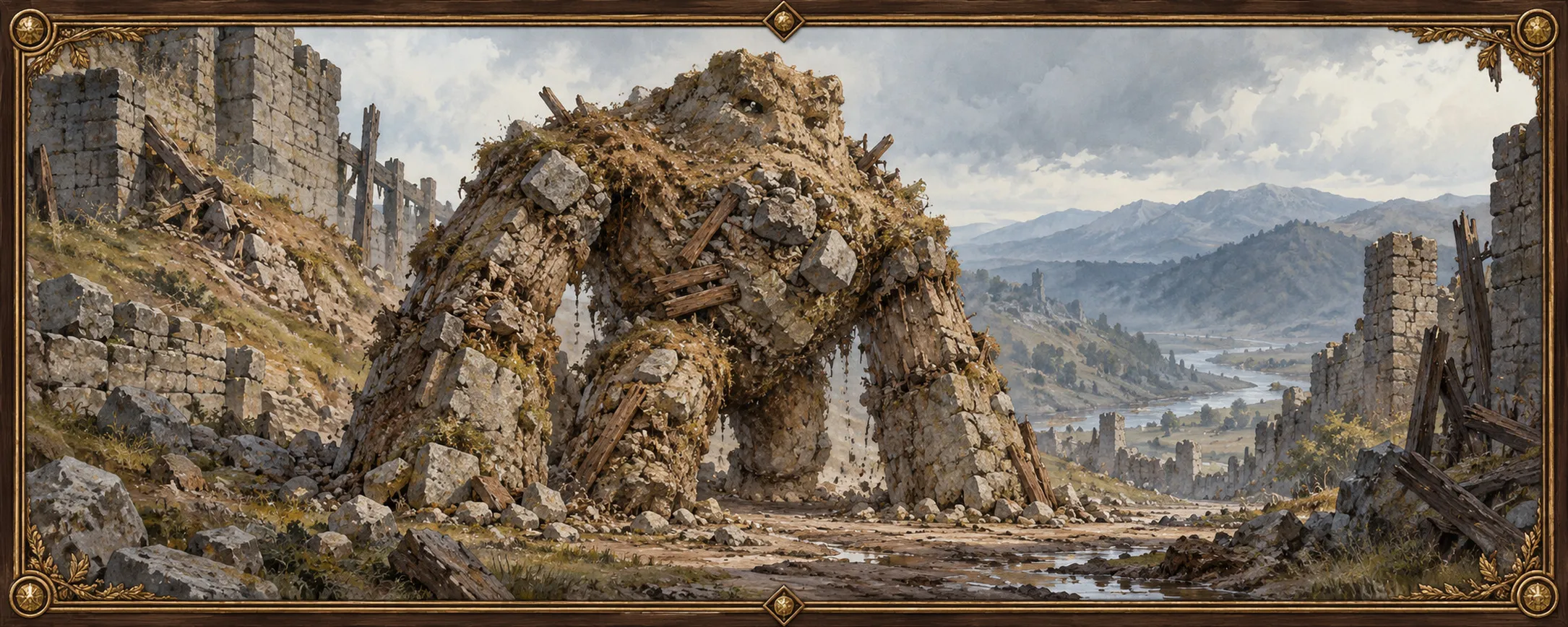
Field Bulwarks
Field Bulwarks are the hard constructs of war: great figures of earth, rubble, and stone that a battle conjurer raises in a breach to stand where a wall has fallen. Their craft is taught at the Hall of Borrowed Forms, the school of Conjuration given to hard constructs and emergency field assembly. Most bulwarks fell back to earth when their makers let go, and stand now as mounds on old battlefields. A few were raised on warded anchors, and some of those still rise.
Appearance
A raised bulwark is a squat, shoulderless figure two or three times a man’s height and nearly as broad as it is tall, packed earth and rubble bound together, with stones, broken timber, and the stuff of the breach caught in its body. It has no face, only a heavier mass at the top, and its arms are braced columns that reach the ground. It moves slowly, grinding and sliding, shedding soil, and it smells of turned earth and wet stone. A fallen one is a long, grassed mound with a rough human shape when seen from above or at low sun.
Habitat and Range
Bulwark mounds lie in the breaches of the March Wall and along the old causeways, fords, and culverts of the Broken Marches, and at a few gates and crossings of the Headwater Marches. Those still active are few, and the people who live near them know which.
Behaviour and Temperament
A bulwark raised on an anchor lies as a mound until someone tries to pass the breach it was set to hold in the way it was told to stop: armed, at a run, with a cart through a gap. Then it rises, plants itself in the gap, and pushes back whatever comes. It does not pursue and does not judge; it holds. When the gap is clear it settles again.
Abilities
It holds a breach against men, beasts, and carts as a wall would, and it can shove a loaded wagon back down a causeway. Its strength is borrowed, from its matter and from the charge stored in its anchor stone, and each rising draws on that charge.
Life Cycle
Raised in the field in a long chant, a bulwark lasted a battle or a siege and fell as its conjurer tired. Those raised on an anchor, a warded stone set under the breach with a Threshold Mark, go on as long as the anchor holds charge, and nobody knows how long that is for any one of them; anchors fail without warning, and the bulwark is a mound for good.
Uses and Dangers
Repair crews and whoever holds the ford are glad of an active bulwark that still guards a ford, and in places one is the only reason a gap is held. They are dangerous to anyone who does not know the old order it obeys: a hauling crew bringing a cart through a bulwarked gap at the wrong pace can be pushed into the river. Ogre bands, who do the heavy work of the Marches, are asked first when a bulwark must be crossed or dug out, and some have learned to walk a cart through one slowly enough.
Lore and Belief
Marches folk say the bulwarks are the battle-dead of the breach, risen to hold it, and leave small offerings on the mounds; they are earth and stone, and no dead are in them. Critics of the Hall of Borrowed Forms point to the active ones as proof that a servant and a weapon differ only in their orders, since a bulwark set against an enemy long gone still stops the farmer on the road.
Raiders who know the Marches go round the old bulwarks; march-country boasts tell of a war-band that tried to ride through a breach one held and was thrown back three times, until its chief swore the dead had beaten him.