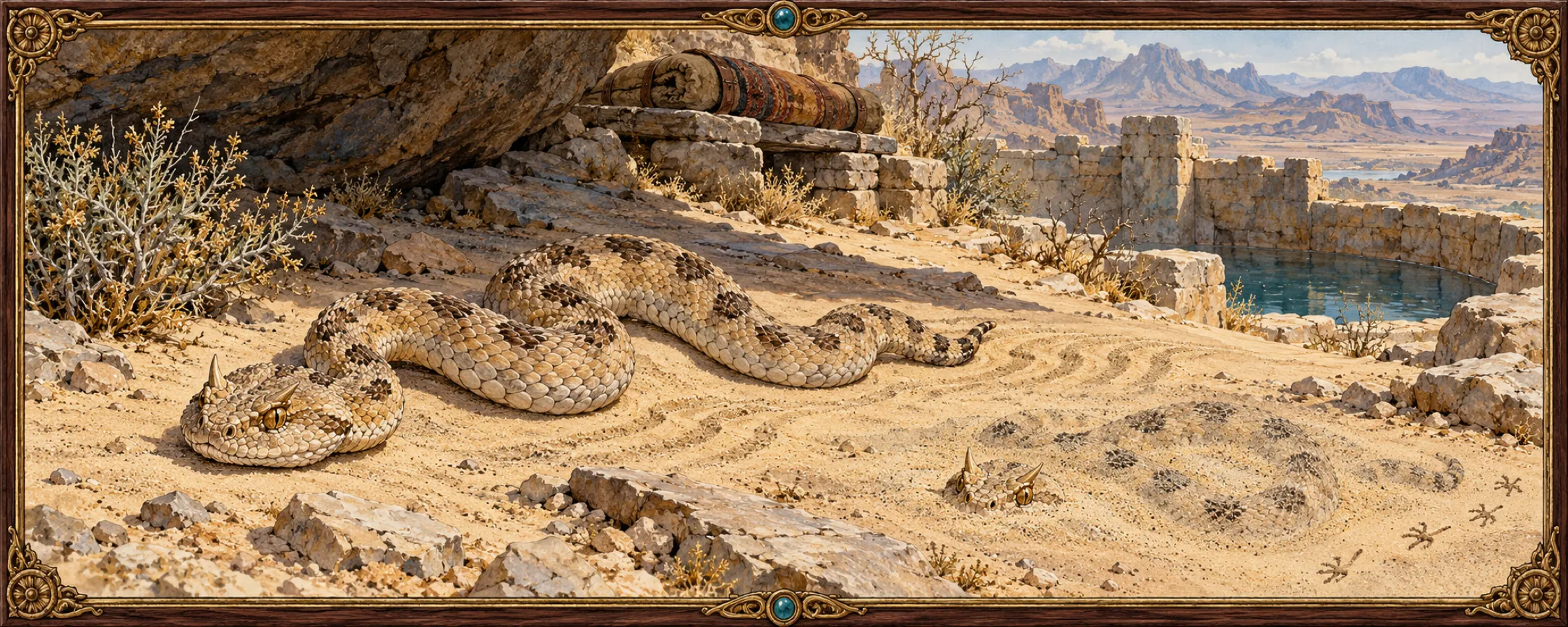
Horned Vipers
Horned vipers lie buried in the sand at the edge of shade across the Glassbelt and the dry rims of the Rimward Basins, with only their eyes and the horns over them showing. Most bites come from a hand put down beside a rock or a foot set in the shadow of a wall. A grown person usually lives through one, sick and swollen for days; a child, an old crosser, or someone already weak may not.
Appearance
A horned viper is short and thick, about as long as a forearm, with a broad, flat, heart-shaped head on a narrow neck and a short tail. Over each eye stands a single pointed scale like a little horn, which some vipers lack. Its scales are rough and keeled, sandy buff or pale grey with darker blotches down the back, matching the ground it lies on so closely that it cannot be seen until it moves. On loose sand it moves sideways in looping coils, leaving a track of parallel hooked bars. When threatened it coils and rubs its scales together, a dry sizzling rasp like fat in a pan.
Habitat and Range
They live in stony desert, sandy flats, wash beds, and the rocky shelves of the rims across the Rimward Basins and the Glassbelt Interior, and around the walls of wells, shelters, and ruins, where lizards and rodents gather. They are commonest where there is sand to bury in and shade to lie beside.
Behaviour and Temperament
A horned viper hunts by waiting. It shuffles itself into the sand until only its eyes and horns show, at the edge of a rock’s shade or beside a track, and strikes the lizards, rodents, and small birds that come within reach. It hunts at night in summer and by day in the cool months. It does not chase and does not attack anything too large to eat unless it is stepped on or touched, but it will not move out of the way either.
Life Cycle
Horned vipers lay a clutch of eggs in warm sand in early summer, and the young hatch in late summer as small copies of their parents, able to bite from the start. They live ten years or more.
Uses and Dangers
The bite brings burning pain, swelling that spreads up the limb, blackened skin, and fever; a strong adult recovers in a week or two, sometimes losing a finger, while a small child can die within a day. Crossers shake out bedding and boots, carry a stick to turn stones, sleep off the ground where they can, and keep children out of the shade of the walls. Salvagers cut a bitten limb and bind it, which does little good. The skins are worn as bands.
Lore and Belief
The horns are held by Glassbelt salvagers to be the viper’s ears, and they say it hears the footsteps of a crossing a day away. Rimward children are told that a viper lies at the edge of every shade, so that nobody rests in shade without looking first, and the lesson is a good one. Orc kindreds say a viper found in a cistern channel means the channel has gone too long uncleared.
Basin raiders are said to toss vipers into an enemy’s cistern before a raid; the kindreds count it among the worst of deeds and blood-feud follows it.