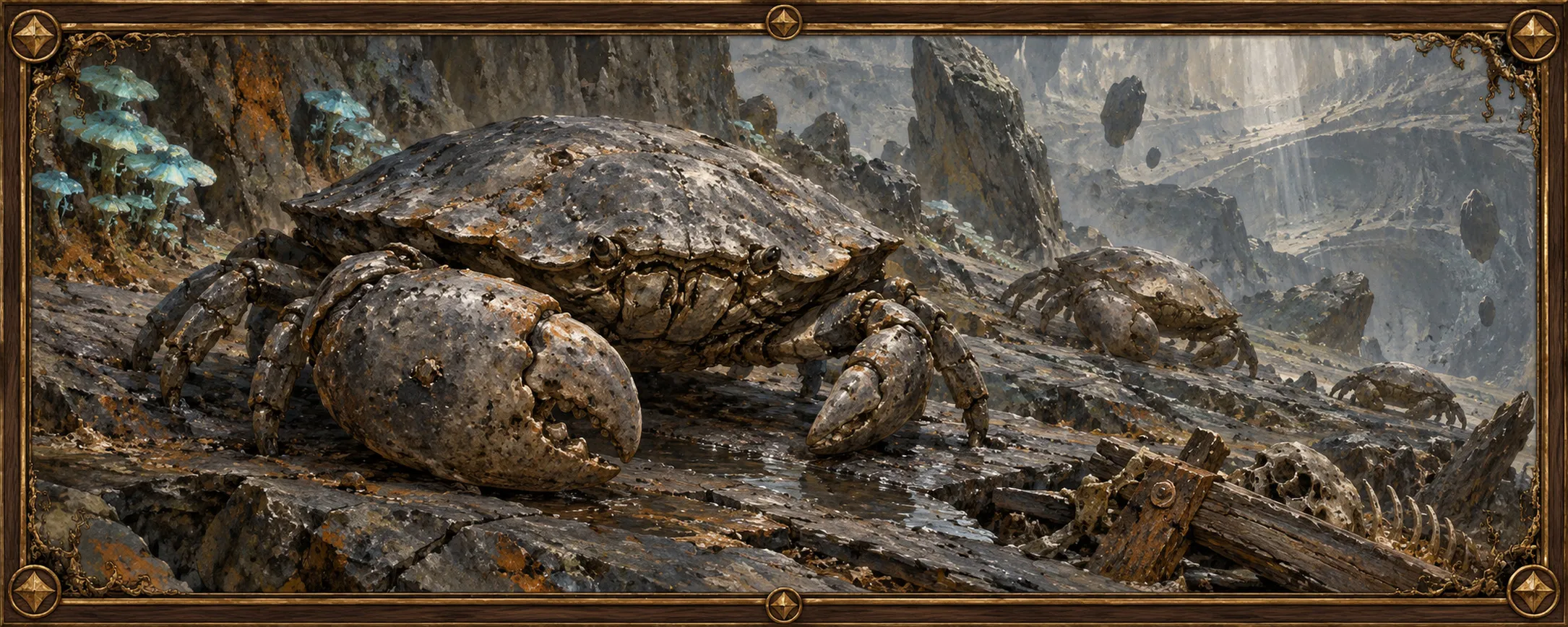
Lead Crabs
Lead Crabs are the scavengers of the Gravity Well. Where the Well’s pull multiplies every weight, they have grown heavier than the stone they walk on, and they live by the Well’s own law: what is moving is hard to stop, and what is still is hard to move.
Appearance
A grown Lead Crab is as broad as a shield and no higher than a hand, its shell flattened into a low dome. The shell is dull grey with the metallic sheen of the Well’s compressed rock, pitted and scarred, and so dense that a dropped hammer rings off it. The claws are short, thick, and blunt, one larger than the other. It moves sideways in slow, grinding steps, and each one is heard as a dull thud through the ground before it is seen. It smells of wet stone and iron.
Habitat and Range
They live on the inner slopes, below the rim where the Floaters range and above the crushing depths, in the cracks of the compressed stone and under the debris drifting slowly inward. They are scattered rather than many, and each keeps a stretch of slope.
Behaviour and Temperament
They eat what the Well brings in: the drifting dead, broken tools with something organic on them, the bioluminescent fungi on the walls, and the remains of travellers. They are slow and patient, and they do not chase. A Lead Crab that has begun to move goes on moving, and anything in its path is pushed aside or ground under. It closes on whatever it touches and does not let go.
Abilities
Its weight is its whole weapon. A claw closing on a boot crushes the foot inside; on a hand, the hand. A crab once set in motion cannot be turned by strength, and a crab at rest cannot be lifted. Blades skid off the shell, which the Well has packed as hard as Well-Iron.
Life Cycle
The young are born light and float near the rim in loose clusters, and grow heavier as they work their way inward, year by year, shell by shell. The oldest are found deepest. A dead crab’s shell does not rot; it slides slowly downhill towards the centre and is lost.
Uses and Dangers
Their shells are the prize: prospectors who can find an empty one and haul it out sell it for its metal, which smiths value like Well-Iron, and the climb out with it is the hardest part. The danger is to the unwary and the fallen. A traveller who slips and slides downhill into a crab, or who sits to rest beside a grey stone that is not a stone, may lose a limb. The Weight-Bearers are said to step round them without a glance.
Lore and Belief
Prospectors tell of a crab so old that it has sunk into the rock and become a boulder with claws, waiting for something to walk into it. Some believe the crabs are what crayfish carried in through a Sink-Gate became; nothing is known of their origin.
Salvagers say a crab’s claw, cut free, is the heaviest thing a man can carry out of the Well, and the salvager who brought one out on a sledge and sold it to a smith as an anvil is sworn to have been real.