Kingfishers
Kingfishers are the small, brilliant fishing birds of clear water. They dig their nests into earth banks, and the Goblin households of Lowbank, who live among flood-cut banks and are always reading them, say a pair nesting in a bank means a sound bank, and that kingfishers leave a bank the year before it goes.
Appearance
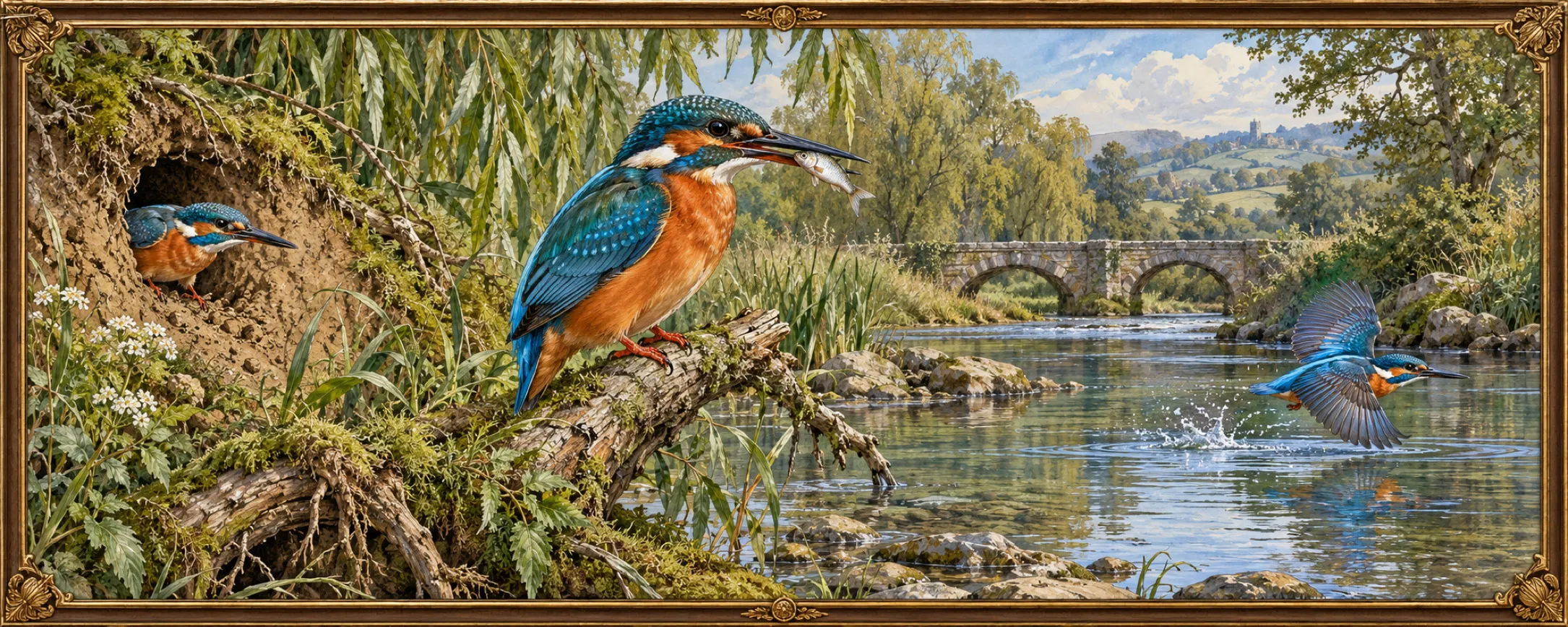
A kingfisher is the size of a sparrow but stouter, with a large head, a long dagger bill, and short red legs. Its back flashes electric blue and green, its breast and cheeks are bright orange-chestnut, and its throat is white. In flight it is a streak of blue low over the water.
It perches very still on a branch above the water, bobs its head, and dives straight in with a small splash, coming back with a fish crosswise in its bill, which it beats against the branch before swallowing head first. Its call is a shrill, piping whistle as it flies. A nest burrow stinks of fish bones.
Habitat and Range
Kingfishers live on clear, slow-to-moderate water with perches and earth banks: the side channels and willow islands of the Greyford Reach and the streams and millponds of the Headwater Marches. Muddy water and hard frost drive them away.
Behaviour and Temperament
A kingfisher eats small fish, water insects, and tadpoles. Each pair holds a stretch of water and drives other kingfishers out of it. It nests at the end of a tunnel as long as an arm, dug into a sheer earth bank above the water, and it chooses the bank carefully: firm earth, not too sandy, high enough to stay dry.
Life Cycle
A pair raises two or three broods a summer, six or seven young at a time, in the dark at the end of the tunnel. Many die in their first hard winter. A kingfisher seldom lives more than two or three years.
Uses and Dangers
They give nothing but their colour; a few of their feathers end up in Highbank milliners' work. They do no harm, beyond a few fish from the ponds.
Lore and Belief
Lowbank Goblins say a pair nesting in a bank means a sound bank, and they watch which banks the birds use in spring; when a long-used bank goes empty, households near it begin to think about moving. Whether the birds feel a bank weakening, or the Goblins notice it at the same time and credit the birds, nobody can say. Headwater Humans say a kingfisher’s dried body hung in the house turns its beak to the wind.