Scar Vultures
Scar vultures are the great carrion birds of the Windscar escarpments. They nest on the faces of the Shearline and the high shelves, ride the warm air above open country, and come down on any death within sight. In the High Scars, where exposure kills more people than anything else, a circle of vultures over a pass is news: someone did not get through, and escorts read it before any runner arrives.
Appearance
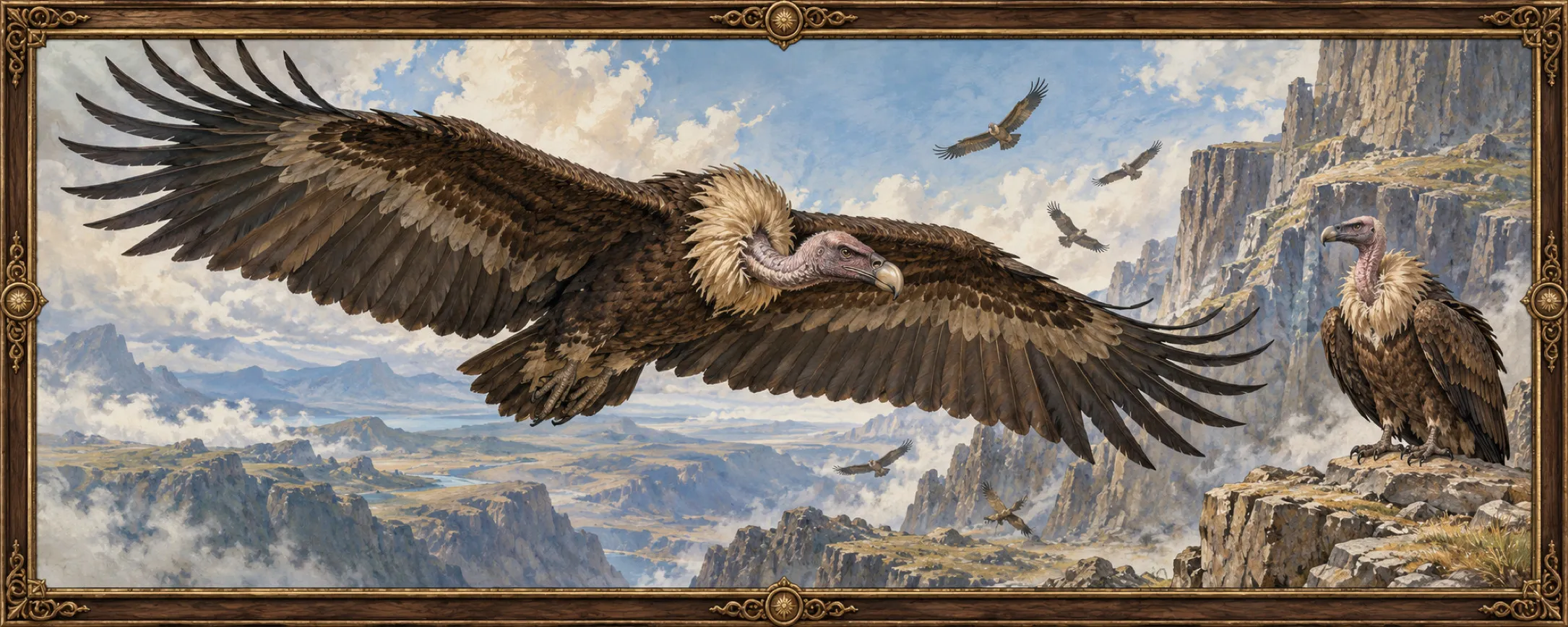
A scar vulture stands as high as a child, with wings that span more than two tall men laid end to end, broad and fingered at the tips. Its body is dark brown, its ruff of feathers at the base of the neck pale buff, and its head and long neck bare, wrinkled, and a dull pinkish grey, dark with blood after feeding. The bill is heavy and hooked. On the ground it hops and shoulders its way about clumsily; in the air it hardly moves its wings, circling for hours on a thermal. A feeding crowd hisses, grunts, and squabbles, and smells of the carcass.
Habitat and Range
They nest in colonies on high escarpment ledges and cliff faces and range over enormous distances: the shelves and passes of the High Scars, the floors and rims of the Rimward Basins, and out over the Glassbelt Interior along the crossing routes. A few birds are almost always in the sky above any stretch of open Windscar country.
Behaviour and Temperament
Scar vultures find food by watching: each other, the wild dogs, the wind cats, and the camps. When one drops, those nearest see it and follow, and within the hour a carcass is ringed by dozens. They strip it to bone in an afternoon. They do not kill, and they are wary of living people, rising heavily if anyone approaches, but they will wait a long time on a rock beside a beast or a person that is dying.
Life Cycle
A pair lays a single egg on a bare ledge or a rough platform of sticks late in the windy season, and both parents feed the chick for many months. They use the same ledge for generations and may live forty years.
Uses and Dangers
They clean the shelves. Without them the carcasses of the dry country would lie for months, foul the few waters, and feed the flies. Escorts use them as a far-seeing eye: a circle forming over a pass, a camping ground, or a stretch of the crossing is reported along the warning ridges as fast as a fire, and a party is sent to see. Their feathers fletch arrows.
Lore and Belief
The kindreds hold that the vultures carry what is left of the dead to Ushkar the Ancestor-Warden so that he can count them, and killing one is a grave wrong. Escorts say that a vulture that follows a party from the start has already chosen someone in it, and a captain who hears this said at a treaty-ground does not laugh. Salvagers on the Glassbelt say the vultures will not land on furnace ground; the truth is that nothing dies there that they can reach.
Raiders on the shelves are said to read the vultures to find where a crossing has gone wrong, and to come in after the birds to strip what the weather left.