Fogbells
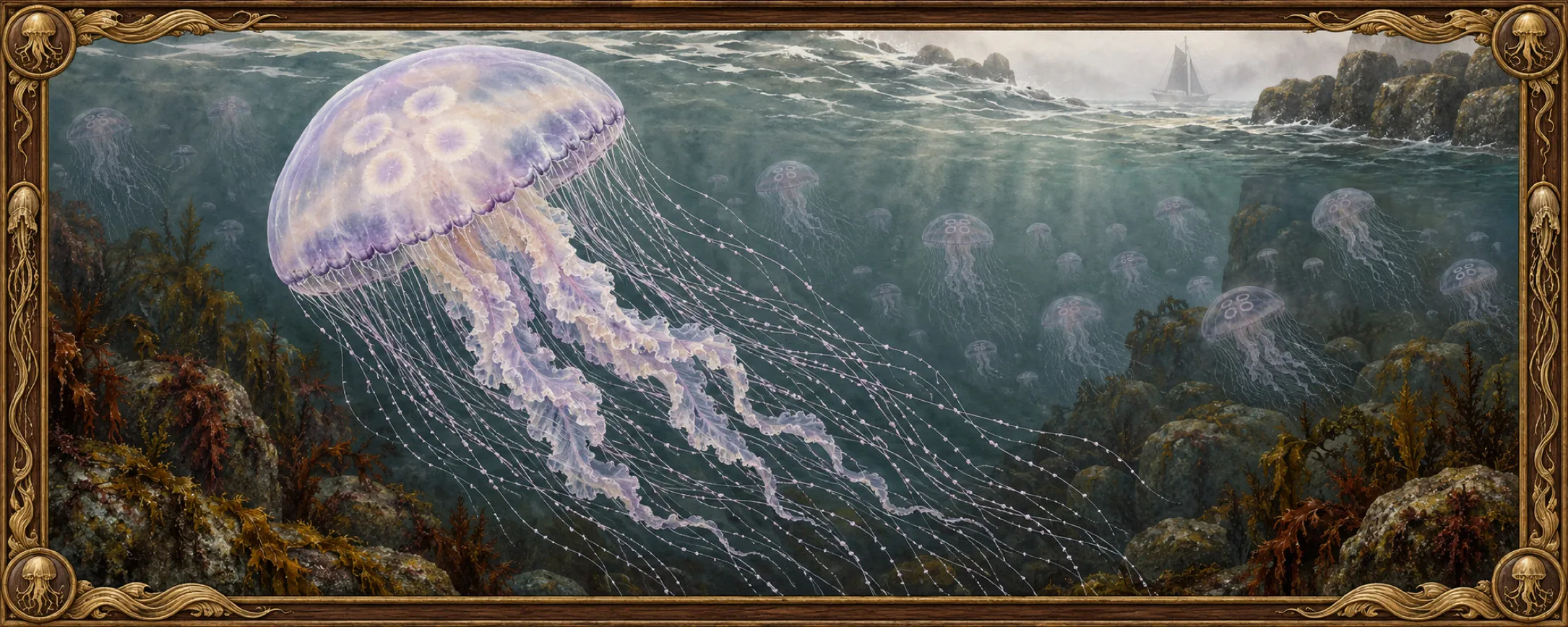
Fogbells are the bell jellyfish of the open water off the far side’s north coast. In most seasons a few drift by. When the Long Grey, the great fog belt of the outer coast, rolls in off the Unrun Sea, the same winds and currents often bring them in by the thousand, and a cove on the Tidelace may be thick with them when the fog lifts. Their sting welts the skin, and enough of it can stop a swimmer’s heart.
Appearance
A fogbell is a clear, soft bell the size of a bowl to a cartwheel, pale milky violet, with a darker rim and four pale rings inside it like the marks of a thumb. From the rim hang dozens of fine stinging threads, as long as a boat or longer, nearly invisible in the water, and from the centre four frilled arms. It moves by slow pulses of the bell, opening and closing like a breath, and drifts more than it swims. A bloom seen from a boat is a field of pale shapes as far as the eye can follow. Stranded on the shingle a fogbell is a shapeless clear jelly that still stings, and a stranded bloom smells sour and fishy as it rots.
Habitat and Range
Fogbells live in the open sea beyond the coast and come inshore when wind and current drive them: into the sounds of the Soundchain Roads, the coves and outer inlets of the Tidelace, and around the outer isles. A bloom can lie in a sound for days, and the breakwaters of the better harbours keep the worst of it out.
Behaviour and Temperament
A fogbell drifts with its threads trailing, catching small fish, shrimp, and drifting animals that blunder into them; the threads sting, and the arms carry the catch to the mouth. It has no mind and no intent, and does not seek people. It simply stings whatever touches it.
Life Cycle
Fogbells spawn in the open sea. Their young grow as tiny stalked things fixed to rock or drifting weed, which bud off small bells in spring; the bells grow through the summer and die in autumn, and a bloom of them washes up dead after the last fogs.
Uses and Dangers
A bloom closes a coast to swimmers, waders, and divers, fouls nets so heavily that they tear or must be burned clean, and stings the hands of every fisher who hauls them. The sting brings burning pain and raised red welts along the line of the threads; a swimmer caught in many may cramp, choke, and drown, or the heart may stop. Children are kept off the shingle after a fog. Vinegar or seawater eases the sting, and fresh water makes it worse.
Lore and Belief
Gnome pilots enter blooms in their logs with the date and the fog, and some sounding houses claim to be able to tell from their logs when a bloom will follow a Long Grey; others say that is precise and not true. Coastal Humans call the fogbells the Grey’s lanterns and say the fog carries them as a boat carries lamps, to find the shore in the dark. The Thaluren keep their young out of a bloom and wait for it to pass.
Wreckers on the outer coast are said to wait for a bloom, knowing that a crew which has blundered into the stinging water will run for any light ashore.