Pack Animals
Pack animals and draught teams are the beasts that carry trade where boats cannot and Ogres are not hired: loaded on their backs, hitched to carts, or harnessed to barges on the towpath. They are counted, tolled by the head, stabled at inns and waystations, and lost first when a road turns against a caravan. The best known of them have pages of their own, the mules of the mountain roads, the oxen of the grain carts, and riding horses; the rest are the road beasts below, whose breeds the drovers know and few others ask about.
Appearance
The Caravan Beasts of the Headwater Roads
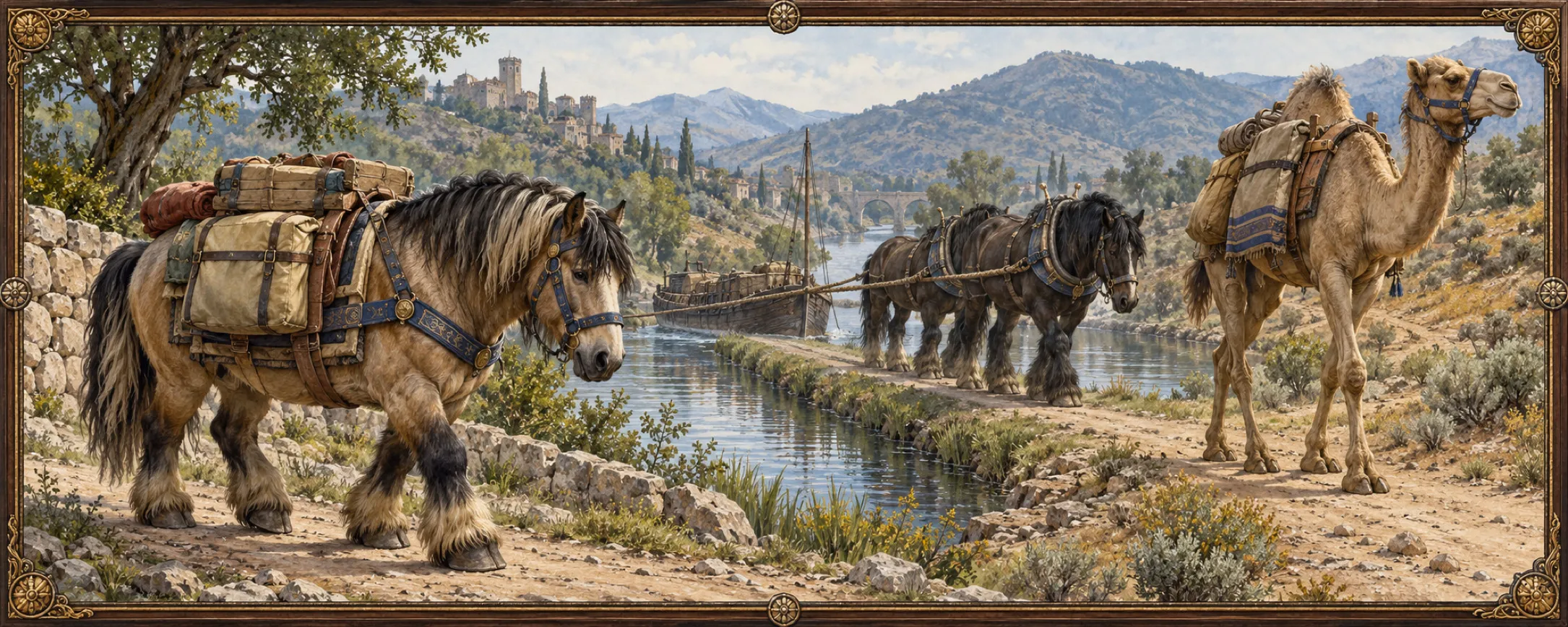
Beside the mules, the exchange-road caravans use short, thick-set pack beasts with broad backs, heavy manes, and feathered fetlocks, most of them dun or grey, a hand lower than a riding horse and far stronger for their size. Loaded, they carry panniers or a pack-frame lashed on a padded saddle and walk in a nose-to-tail string tied by the halter. They are quiet and plodding, and the bells on the lead beast are the sound of a caravan coming.
The Towpath Teams of the Serath
The draught teams of the Serath towpaths are the heaviest beasts on the roads: great broad-hoofed, slow, deep-chested animals, brown or black, harnessed in pairs or fours to a towline and leaning into it at a walk, hour after hour, against the current. Their harness creaks and their hooves sink into the towpath clay.
The Escort Beasts of the Far Side
Windscar escorts and the parties they guide load thirstbacks: rangy, long-legged, dust-coloured beasts with a hump of fat over the shoulders, which go long between waters, are led on a rope, and groan at every load.
Habitat and Range
On the exchange roads of the Headwater Marches, walled waystations keep stores, fresh animals, and the escort, spaced so that a laden caravan reaches the next before dark; the last of them before the hold’s wardens take over is Snowshut. At the Greyford Reach the carters' inns have big yards and stabling. On the Lower Serath the haulers' hamlet of Towrest keeps stabling for the draught teams that drag barges upstream.
On the far side, escort beasts walk the ramps, rim tracks, and passes of the Windscar, the Lee Road to the Leeward Folds, where loads go on backs and pack animals rather than wheels, and the cliff stairs down to the Soundchain stations; the few companies that cross the Glassbelt take thirstbacks with them.
Behaviour and Temperament
Pack beasts are herd animals made patient by work. They learn a road and their place in the string, follow the lead beast, and resist anything new: a strange bridge, a narrow stair, deep water. An overloaded beast stops and will not be moved; a frightened one in a string drags the next with it. The far-side thirstbacks are the most stubborn and the most enduring of all.
Life Cycle
Most pack and draught beasts are bred on farms and in the herds and sold to the roads at three or four years old. They work ten or fifteen years and end as hide, meat, and glue.
Uses and Dangers
Pack beasts carry the goods of the roads: grain, salt meat, lamp oil, and cloth up the Headwater roads, metal and tools down; grain and salt across the Greyford fords; barges upstream on the Serath; hides, felt, salt, and stores along the Windscar routes. At the Greyspan and its side fords, whoever holds the crossing that season takes what they can from every beast that passes.
The roads take them first. In the Headwater winter a caravan caught late loses its animals first and then its people. In the Rimward Basins the salt crust of the pan floors lies over mud that takes a laden animal to the belly. Heavy loads that no beast can carry, beams, stone blocks, and broken carts, go to Ogre bands, who also carry wounded animals off the road.
Lore and Belief
Carters say a beast that will not leave the stable in the morning knows the road better than its master, and on the Headwater roads no caravan-master forces one out. A string’s lead beast is named and its bell blessed; selling it is bad luck. Towpath families of the Serath say their teams know every stretch where the towpath has fallen in, and they do.
A loaded string is what road-bandits wait for, and carters on the lonely stretches travel in company and sleep with a spear by the packs. Every Headwater road has a waystation that once saw a mule string walk home alone, packs full and no carters.