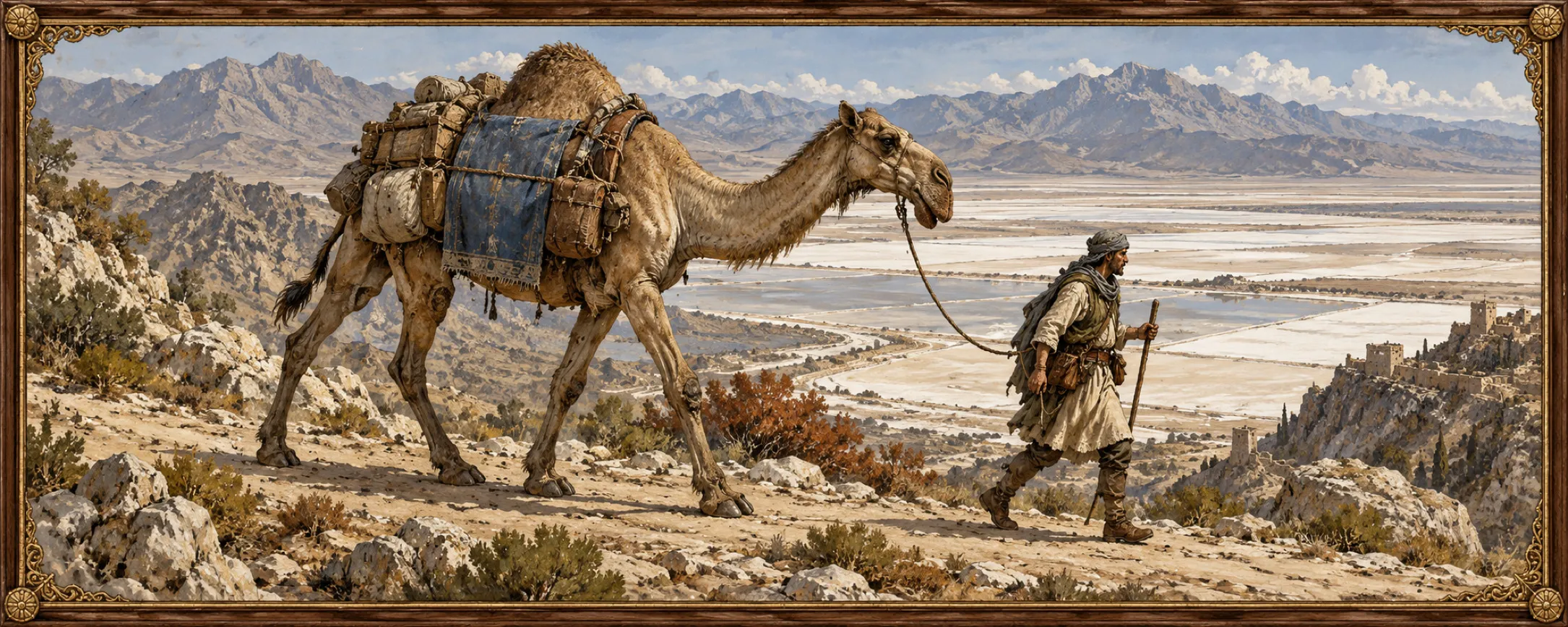
Thirstbacks
Thirstbacks are the escort beasts of the far side: the animals Windscar escorts load for the parties they guide, and the few the crossing companies take with them into the Glassbelt. The name is the Edgeway Kindreds': a thirstback carries its thirst on its back, in the hump, and goes on long after a lowland beast would have lain down. The other beasts of burden of the roads stand under Pack Animals.
Appearance
A thirstback is rangy and long-legged, taller at the shoulder than a riding horse and narrower, with a long neck carried low, a heavy-lipped muzzle, and tough split hooves spread wide for sand and crust. Over the shoulders rises a hump of fat that stands full and firm after good water and hangs slack and leaning after a long dry stage. Its coat is short and dust-coloured, paler underneath, and wears thin where the load rides. It walks with a rolling, pacing gait, both legs of one side together, and is led rather than driven, on a rope. It groans aloud when loaded and again when unloaded, grumbles through the night, and smells of dust, old dung, and the sour cud it chews.
Habitat and Range
Thirstbacks walk the ramps, rim tracks, and passes of the Rimward Basins and the High Scars, and the Lee Road to the Leeward Folds, where loads go on backs rather than wheels. They are bred in the kindreds' herds alongside the stair kine and sold to escorts and crossers. Few go farther than the edge of the Glassbelt; the companies that cross take only as many as the wells can water, and on the white pans they wrap the beasts' eyes and lead them by touch.
Behaviour and Temperament
Thirstbacks are the most enduring and the most stubborn beasts of any road. They walk on through heat and dust for days between waters, browse thorn, saltbush, and dry grass that nothing else will eat, and drink a great deal at once when they reach a well. Then, for no reason anyone can see, one will kneel in the track and refuse a step. They follow the lead beast of the string, bite and kick when ill-handled, and remember a cruel handler for years.
Life Cycle
A cow bears one calf after a long carrying, in the calm months, and the calf walks within the day. Thirstbacks are broken to the rope at three or four years, work fifteen years or more, and end as hide, meat, and hair for rope.
Uses and Dangers
They carry hides, felt, salt, and stores along the Windscar routes, and water, salvage, and the crossers' goods on the Glassbelt track. Their milk is drunk on the road, their dung burned where there is no wood, and their hair spun into rope and tent-cloth. Escort captains on the far side declare how many beasts their party brings as carefully as how many people, because a thirstback drinks what a family would.
The danger is the beast’s own temper and the road’s. A bull in season bites, and a string that panics on a narrow ramp can take its handlers over the edge. The salt crust of the pan floors lies over mud that takes a laden thirstback to the belly.
Lore and Belief
Windscar escorts hold that a thirstback which will not drink at a well has smelt something wrong in the water, and no party of theirs drinks there after it. Edgeway crossers say a thirstback kneeling in the track has seen the well ahead gone dry, and wait out the day rather than drive it on. Both say a thirstback’s groan as it is loaded counts the days to the next water, and listen.
Thirstbacks are what raiders on the escort routes want most, and a string lost to a raid can kill its party as surely as a dry well; the escorts' songs tell of the night attack at a well-head and of the escort captain who held the beasts' tether-line with one hand and fought with the other.