Wild Asses
Wild asses live where the herds cannot: out on the dry floors and washes of the Rimward Basins and along the Windscar edge of the Glassbelt. They come down to the Long Pan in a good year, and in a bad one they dig for water in dry wash beds with their hooves. A hole dug by a wild ass is the first water many crossers find.
Appearance
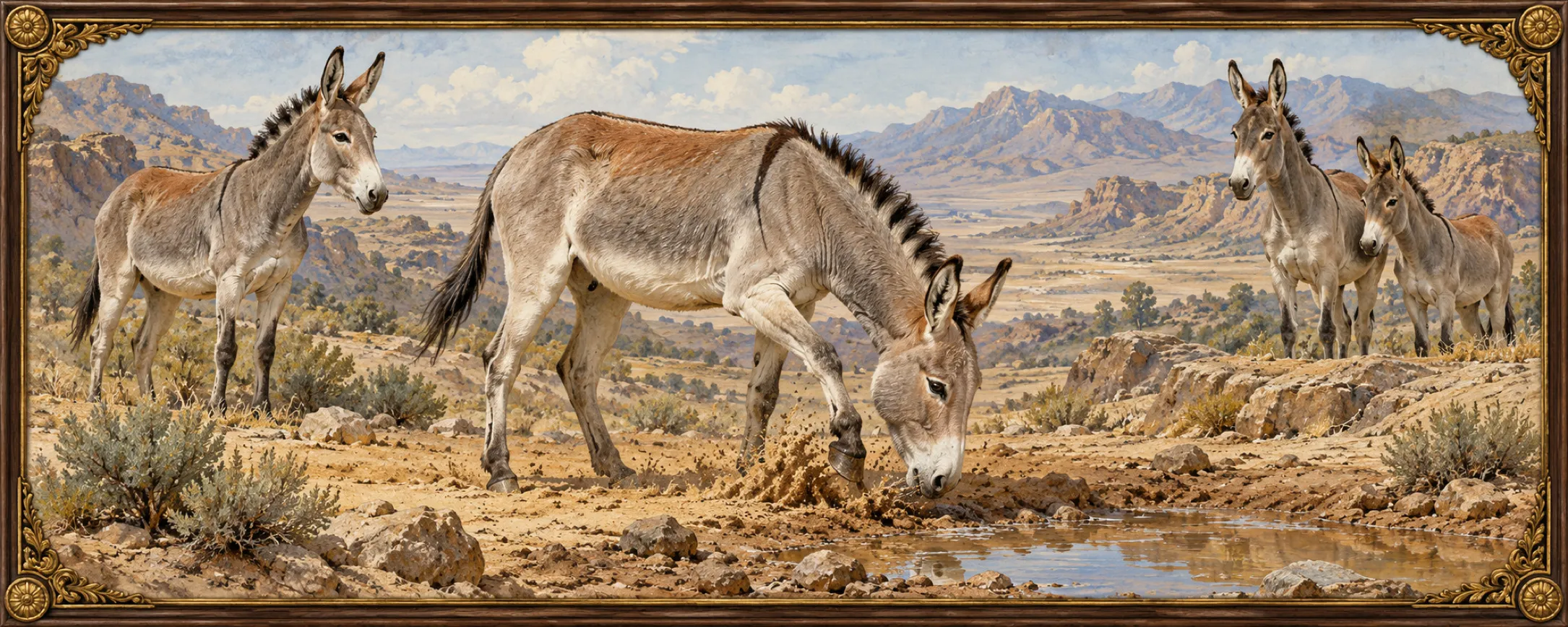
A wild ass stands a little lower than a pack pony, lean and narrow, with a big head, long upright ears, and a short, stiff, dark mane. Its coat is grey to sandy grey, paler on the belly, legs, and muzzle, with a dark stripe down the spine crossed by another over the shoulders, and often faint dark bars on the legs. Its hooves are small, narrow, and hard as horn. It trots with a quick, short stride and can keep it up for hours; when it runs it runs very fast. Its bray is a harsh, sawing roar that carries across a basin floor, and a stallion’s carries farthest.
Habitat and Range
They live in small bands on the open floors, dry washes, and low dividing ridges between the basins, and out onto the stony desert at the Glassbelt’s edge. They keep away from the strongholds and the herd grounds, and they move to water rather than living near it, walking a day or more between drinks.
Behaviour and Temperament
Wild asses graze the coarsest grass and browse thorn and dry scrub the herds will not touch. Females and young move in loose bands; stallions hold a stretch of ground near water and drive other males off it with bites and kicks. When the washes are dry they paw down through the sand of the bed where water lies beneath, sometimes deeper than a forearm, and drink from the seep. They are wary, keep their distance from people, and are hard to approach on open ground.
Life Cycle
A jenny bears one foal after the storms, when there is grass. It can run within hours and stays with her a year or two. They live twenty years or more.
Uses and Dangers
The kindreds hunt them now and then for meat and hide, and some escorts have caught and broken foals to the pack, though the beasts never take well to it. Their real use is their digging: a fresh ass hole in a dry wash means water is close to the surface, and herders and crossers widen it and drink. A cornered stallion kicks hard enough to break a leg, and herders keep their own stock away from one’s water.
Lore and Belief
The kindreds say that the wild ass remembers every water it has ever drunk from and never forgets the way, and they follow ass tracks across a basin floor in a dry cycle. Salvagers on the Glassbelt edge say an ass that will not drink at a hole has smelt the old fire in the ground beneath it. Children are told that a wild ass’s bray at night is the sound of a well being dug somewhere nobody knows.